TRANSMISSION // 2510.13983v3
A New Route for Quantum Optimization with Inequality Constraints
Source published
A proposed framework recasts inequality-constrained binary optimization as a multi-objective problem, then approximates it with a Hamiltonian built from powered objectives. Its guarantees depend on problem properties, and hardware costs remain significant.
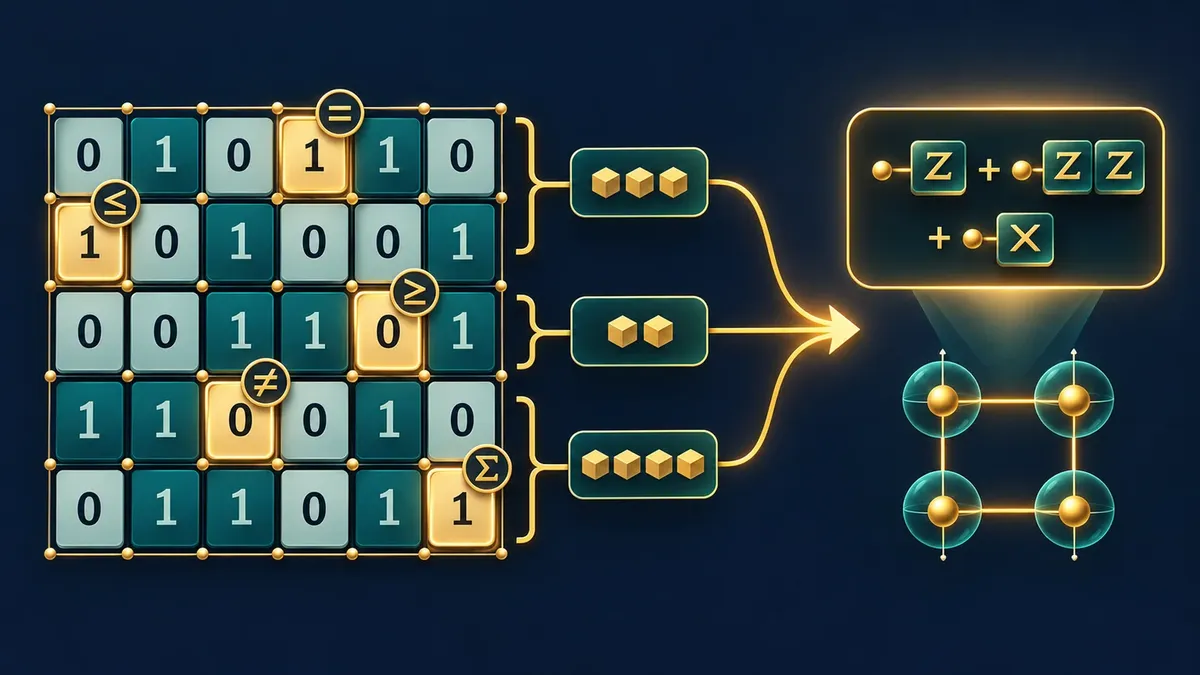
Many optimization problems come with rules a solution must obey, but quantum methods often work most naturally with unconstrained objectives. The MOQA framework offers a mathematical way to bridge that gap—without adding variables for slack—while raising practical questions about approximation and circuit cost.
Turning constraints into competing objectives
Choosing delivery routes, allocating resources or scheduling energy use can be framed as binary optimization: each decision is represented by a bit, and the aim is to minimize a cost. Real problems also impose rules. An inequality constraint might require a route to stay within a distance limit or an allocation to meet a minimum threshold.
Quantum optimization methods such as quantum annealing and the Quantum Approximate Optimization Algorithm (QAOA) encode costs in a Hamiltonian, an operator whose lowest-energy states represent good solutions. Inequality constraints can be awkward to encode. A common route is to introduce slack variables—extra bits that account for the difference between the two sides of a constraint. That can increase the number of variables and complicate the optimization.
Sebastian Egginger and colleagues propose a different approach, called Multi-Objective Quantum Approximation (MOQA). Their central observation is that an inequality-constrained problem can be rewritten as minimizing the maximum of several cost functions. In this view, the original objective and penalties for constraint violations become a collection of objectives that must be considered together.
Approximating the maximum
The exact maximum of several functions can be difficult to encode directly. MOQA approximates it using a sum of their powers: for objective values shifted to be nonnegative, the sum increasingly reflects the largest value as the power, denoted p, rises. This is related to how the p-norm approaches the maximum norm at high p.
The researchers translate this approximation into a Hamiltonian. If the starting objectives are represented by k-local Hamiltonians—terms involving at most k variables—the powered construction can reach locality up to kp. For quadratic objectives, the number of terms grows on the order of n to the power 2p, where n is the number of binary variables. The framework does not add decision variables, but its Hamiltonian can become more complex as p increases.
The paper gives a condition under which the approximation recovers an exact optimum. The required power depends on the number of objectives and on the relative gap between the best and next-best objective values. This is a mathematical guarantee, not a promise that the necessary power will be small: the gap may not be known in advance, and a small gap can make the threshold demanding. The authors also give a condition for achieving a chosen approximation ratio without requiring exact recovery.
What the tests show—and what they do not
The paper reports numerical tests on randomly generated inequality-constrained quadratic problems and on an optimization version of Not-All-Equal 3SAT, a satisfiability problem with multiple constraints. In the random-problem tests, the authors compare the approximate objective with the exact maximum across instances. They report that approximation quality generally improves as p increases, and that useful results can occur below the theoretical threshold.
For the satisfiability tests, the authors report high success in recovering optimal solutions at a moderate approximation level, including for instances with up to 160 constraints. They also describe a separate test in which the method helps distinguish satisfiable from unsatisfiable instances. These are results on the sampled problem sets and evaluation procedures described in the paper; they do not establish performance on every application or on quantum hardware.
An important distinction is that the study constructs and analyzes the Hamiltonian encoding. It does not run the full optimization pipeline on a quantum processor or demonstrate that QAOA or quantum annealing finds the encoded ground state efficiently. The authors explicitly leave the choice and evaluation of ground-state solvers as a separate, modular step.
There are practical costs on both sides of the quantum-classical boundary. Building the Hamiltonian requires classical preprocessing, which can be substantial depending on p. On quantum hardware, higher locality means interactions involving more qubits; devices that primarily support one- and two-qubit gates may need deeper circuits or additional resources to implement them. Avoiding slack variables therefore does not mean avoiding overhead altogether.
MOQA is a theoretical and numerical contribution to how constrained binary problems might be represented for quantum optimization. Its guarantees clarify when the approximation preserves an optimum, while its tests suggest that lower powers can sometimes be useful even without that guarantee. Whether the resulting encodings lead to practical advantages will require further work with concrete hardware and ground-state solvers. The source is an arXiv preprint, so its claims should be read as research results that have not necessarily undergone peer review.
- quantum optimization
- binary optimization
- inequality constraints
- Hamiltonians
- QAOA
- MOQA
Related reading
Automatically matched by shared topic keywords. These links do not imply that the sources agree or establish a consensus.
How a QAOA benchmark’s local weakness emerged
Source published
Shared keywords: quantum optimization
A promising quantum optimization strategy loses its edge when noise enters
Source published
Shared keywords: quantum optimization
A penalty-free route to constrained quantum optimization
Source published
Shared keywords: quantum optimization
Why the penalty matters in binary optimization
Source published
Shared keywords: binary optimization
Quantum rotations shrink optimization circuits in benchmark study
Source published
Shared keywords: quantum optimization