TRANSMISSION // 2510.12677v3
Decoding multimode GKP codes with noisy auxiliaries
Source published
A decoder that tracks cross-mode error correlations could lower logical error probability in multimode GKP error correction.
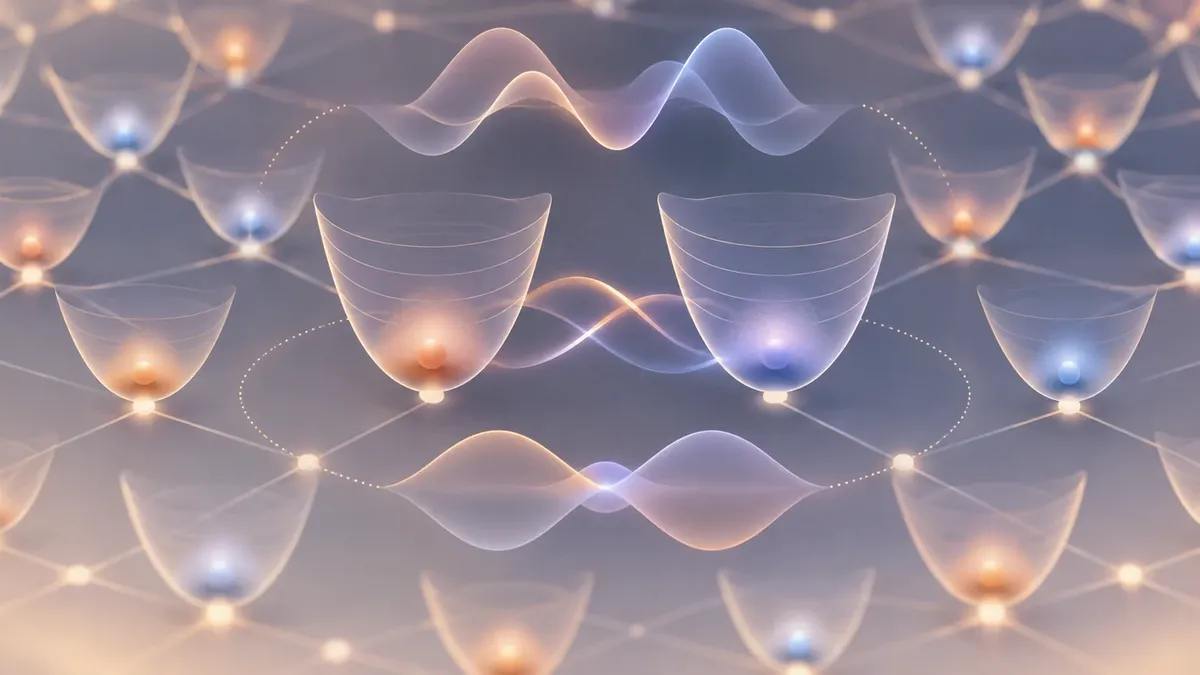
Quantum error correction aims to protect information from decoherence. A study of multimode GKP codes examines whether decoding can improve when it accounts for noise in the auxiliary states used during correction.
Quantum error correction schemes are designed to protect logical information from decoherence. One approach, the Gottesman–Kitaev–Preskill (GKP) encoding, stores logical qubits in several harmonic oscillators. Marc-Antoine Roy, Thomas Pousset and Baptiste Royer study how to decode measurements from Steane-type error-correction protocols for these multimode codes.
Their decoder takes noise in auxiliary states into account. In particular, it tracks correlations between errors on different modes as those errors spread through the error-correction circuit. The central question is whether using those correlations can improve the decoding of measurement results.
The authors report that leveraging correlations between measurement results and the errors affecting the multimode GKP state can reduce the logical error probability by at least an order of magnitude. They describe this as a route to more robust quantum computation.
That result should be read with care. The available evidence here is the paper’s abstract, which does not give the noise assumptions, code configurations, comparison baseline or detailed methods behind the reported reduction. It therefore does not allow a fuller assessment of how broadly the result applies. These are limits of what can be established from the abstract provided, not limitations the authors necessarily identify in the paper.
The finding concerns decoding in a particular class of error-correction protocols. The abstract alone does not establish how the approach performs across other settings. The source is an arXiv preprint record; this account is based on its abstract rather than a review of the full paper, and the supplied material does not establish the work’s peer-review status.
- quantum error correction
- GKP codes
- quantum decoding
- multimode codes
- auxiliary-state noise
Related reading
Automatically matched by shared topic keywords. These links do not imply that the sources agree or establish a consensus.
A changing grid could offer a new way to protect quantum information
Source published
Shared keywords: gkp codes, quantum error correction
When the Most Likely Error Is Not the Best Correction
Source published
Shared keywords: quantum decoding, quantum error correction
GARI++ splits quantum error correction into a fast first pass and a smaller cleanup
Source published
Shared keywords: quantum decoding, quantum error correction
Small changes to a decoder’s assumptions improve quantum error correction in simulations
Source published
Shared keywords: quantum decoding, quantum error correction
Froq tests quantum-side speculation in simulation
Source published
Shared keywords: quantum decoding, quantum error correction