TRANSMISSION // 2510.08199v2
Can Europe decarbonize industry without losing production?
Source published
A published European energy-system model finds deep industrial decarbonization feasible. It examines how green intermediate imports, factory relocation and subsidies affect modeled costs and domestic production.
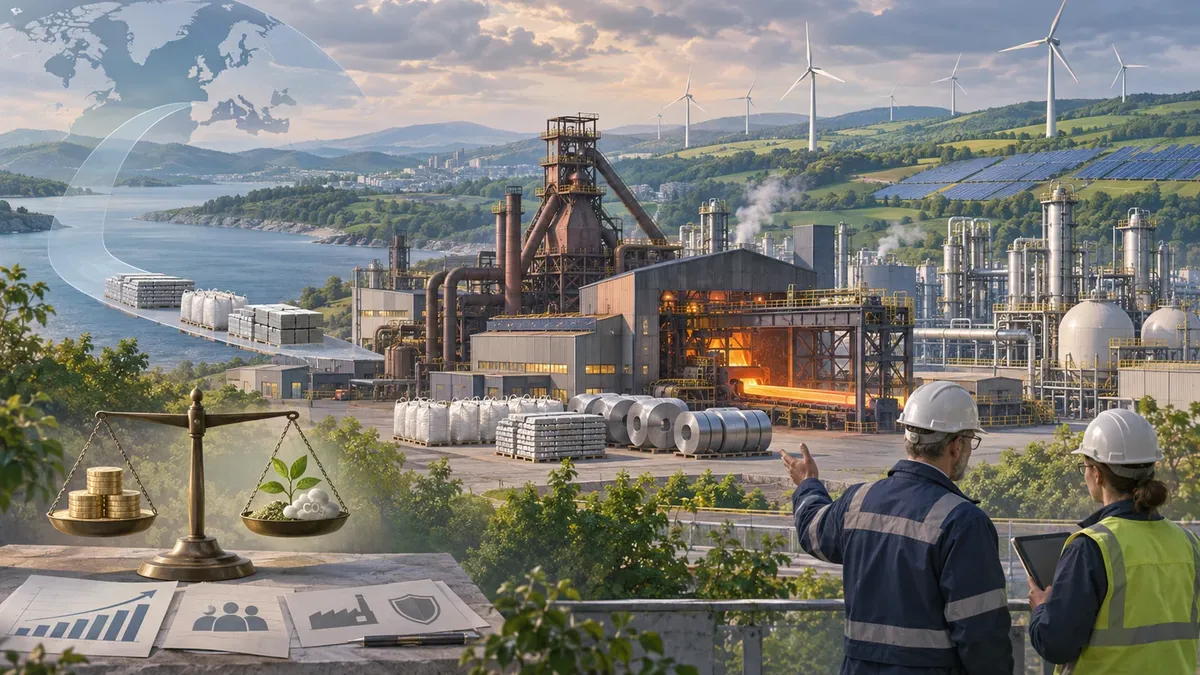
Europe’s heavy industries need to cut emissions, but low-carbon production can raise costs. A published modeling study compares ways to ease those pressures while retaining industrial activity in Europe—and shows why its results are scenarios, not forecasts.
Europe faces a difficult industrial balancing act: steel, cement and chemical production must cut greenhouse-gas emissions, but the investments required could raise the costs of making industrial goods. Can Europe decarbonize while retaining industrial activity, without producing every energy-intensive input at home?
Alice Di Bella and colleagues explore that question with an extended version of PyPSA-Eur, a computer model that optimizes investments and operations across Europe’s energy system. The researchers added detailed representations of five industrial areas: steel, cement, ammonia, methanol and high-value chemicals. Their scenarios combine climate targets with different assumptions about industrial production: continued decline, stable output or reindustrialization. These production trajectories are stylized assumptions, not economic forecasts.
The model represents existing industrial plants and evaluates technologies, energy use and costs across regions and time. It tests three responses to cost pressures: relocating production within Europe toward areas with better renewable resources; importing selected low-carbon intermediate materials, including hot briquetted iron (HBI) for steelmaking, ammonia and methanol; and subsidizing domestic production to close modeled cost gaps. The relocation exercise is a model-based cost comparison, not a comprehensive assessment of where factories could realistically move. In the climate-policy scenarios, emissions targets tighten toward net zero by 2050.
Cleaner production is feasible, but the transition has a costly phase. The modeled pathways rely mainly on electrification and green hydrogen, with carbon capture playing a prominent role in cement. Industrial costs rise sharply around 2040, when investment in low-carbon equipment and processes is intensive, then ease by 2050 as major investment phases are completed. That easing does not eliminate cost differences with regions that have abundant, lower-cost renewable energy.
The policy comparisons involve different trade-offs. Moving factories to renewable-rich parts of Europe lowers electricity spending in the model, but the savings are limited relative to the transition’s scale. The relocation scenario excludes practical barriers such as moving costs, labor-market frictions, supply-chain changes and infrastructure needs. The authors therefore describe it as a stylized benchmark, not a prediction of future industrial geography.
Importing green intermediate goods offers another route: Europe could bring in some energy-intensive, partially processed materials while retaining later manufacturing steps at home. In scenarios allowing imports from 2040, steel production increasingly combines imported HBI with domestic electric-arc furnaces; ammonia and methanol production shift substantially toward imports. The authors report lower system costs and reduced domestic green-hydrogen demand, particularly under reindustrialization. These results depend on assumed import prices and availability, not observed future trade.
Broad reindustrialization can also carry a large modeled subsidy requirement. In the highest-requirement case—reindustrialization without intermediate imports—the paper estimates average annual subsidies of about €235 billion over its 2035–2055 calculation period. This is an estimate of the cost gap under the model’s assumptions, not an observed expense or proof that governments could provide that support. The authors’ policy interpretation favors upgrading existing capacity, using selected green imports and keeping public support targeted and time-limited.
Important uncertainties remain. PyPSA-Eur identifies least-cost pathways under specified assumptions; it does not forecast market shares, jobs or political decisions. The analysis omits, among other things, geopolitical shocks, some recycling and production options, and infrastructure for transporting and storing captured carbon. Import costs, technology performance and real-world trade conditions could change the comparison. Competitiveness is measured mainly through modeled production costs and cost gaps, not a complete measure of global market position.
The supplied paper text identifies the work as an article published in Cell Reports Sustainability. Its results are model-based and conditional: they offer a structured comparison of policy options, not a guarantee that any approach will preserve industrial capacity. Economic, political and supply-chain outcomes remain uncertain.
- European industry
- industrial decarbonization
- green hydrogen
- PyPSA-Eur
- green imports
- industrial policy