TRANSMISSION // 2510.07387v2
How stars near the Milky Way’s black hole could test dark matter
Source published
A theoretical study models how dark matter scattering inside stars could alter their orbits around Sagittarius A*, and estimates what existing and future observations might reveal.
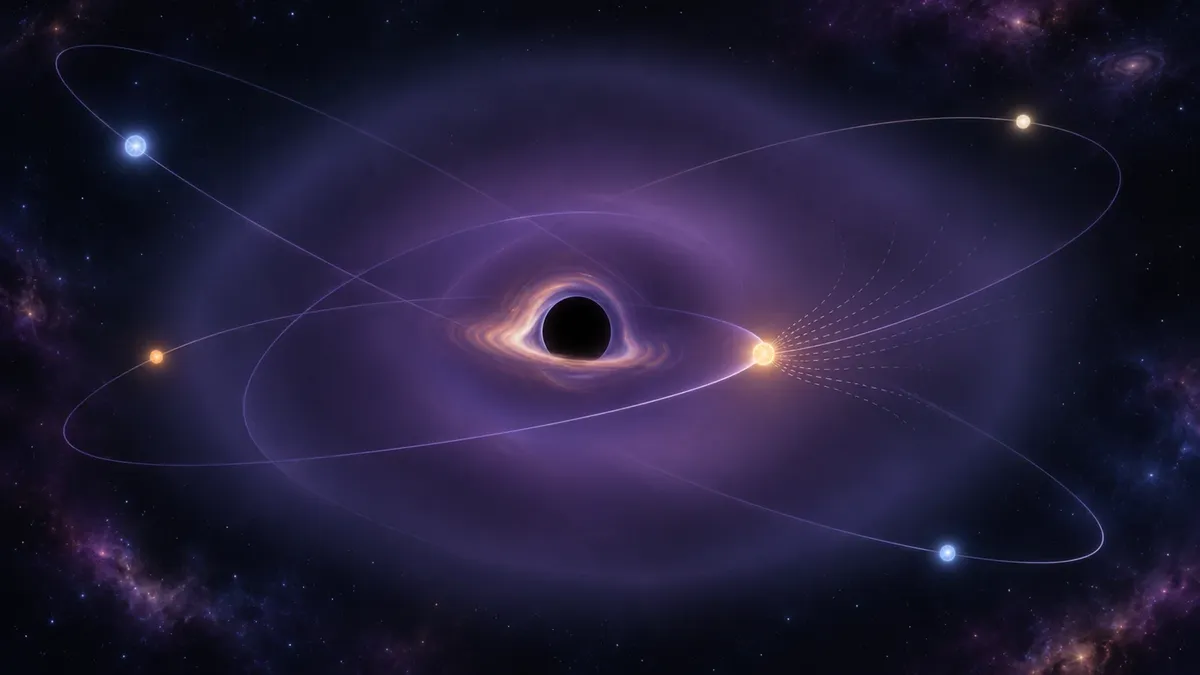
Could stars near the Milky Way’s central black hole reveal how dark matter interacts with ordinary matter? A new theoretical study proposes that, under particular assumptions about dark matter near Sagittarius A*, particle collisions inside stars could gradually change their orbits.
Stars close to Sagittarius A* (Sgr A*), the supermassive black hole at the center of the Milky Way, move through an extreme environment. Their orbits are already used to study gravity. A new preprint by R. Andrew Gustafson, Ian M. Shoemaker and Volodymyr Takhistov explores a different possibility: could those orbits also reveal dark matter scattering inside stars?
The paper frames dark matter as something detected only through its gravitational effects so far. The authors propose that if dark matter particles pass through a star and scatter off its nucleons—the particles that make up atomic nuclei—the collisions transfer momentum to the star. Over time, that force could alter the star’s motion in addition to gravity.
Modeling a small push on a stellar orbit
The researchers calculate the momentum transfer expected as dark matter crosses a star. They then simulate several stars around Sgr A*: S2, whose orbit has been observed over many years, and the more eccentric S62, S4711 and S4714.
Their simulations compare three situations: a black hole alone; a black hole with surrounding dark matter affecting the orbit through gravity; and the same setup with dark matter–nucleon scattering added. This helps distinguish the proposed scattering force from the gravitational pull of dark matter. In the model, the scattering effect is strongest when a star moves quickly through a dense region, especially near its closest approach to the black hole.
The team uses S2 observations from 2000 to 2019 to estimate which combinations of dark matter mass and scattering strength would cause orbital changes larger than the measurement uncertainties. These are model-based constraints, not evidence of a detection. The analysis holds the stars’ orbital parameters at measured best-fit values and assumes a particular dark matter density profile near Sgr A*.
What the study finds—and what it depends on
Under its chosen assumptions, the study finds that scattering could leave an imprint on stellar motion. The authors estimate constraints from S2’s existing data and project that future observations could test additional parameter space. Their calculations also suggest that stars with more eccentric orbits and closer approaches, such as S62 and S4714, may be especially useful probes.
A second approach asks whether a star could remain on an orbit like its present one for roughly a million years without losing enough orbital energy to be torn apart by the black hole. This provides a complementary constraint in the model. It carries an important assumption: the star must have occupied, or repeatedly sampled, a comparable orbit over that period. If stars were recently placed on their current orbits, the survival-based inference could be weaker.
The results depend strongly on how much dark matter is near Sgr A* and how it is distributed. The paper adopts a power-law “spike” as a benchmark, describing the example as optimistic but well motivated—not as an established description of the Galactic Center. The authors emphasize that the numerical reach changes substantially with the profile. For the smooth profiles they consider, current gravitational measurements restrict the parameter space accessible to the S2 data; steeper profiles can allow stronger sensitivity.
The proposed mechanism does not require dark matter to be captured and annihilated inside a star. But its predicted strength still depends on the environment and the assumed particle interaction. The authors describe some survival-based constraints, for the distributions they consider, as extending beyond certain direct-detection and cosmological bounds. That comparison is conditional: different methods rely on different assumptions, and the paper calls for more complete fits that vary orbital parameters, reference-frame quantities and dark matter properties together.
This is a theoretical preprint on arXiv, not a report of a confirmed dark matter signal. It presents simulations and proposed ways to interpret stellar-orbit data; it does not establish that a dark matter spike exists around Sgr A* or that scattering has affected these stars. Its contribution is a possible way to connect particle interactions to stellar motion—one that future observations and improved modeling can test.
- dark matter
- Sagittarius A*
- stellar orbits
- S2 star
- dark matter scattering
- Milky Way center
Related reading
Automatically matched by shared topic keywords. These links do not imply that the sources agree or establish a consensus.
Halo Stars Help Put the Milky Way’s Mass Near 1.3 Trillion Suns
Source published
Shared keywords: dark matter
Galactic dust offers a tentative clue to dark matter—not a verdict
Source published
Shared keywords: dark matter
A cosmological window for majoron dark matter
Source published
Shared keywords: dark matter
A scalar-field proposal connects neutrino masses and dark-matter interactions
Source published
Shared keywords: dark matter
Can the Sun test dark matter behind LZ’s unusual recoil?
Source published
Shared keywords: dark matter