TRANSMISSION // 2510.07240v3
A photonic route to quantum state shadows
Source published
A preprint presents a classical-shadow protocol for photonic states, with theoretical efficiency guarantees and demonstrations on two integrated processors.
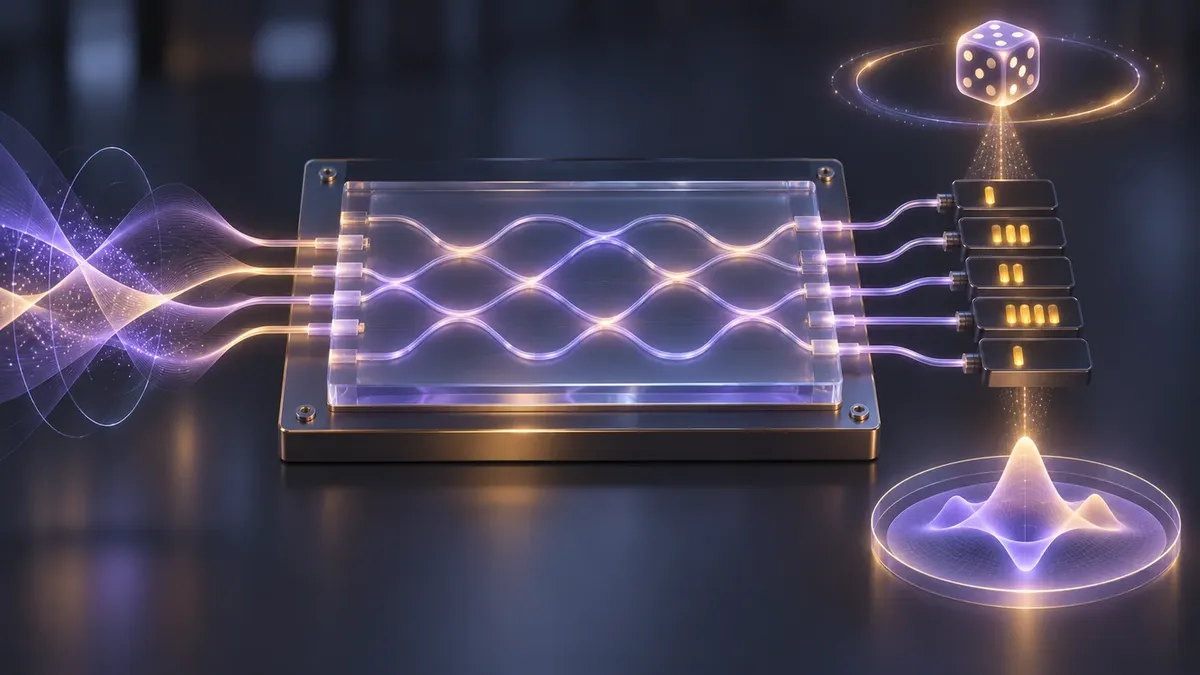
How can researchers estimate useful properties of an unknown quantum state from measurements on a small number of copies? A preprint introduces a classical-shadow protocol for photonic systems and reports experiments on integrated quantum processors.
Learning properties of photonic states
Quantum experiments can produce states whose properties researchers want to measure. Classical shadows are a way to estimate properties of an unknown state using randomized measurements on copies of it. Hugo Thomas, Ulysse Chabaud and Pierre-Emmanuel Emeriau ask how to formulate this approach for photonic quantum hardware.
Their paper, Learning photonic quantum states, introduces a protocol using randomized passive linear-optical transformations, followed by photon-number measurement. The authors provide theoretical guarantees that the protocol is efficient in sample use and computation time for physical observables of interest. The available abstract does not give the precise conditions or scaling behind those guarantees, so their detailed scope cannot be assessed here.
Experiments and applications
The researchers report demonstrations on integrated quantum-processing units with 12 and 24 optical modes. They showcase five applications, including Hamiltonian measurement and learning complex photonic states. These examples illustrate tasks addressed in the work, but the abstract does not provide application-specific results, numerical performance, or comparisons with other methods.
The study combines mathematical guarantees with experimental demonstrations. However, the evidence available for this account is the paper’s abstract rather than its full text. It does not specify sample counts, error bars, detailed hardware conditions, or how each application was evaluated. Those details would be needed to judge practical performance and to understand exactly how the guarantees apply.
The demonstrations establish that the authors implemented the protocol on the two reported processors; they do not, by themselves, establish how it will perform on other devices or larger systems. The abstract also does not support claims that the approach is universally superior or ready for routine use.
The source is an arXiv preprint, version 3, posted October 8, 2025. A preprint is a publicly shared research manuscript and may not have completed peer review. These findings should therefore be read with that limitation in mind.
Source: Learning photonic quantum states, by Hugo Thomas, Ulysse Chabaud and Pierre-Emmanuel Emeriau.
- quantum photonics
- classical shadows
- quantum state learning
- linear optics
- photon-number measurement
- quantum information
Related reading
Automatically matched by shared topic keywords. These links do not imply that the sources agree or establish a consensus.
A proposed test for quantum imaginarity
Source published
Shared keywords: classical shadows, quantum information
A bright squeezed-light source, with limits still to solve
Source published
Shared keywords: quantum photonics
When does photon entanglement still allow classical estimates?
Source published
Shared keywords: linear optics
A design test for photon-pair sources without periodic poling
Source published
Shared keywords: quantum photonics
Voltage brings silicon-carbide quantum emitters into tune
Source published
Shared keywords: quantum photonics