TRANSMISSION // 2510.05225v3
Quantum error correction on a sparse lattice
Source published
Researchers propose measurement-based quantum codes and logic-gate schemes for a honeycomb lattice with limited connections. Simulations suggest error-correcting behavior, but the designs have not been demonstrated experimentally.
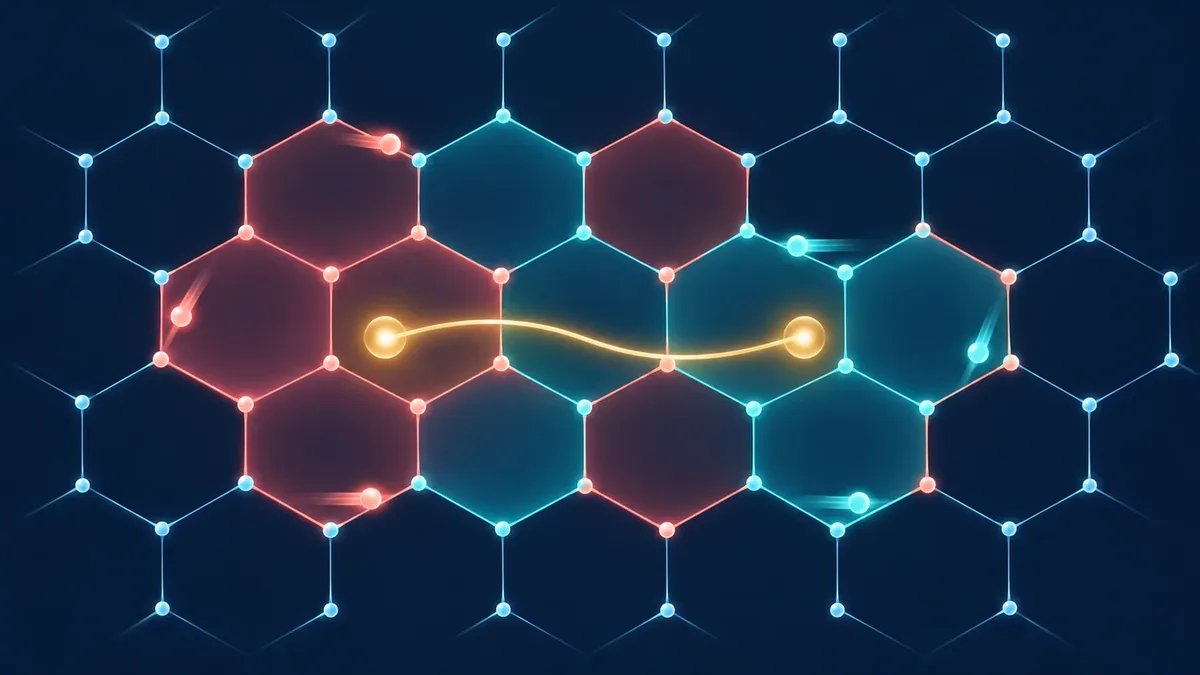
Can a quantum computer protect information and perform logical operations without a densely connected grid of qubits? Dominic J. Williamson and Bence Hetényi propose ways to do both on a honeycomb-like lattice, using repeated measurements and carefully timed changes in which qubits carry the information.
Quantum computers are vulnerable to errors, so practical machines need quantum error correction: information is encoded across multiple physical qubits, and repeated measurements help reveal errors without directly reading the protected information. Many error-correction schemes are designed around particular layouts of qubits. But when hardware has limited connections, implementing the needed measurements and logical operations can be challenging.
In this work, Dominic J. Williamson and Bence Hetényi explore schemes for a honeycomb heavy-hex lattice, where each site has only a small number of neighbors. Their designs use nearest-neighbor gates and measurements during a computation. The central idea is to treat error correction as a changing process: rather than keeping the same set of qubits as data throughout, the protocol moves quantum information between qubits and changes which measurements are made over time.
Measurements that change the code
The authors first describe Floquet codes, which protect information through a repeating sequence of measurements. In their lattice layout, measurements between neighboring qubits are carried out with the help of qubits on the links between them. The sequence changes from round to round, so the effective code—the pattern of checks that detects errors—also changes.
They then propose a “dancing” version of this approach. During a measurement, information can be moved onto qubits that had served as measurement ancillas. The protocol resets qubits as it goes, with the goal of reducing leakage: unwanted transitions that can leave a physical qubit outside the states used to represent quantum information. The authors also describe ways to reset qubits at different rates while preserving the code’s distance, a measure of how many errors the encoding can tolerate before information is lost.
A further step is to interleave two Floquet codes on the same lattice, forming what the paper calls a Double Floquet code. The codes occupy different parts of the lattice at different stages. The authors show how to bring their logical information together to carry out an entangling Clifford operation, including a logical CNOT, using a short sequence of local swaps and gates.
Finally, the paper describes switching between the Double Floquet code and a color code. A shallow circuit followed by measurements can extract color-code syndromes without requiring a square-grid layout. Such switching could also provide access to logical Clifford operations supported by the color code.
What the results show—and what they do not
The evidence is numerical, not a hardware demonstration. The researchers simulate circuits under circuit-level noise, in which errors can occur during operations as well as on qubits. They use established quantum-circuit simulation and decoding tools to estimate logical error rates and thresholds—the approximate physical error rates below which increasing the code size improves protection in the modeled setting.
The simulations show threshold-like behavior for the proposed schemes. The paper reports thresholds of about 0.3% for a standard Floquet implementation, about 0.25% for some dancing-code and switching-color-code cases, and about 0.2% for the Double Floquet code. These are results for the specific circuit and noise models studied, not measured performance on a quantum processor. The authors also note that leakage-reducing measurements can lower the threshold in some configurations, and that the doubled circuit depth and gate count contribute to the lower threshold reported for the Double Floquet code.
The work is therefore a set of proposed protocols supported by simulations, rather than evidence that the schemes already work on real devices. Practical performance will depend on hardware-specific errors, measurement and reset speeds, and the ability to decode the resulting measurement records. The authors identify preparation of logical magic states—and evaluation of a complete fault-tolerant architecture—as open directions. The paper text says the work was accepted in 2026; the supplied source is an arXiv record, so its publication status and version should be checked against the linked record.
- quantum error correction
- Floquet codes
- heavy-hex lattice
- logical gates
- quantum computing
Reviewed cross-references
These connections were reviewed by a model, not independently fact-checked by a human. Similarity does not imply agreement; consult the original papers and the evidence below.
A changing grid could offer a new way to protect quantum information
Shared method: Both papers use time-ordered measurement sequences as the basis of dynamical error-correcting codes: Williamson and Hetényi describe nearest-neighbor Floquet-code measurements on a qubit lattice, while Pelletier and Royer formulate dynamical GKP codes using translation measurements. This is a shared high-level method, not evidence that their code constructions or hardware requirements are interchangeable; one concerns qubits and the other oscillator encodings.
Model review: · openai-codex/gpt-6-luna
Evidence and provenance
Selected excerpts, not complete papers. PDF extraction can omit figures or damage equations, tables and reading order; sources may be preprints.
2510.05225v3 — Original paper
Excerpt reference:
static/papers/2510.05225v3.md:13-36
Basis: Paper text
Source SHA-256:e1f3c5fe0961922b9b17bb9d5f251dda28336bf4d938fb9f2a0eb9c0f5ee3c942510.05225v3 — Original paper
Excerpt reference:
static/papers/2510.05225v3.md:109-210
Basis: Paper text
Source SHA-256:e1f3c5fe0961922b9b17bb9d5f251dda28336bf4d938fb9f2a0eb9c0f5ee3c942611.14081v1 — Original paper
Excerpt reference:
static/papers/2611.14081v1.md:12-62
Basis: Paper text
Source SHA-256:ea564795dadf6390fe620e4c1cc2c579a2fbe272176656edfde2ffb5a17894072611.14081v1 — Original paper
Excerpt reference:
static/papers/2611.14081v1.md:63-118
Basis: Paper text
Source SHA-256:ea564795dadf6390fe620e4c1cc2c579a2fbe272176656edfde2ffb5a1789407
Related reading
Automatically matched by shared topic keywords. These links do not imply that the sources agree or establish a consensus.
A changing grid could offer a new way to protect quantum information
Source published
Shared keywords: floquet codes, quantum error correction
Turning Floquet-code dynamics into a static distance problem
Source published
Shared keywords: floquet codes, quantum computing, quantum error correction
A proposed shortcut to addressable quantum gates
Source published
Shared keywords: logical gates, quantum computing, quantum error correction
Magic-state factories tailored to quantum algorithms
Source published
Shared keywords: quantum computing, quantum error correction
Why some simple gate patterns cannot control every logical qudit
Source published
Shared keywords: quantum error correction