TRANSMISSION // 2510.02848v3
How Rhythm-TTS Gives Synthetic Speech More Room to Breathe
Source published
Rhythm-TTS combines discrete speech planning with continuous acoustic generation, and samples phoneme timing and pauses to vary how the same text sounds across runs.
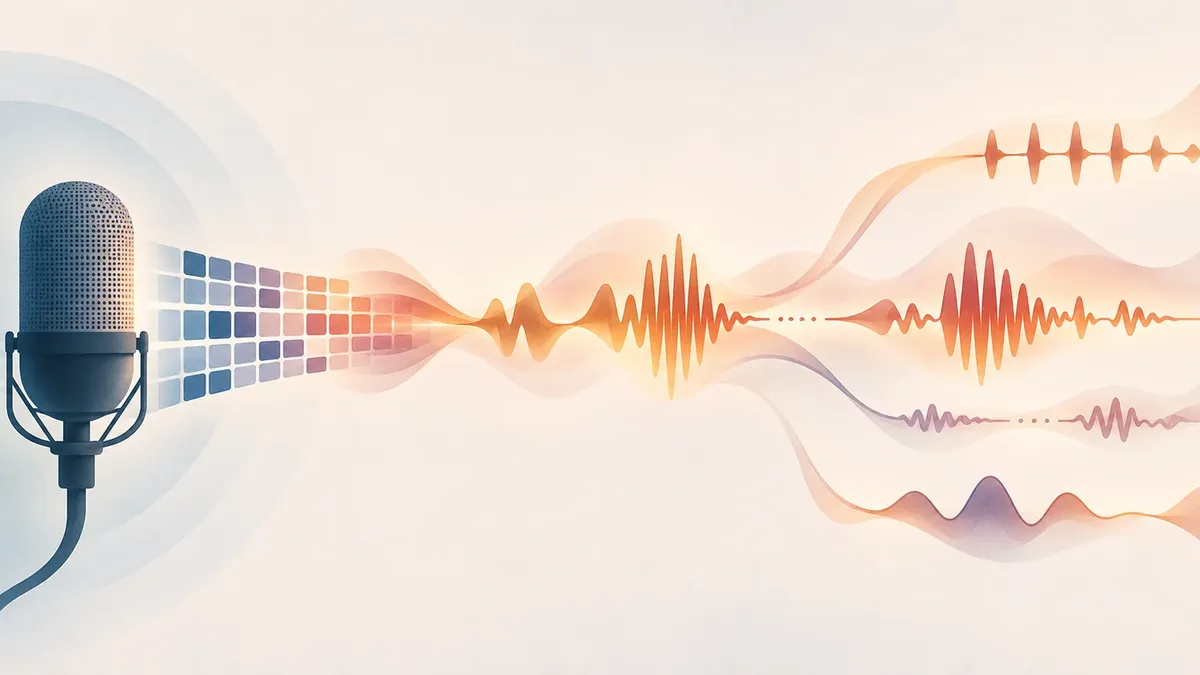
A sentence can be spoken clearly and still sound unnaturally fixed. Rhythm-TTS is a zero-shot speech system designed to preserve a speaker’s voice while generating more flexible pacing. Its authors report promising benchmark results, but the evidence is largely automatic and limited to English audiobook speech.
Zero-shot text-to-speech (TTS) aims to produce speech in a voice the system has not been trained specifically to reproduce, using a short reference recording. A central challenge is balancing reliable pronunciation with the fine acoustic detail that makes a voice sound natural and recognizable. Another, less commonly measured challenge is rhythm: people may read the same sentence with different timing and pauses, while a system can repeat nearly identical pacing each time.
Rhythm-TTS, described in an arXiv preprint, tackles both issues. It combines a discrete plan for speech with continuous acoustic generation, and explicitly samples variations in phoneme durations and pauses. The paper asks whether this design can improve speech quality and speaker similarity while adding rhythm variation without sacrificing intelligibility.
A plan, then a continuous rendering
Many speech systems use a neural audio codec, which represents speech as a sequence of discrete tokens. These tokens are convenient for planning and sequence prediction, but converting them back into sound through codebook lookups may lose fine acoustic details. Systems that generate continuous acoustic representations directly can retain more detail, but may need to learn text alignment and speaker conditioning in a more demanding way.
Rhythm-TTS uses codec tokens as an intermediate plan rather than as the final acoustic representation. First, a code generator predicts hierarchical tokens conditioned on the input phonemes and a reference speech prompt. The system then turns those tokens into a continuous prior and uses a flow-matching denoiser to generate continuous speech latents. These latents are passed to a codec decoder to produce the waveform. In this design, the discrete plan helps organize the output, while the continuous stage generates its acoustic detail.
The system also adds a probabilistic rhythm planner before token generation. One component samples spoken-phoneme durations; another samples whether pauses appear and how long they last. Because these timing choices can vary between runs, the same text and speaker prompt need not produce exactly the same pacing.
What the tests reported
The researchers trained Rhythm-TTS on 500 hours of LibriTTS and evaluated it on unseen speakers from LibriSpeech test-clean. The main comparison used three-second speech prompts, with additional tests using one- and five-second prompts. They assessed pronunciation using word error rate (WER), estimated naturalness with the automatic UTMOS metric, measured speaker similarity with embedding-based scores, and compared rhythm across repeated generations using an automatic timing metric called DS-WED. Most fidelity scores came from one synthesis per text-prompt pair; rhythm diversity was measured across three runs.
In a controlled comparison using the same predicted token plan, the authors report that continuous “shortcut” generation improved UTMOS and speaker-similarity scores over reconstructing speech by codebook lookup, while WER remained nearly unchanged across prompt lengths. This comparison supports the proposed acoustic-generation component, though it does not establish that every listener would hear an improvement.
For the three-second prompt setting, the paper reports WER of 0.04 for Rhythm-TTS and UTMOS of 3.79. The highest reported speaker-similarity score against a reconstructed prompt was 0.59 among the compared systems. These are metric results, not direct proof of human preference. Comparisons across systems also require care: some reference systems were trained on much larger datasets, and the authors identify matched-data comparisons and internal ablations as the more appropriate evidence for attributing gains to their design.
The rhythm tests found that the full system had a mean DS-WED of 112.22, compared with 41.76 for a Rhythm-TTS version that kept durations fixed. Mean WER was 0.04 for both. The authors summarize this as 2.69 times more measured diversity without a change in mean WER. Their diversity-to-WER ratio was also highest in the reported comparison, but they caution that this ratio is a diagnostic: it can become large when WER is small and is not a measure of perceived quality. In an ablation, replacing sampled durations with their predicted means reduced naturalness and speaker-similarity scores while leaving WER at 0.04; removing sampled pauses also worsened some reported results.
What remains uncertain
The findings are promising but bounded. The evaluation focuses mainly on English audiobook datasets and unseen audiobook speakers. The paper says generalization to multilingual, noisy, emotional, conversational, or singing speech remains untested. Its rhythm measures are automatic; controlled listening studies would be needed to establish whether people perceive the variation as natural or useful. The system also depends on a neural codec, which may impose its own limits or artifacts.
The authors report an inference speed of real-time factor 0.016 for one configuration, measured end-to-end on an NVIDIA A100 GPU. That result depends on the hardware and setup and should not be read as a universal speed guarantee. More broadly, the paper is an arXiv preprint, not evidence of independent replication or peer-reviewed confirmation. Its benchmarks and automatic metrics provide a technical case for the approach, not a final verdict on how it sounds to listeners in everyday use.
The work also notes a potential misuse: a system that imitates a voice from a short recording could be used without consent. The authors identify risks including impersonation and deceptive synthetic audio. Those concerns matter alongside the technical question of whether generated speech can sound more varied.
- text-to-speech
- Rhythm-TTS
- voice cloning
- speech rhythm
- flow matching
- artificial intelligence
Reviewed cross-references
These connections were reviewed by a model, not independently fact-checked by a human. Similarity does not imply agreement; consult the original papers and the evidence below.
FoleyForge edits sound effects with words, balancing change against fidelity
Shared method: Both papers use flow-based generative modeling: Rhythm-TTS uses flow matching to generate continuous speech latents, while FoleyForge fine-tunes a rectified-flow model for sound-effect editing. This is a bounded methodological connection, not evidence that the systems share an architecture or have comparable results; their tasks and outputs differ.
Model review: · openai-codex/gpt-6-luna
Evidence and provenance
Selected excerpts, not complete papers. PDF extraction can omit figures or damage equations, tables and reading order; sources may be preprints.
2510.02848v3 — Original paper
Excerpt reference:
static/papers/2510.02848v3.md:84-144
Basis: Paper text
Source SHA-256:434d8b484830dafbd2bb255fec399d334336a853c45b8e81a6885e6ac7bd65b32611.08695v1 — Original paper
Excerpt reference:
static/papers/2611.08695v1.md:113-169
Basis: Paper text
Source SHA-256:67ed8c18f45e6ad57d4197a3ed56f629c9734907ea3cd7d33fd2c20c27121ffe
Related reading
Automatically matched by shared topic keywords. These links do not imply that the sources agree or establish a consensus.
When a Voice Clone Does Not Sound Like the Same Person
Source published
Shared keywords: voice cloning
Why AI’s imagined worlds can look right but behave wrong
Source published
Shared keywords: artificial intelligence
A discrete-time bridge between deterministic diffusion and flow matching
Source published
Shared keywords: flow matching
Keeping Generated Graphs Within Mathematical Bounds
Source published
Shared keywords: flow matching
ChainFlow drafts several AI tokens by predicting where a model’s internal states go next
Source published
Shared keywords: flow matching