TRANSMISSION // 2509.01587v2
When Should Federated Learning Cluster Clients?
Source published
A proposed method aims to identify a suitable time to group federated-learning clients, with experiments across more than 40 tasks and five benchmark datasets.
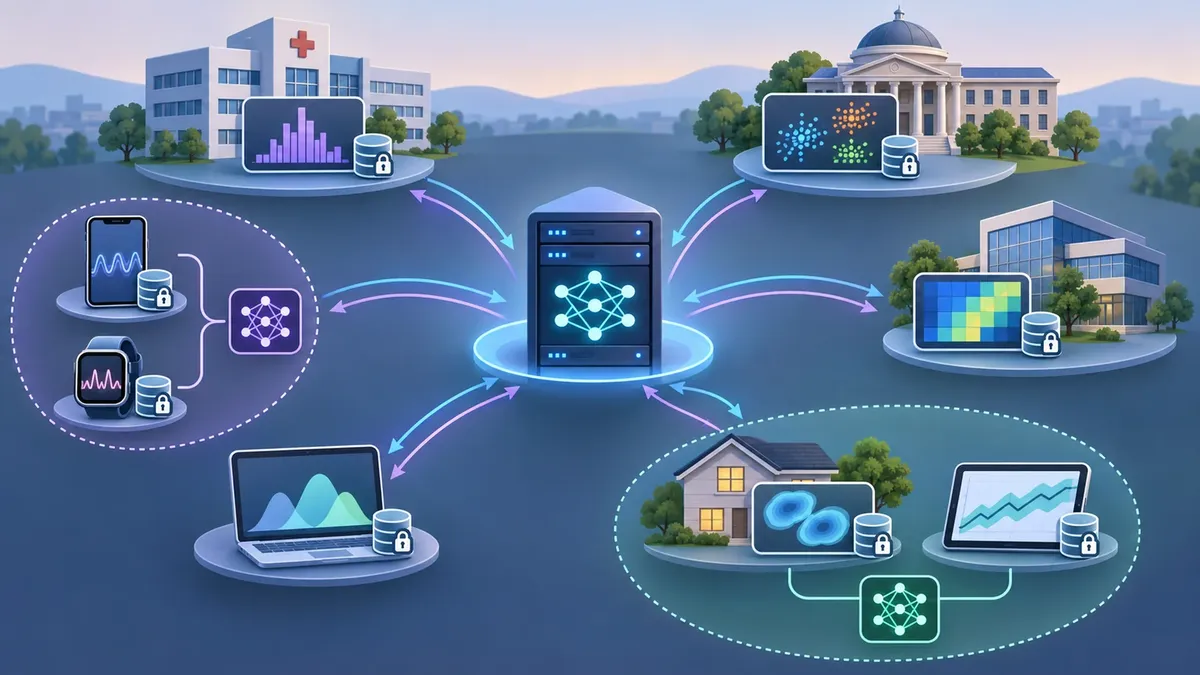
Federated learning lets multiple clients train models while keeping their data local. When clients’ data differ, groups may benefit from personalized models. This study proposes an automated approach to deciding when to form those groups and reports tests across benchmark tasks.
The question: when to group clients?
Federated learning lets multiple clients—such as devices or institutions—contribute to model training without transferring their data directly to one another. Because clients may have different data distributions, a single shared model may not suit everyone. Clustered federated learning (CFL) seeks to organize clients into cohorts so they can receive personalized models.
A practical challenge is deciding when to form those groups. The authors propose One-Shot Clustered Federated Learning (OCFL), described in the abstract as a “clustering-agnostic” algorithm that can automatically detect the earliest suitable moment for clustering. The abstract does not define that term, explain the detection rule, or say how the algorithm determines what counts as suitable. Its precise operation therefore cannot be reconstructed from the available evidence.
What the study tested
The abstract says the researchers evaluated their methodology using various one-shot clustering algorithms across more than 40 tasks on five benchmark datasets. It does not name the datasets or tasks, specify the evaluation measures, or describe the experimental setup in detail.
The researchers also revisited whether clients could be distinguished using their gradients or model weights. They report that density-based clustering methods were highly efficient for differentiating between the loss surfaces of neural networks trained on different distributions. A loss surface describes how a model’s loss changes as its parameters change. The abstract does not identify the clustering methods, define the efficiency measure, or provide results that would let readers assess this finding in detail.
Another part of the work examined local explanations produced with GradCAM, a method for highlighting image regions relevant to a model’s prediction. The authors say this inspection offered insight into the relationship between personalization and the explainability of local predictions. The abstract gives no specific examples or measurements, so it does not establish that personalization improves explainability or explain what the inspection found.
What the authors report
The authors characterize OCFL’s performance in their experiments as good and say it enables CFL to be carried out automatically without hyperparameter adjustment. This is their description of the tested approach, not evidence that all choices in a real deployment can be avoided or that the method will work equally well in other settings.
They also report high efficiency for density-based clustering in distinguishing the loss surfaces described above. These findings are encouraging within the experiments summarized, but the abstract provides no numerical results or named comparison methods. It is not possible to quantify the reported performance or efficiency, or to determine how consistently they held across tasks.
What remains uncertain
The abstract leaves several key details unresolved: how OCFL identifies the earliest suitable time to cluster, which clustering algorithms were tested, and what the benchmarks contained. Without those details, readers cannot judge how the approach responds to particular patterns of client data or how broadly the results might apply.
The GradCAM analysis is presented as a way to gain insight into personalization and explainability. The abstract does not report a specific relationship, establish that explanations are more reliable, or show that they measure prediction quality. Those conclusions would require evidence beyond the supplied summary.
Evidence and source limits
This account is based on the supplied abstract rather than the full paper. The experimental setup, numerical results, detailed comparisons, and study limitations could not be checked against the complete text. The source is an arXiv preprint; the supplied material does not establish peer-review status or independent replication.
The work proposes automating the timing of client clustering and reports favorable results across a broad set of benchmark tasks. How the method works in detail, and whether the findings extend beyond the reported experiments, remain open questions.
- federated learning
- clustered federated learning
- client clustering
- personalized models
- GradCAM
Related reading
Automatically matched by shared topic keywords. These links do not imply that the sources agree or establish a consensus.
Can Communities Help Shape AI Without Handing Over Their Data?
Source published
Shared keywords: federated learning
FedFiOT matches neurons to merge federated models with fewer exchanges
Source published
Shared keywords: federated learning
A Style-Aware Way to Combine Federated Learning
Source published
Shared keywords: federated learning
In federated learning, more attackers mattered more than split triggers
Source published
Shared keywords: federated learning
When Spiking and Standard AI Train Together
Source published
Shared keywords: federated learning