TRANSMISSION // 2508.21069v2
A late finish to cosmic reionization
Source published
A reconstruction using Lyman-alpha observations, DESI data and Big Bang nucleosynthesis constraints points to rapid, late reionization—but some CMB data combinations favor a higher optical depth.
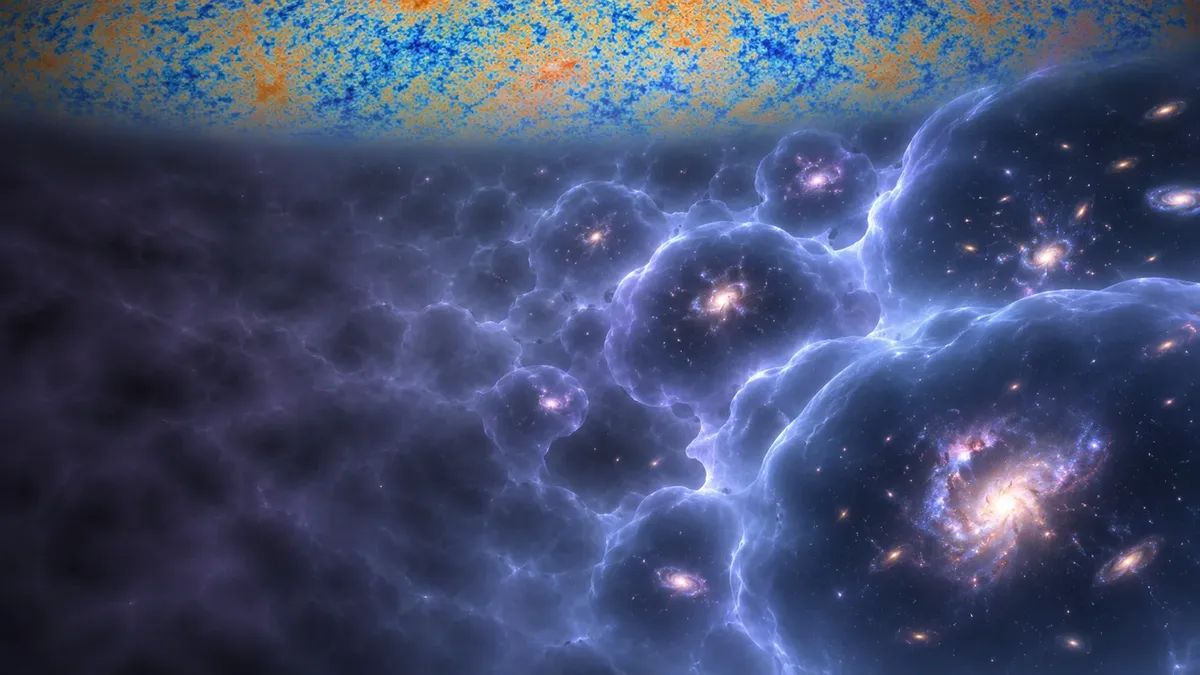
When did the first stars and galaxies clear the early universe’s neutral hydrogen? A new analysis combines several ways of estimating that timeline and finds a sharp disagreement between one set of observations and a particular combination of cosmic microwave background and expansion measurements.
The early universe began with much of its hydrogen electrically neutral. Radiation from the first luminous objects gradually stripped electrons from hydrogen atoms, a transition called reionization. Its timing matters because free electrons scatter light from the cosmic microwave background (CMB), the afterglow of the Big Bang. The total amount of scattering is described by the optical depth, τ. Measuring it helps researchers interpret the CMB, but different datasets do not all point to the same value.
In this study, Willem Elbers compares several independent routes to estimating τ. The main analysis reconstructs how the average neutral-hydrogen fraction changed over time using observations of Lyman-alpha features in quasar and galaxy spectra, including recent James Webb Space Telescope results. The measurements include limits from dark regions in hydrogen absorption spectra, as well as constraints from spectral features called damping wings and from the strength of Lyman-alpha emission.
Rather than requiring the history to follow one preset curve, the study uses a Gaussian process: a statistical method that allows a range of smooth histories while fitting the available measurements. The researcher combines the reconstructed history with DESI measurements of baryon acoustic oscillations (BAO)—a pattern in the distribution of galaxies that helps map cosmic expansion—and a Big Bang nucleosynthesis (BBN) constraint on the amount of ordinary matter. This provides an estimate of τ without using CMB data in the reconstruction. The analysis also tests CMB polarization and small-scale CMB measurements, alongside other observations, using a Bayesian parameter-fitting approach.
The baseline reconstruction favors reionization that happened relatively late and over a short interval. Its midpoint is at redshift 6.99, with a reported uncertainty range of +0.12 and −0.18; its estimated duration, defined between two points in the neutral-hydrogen fraction, is 1.09 in redshift, with a range of +0.10 and −0.28. The inferred optical depth is τ = 0.0491, with a range of +0.0014 and −0.0031. The authors describe this estimate as largely insensitive to the cosmological model and independent of CMB data.
Large-scale CMB polarization offers a separate check. The study finds that its estimates are consistent with the Lyman-alpha-based result, though they depend somewhat on which version of the polarization likelihood is used. By contrast, estimates from small-scale CMB fluctuations can shift substantially depending on which other observations and cosmological model are included. In the standard ΛCDM model, combining small-scale CMB data, CMB lensing and DESI BAO gives τ = 0.094 ± 0.011—higher than the reconstructed value. The paper describes this disagreement as about four standard deviations in its abstract; its later comparison reports a 3.6-sigma tension using a related parameter combination.
Adding other data changes the picture. In ΛCDM, combining small-scale CMB measurements with supernova observations and galaxy-clustering and lensing measurements gives an estimate more compatible with the Lyman-alpha result. The authors also find that allowing dark energy to evolve over time brings the BAO and CMB combination into better agreement with rapid, late reionization. This is a model-dependent result, not evidence that evolving dark energy has been established.
The reconstruction has important limits. Its baseline assumes reionization began no earlier than redshift 15. Allowing it to start as early as redshift 30 leaves room for extended or even repeated ionization histories and a long tail of higher optical depths, but the observations above redshift 12 are sparse, so those results depend more strongly on the chosen prior. The paper also notes that some Lyman-alpha constraints rely on simulations and assumptions about galaxies, and that uncertainties in measurements of the kinetic Sunyaev–Zel’dovich effect complicate tests of extended histories. Substituting a smaller alternative set of high-redshift measurements produces a less tightly constrained duration, although the authors report that it remains consistent with their main result.
The findings therefore do not settle the disagreement between the datasets. They show that one flexible reconstruction, based on astrophysical observations plus BAO and BBN, favors a late, rapid transition, while certain small-scale CMB combinations favor a higher optical depth under ΛCDM. The article is available as an arXiv preprint; its claims should be read as the author’s analysis, not as a final resolution of the wider cosmological debate.
- cosmic reionization
- Lyman-alpha
- optical depth
- cosmic microwave background
- DESI
- dark energy
Reviewed cross-references
These connections were reviewed by a model, not independently fact-checked by a human. Similarity does not imply agreement; consult the original papers and the evidence below.
Can a different cosmic expansion ease the JWST–CMB reionization tension?
Supporting evidence: Both studies find that inferred reionization optical depth depends on the assumed cosmological expansion history: Elbers reports that evolving dark energy can reduce tension between BAO/CMB constraints and the Lyman-alpha bound, while Mukherjee et al. find a lower predicted optical depth in their SI-motivated background than in ΛCDM. These are complementary, model-dependent results, not a direct replication; the latter study also reports remaining disagreement with some high-redshift neutral-fraction measurements.
Model review: · openai-codex/gpt-6-luna
Evidence and provenance
Selected excerpts, not complete papers. PDF extraction can omit figures or damage equations, tables and reading order; sources may be preprints.
2508.21069v2 — Original paper
Excerpt reference:
static/papers/2508.21069v2.md:1550-1634
Basis: Paper text
Source SHA-256:0499a2cc392fb4a9dc98d16b4091929647b92bdfd641a6533a77043a5d38393a2608.03470v3 — Original paper
Excerpt reference:
static/papers/2608.03470v3.md:174-214
Basis: Paper text
Source SHA-256:84e33559c25851c36e32022761bdc15b33b33d9156adf608d3e75b7fc29da53f2608.03470v3 — Original paper
Excerpt reference:
static/papers/2608.03470v3.md:1760-1803
Basis: Paper text
Source SHA-256:84e33559c25851c36e32022761bdc15b33b33d9156adf608d3e75b7fc29da53f
Related reading
Automatically matched by shared topic keywords. These links do not imply that the sources agree or establish a consensus.
Can a different cosmic expansion ease the JWST–CMB reionization tension?
Source published
Shared keywords: cosmic microwave background, cosmic reionization
Can dark matter and dark energy share an origin? A new cosmology test keeps the idea in contention
Source published
Shared keywords: cosmic microwave background, dark energy
A recombination hint fades when dark energy can evolve
Source published
Shared keywords: cosmic microwave background, dark energy
Could ancient magnetic fields have brought forward cosmic reionization?
Source published
Shared keywords: cosmic reionization
Early dark energy faces a tight cosmic ceiling
Source published
Shared keywords: cosmic microwave background, dark energy