TRANSMISSION // 2508.18448v5
Could Entangled Spins Reveal Screened Dark Energy?
Source published
A theoretical study asks whether screening mechanisms could affect quantum correlations between entangled spins orbiting Earth. The proposed signal is not an observation.
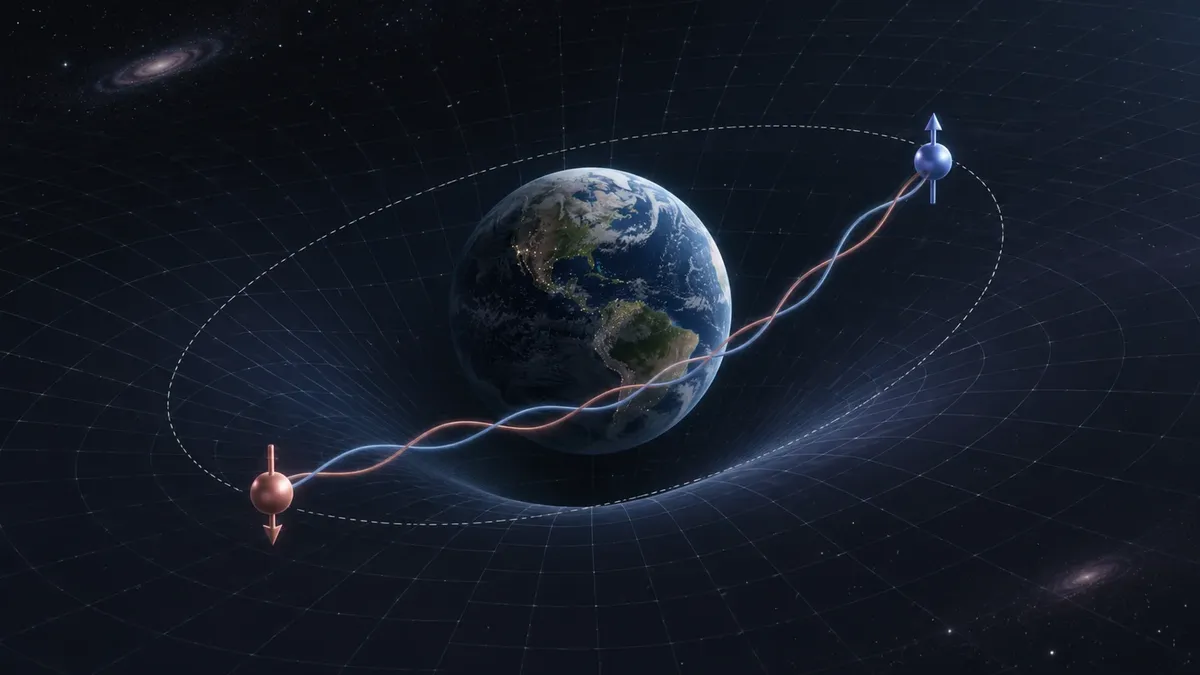
Dark energy is usually studied through the expansion of the universe. This paper explores a different possibility: could certain dark-energy theories subtly change how a pair of entangled particles behave as they orbit Earth?
A cosmic question in a quantum setting
Some explanations of cosmic acceleration invoke a light scalar field—an additional field that could influence gravity. A field that matters across cosmic distances might also produce a “fifth force” detectable in local experiments. Screening mechanisms are proposed ways to suppress that local influence while allowing the field to affect the universe on larger scales.
Fabiano Feleppa, Gaetano Lambiase and Sunny Vagnozzi ask whether screened fields could leave a signature in quantum correlations. Their study, Imprints of screened dark energy on nonlocal quantum correlations, considers a hypothetical pair of massive spin-½ particles orbiting Earth. It asks whether such a system could, in principle, be sensitive to these fields—not whether dark energy has already been observed affecting entanglement.
A theoretical calculation
The authors use a formalism for describing spin evolution in curved spacetime. They evaluate nonlocal correlations through spin observables associated with the Clauser–Horne–Shimony–Holt (CHSH) inequality, a standard way to characterize quantum correlations.
The abstract reports that screening suppresses the CHSH inequality’s violation relative to the flat-spacetime case. The authors apply their formalism to three screening mechanisms: chameleon, symmetron and dilaton.
This is a gedankenexperiment, or thought experiment—not a report of particles placed in orbit or a laboratory measurement. The account here is based on the paper’s abstract alone, which does not provide the equations, assumptions or parameter values needed to assess the full calculation in detail.
What the authors report—and what it does not show
The authors identify regions of parameter space they describe as currently unconstrained, where the screening contribution to the correlations can be comparable to the contribution from general relativity (GR). The abstract does not specify these regions or explain how “unconstrained” is defined. A comparable contribution is a theoretical result for some parameter choices; it is not evidence that the effect has been measured or that it can readily be separated from GR.
The authors say detection would be challenging and present the work as a proof of principle: quantum nonlocality might provide a way to test screened dark energy. The abstract does not establish that the proposed system can be produced, maintained or measured with the precision required. Nor does it report new observational limits on dark-energy theories.
The paper is available as an arXiv preprint. The supplied information does not establish whether it has undergone peer review. Since this account uses only the abstract, it cannot evaluate the complete analysis or its detailed qualifications. The result is best read as a theoretical proposal, not a detection: making the idea into a practical test remains a substantial challenge.
- dark energy
- quantum entanglement
- screening mechanisms
- CHSH inequality
- general relativity
- scalar fields
Reviewed cross-references
These connections were reviewed by a model, not independently fact-checked by a human. Similarity does not imply agreement; consult the original papers and the evidence below.
Could satellites help test hidden forces behind dark energy?
Shared method: Both studies describe screened scalar-tensor gravity using post-Newtonian quantities, including effective gravitational strength and PPN parameters. The first applies this framework to spin evolution and CHSH correlations; the second to satellite observables, so the shared framework does not make their outcomes direct tests of one another.
Model review: · openai-codex/gpt-6-luna
Evidence and provenance
Selected excerpts, not complete papers. PDF extraction can omit figures or damage equations, tables and reading order; sources may be preprints.
2508.18448v5 — Original paper
Excerpt reference:
static/papers/2508.18448v5.md:111-165
Basis: Paper text
Source SHA-256:8fe987946db44dd27fc8686917580524fb64d60c803e80757fc92d14b26519e02511.08448v3 — Original paper
Excerpt reference:
static/papers/2511.08448v3.md:61-109
Basis: Paper text
Source SHA-256:5aa94471989bccdbe4850691f2ccf175a38fab6a2118791a9a386298c9ef39ab
Related reading
Automatically matched by shared topic keywords. These links do not imply that the sources agree or establish a consensus.
The ‘tail’ of early dark energy may matter for the Hubble tension
Source published
Shared keywords: scalar fields
Galaxy clusters test growth under a fixed cosmic model
Source published
Shared keywords: general relativity
A softly broken symmetry offers a route across the phantom divide
Source published
Shared keywords: dark energy
Quantum memory may reshape a field in an expanding universe
Source published
Shared keywords: scalar fields
Quantum entanglement could build patterns that outlast it
Source published
Shared keywords: quantum entanglement