TRANSMISSION // 2508.17150v3
A clustering algorithm that filters first, then fills in the gaps
Source published
SACA builds dense cluster cores using a data-derived threshold, then reassigns filtered points. Tests on 16 benchmarks suggest promise, with important limits.
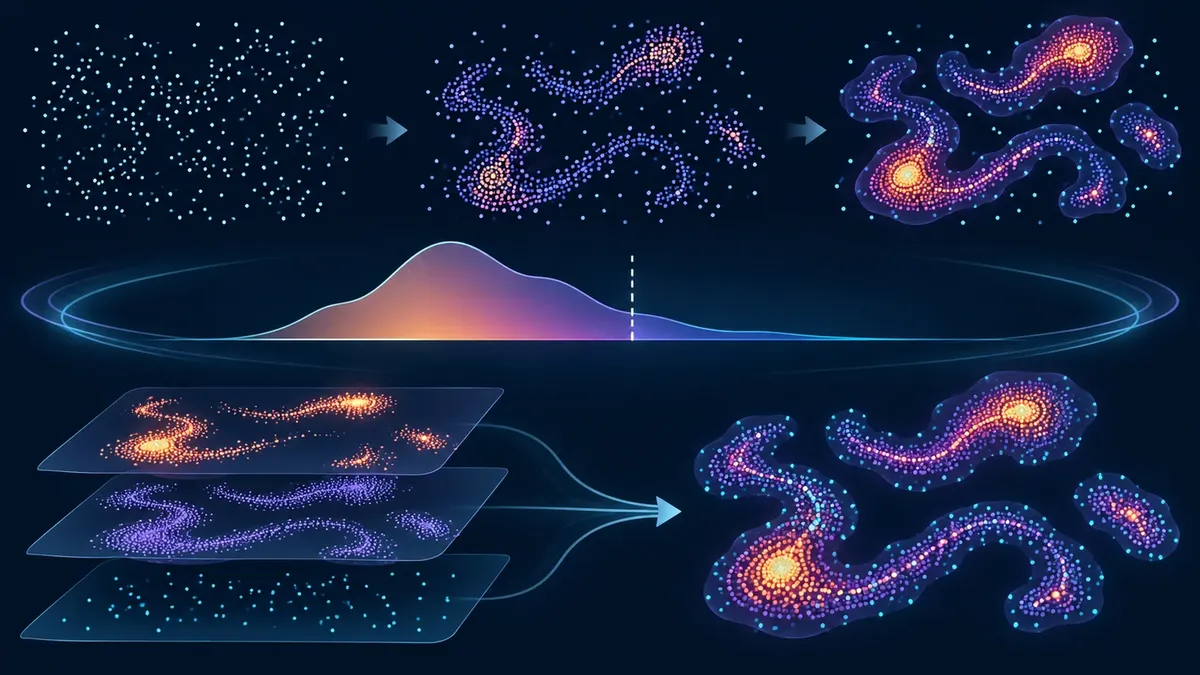
Clustering can reveal groups in data without being told how many groups to expect. But density-based methods often depend on settings that take trial and error to choose. SACA, a new algorithm described in an arXiv preprint, aims to reduce that burden by finding dense cores first and adding less-dense points back afterward.
Finding structure without a long tuning process
Imagine a scatterplot containing several winding groups of points mixed with scattered specks. A clustering algorithm should trace the groups, even when they are not round, and avoid letting isolated points distort the result. Density-based methods are designed for this kind of task: they define groups through local concentrations of points and can label some points as noise. But methods such as DBSCAN require users to choose settings, including a neighborhood distance and a minimum number of nearby points. Poor choices can merge groups or split them apart.
The paper introduces SACA, short for Selective Attention-Based Clustering Algorithm. Its “selective attention” name is an analogy: the method initially emphasizes dense structure, rather than a claim that it models how the brain works. The authors ask whether a data-derived threshold can make density-based clustering easier to use while still recovering useful groups.
How SACA works
SACA measures each point’s distance to its nearest neighbor and uses those distances to calculate a global neighborhood threshold. The methods section says it uses a KD-tree for nearest-neighbor queries rather than constructing a full pairwise distance matrix. Before setting the threshold, it screens unusually large nearest-neighbor distances using a modified Z-score rule.
The algorithm then counts nearby points and temporarily removes those with too few neighbors, leaving denser regions to form initial cluster cores. Once the cores are labeled, SACA assigns the filtered points back to clusters. By default, each point is assigned according to its nearest clustered neighbor. An optional setting instead assigns points to the nearest cluster center, which the paper recommends for convex, overlapping groups.
The key adjustment is the Attention Selectivity Coefficient, C. Raising it prunes more points when building cores and can produce smaller, more detailed groups. So SACA aims to reduce tuning, not eliminate choices altogether: it has this coefficient and an optional assignment setting.
What the tests show
The authors evaluated SACA on 16 benchmark datasets, including existing and author-created examples with different shapes, densities, noise levels and dimensions. They compared it with DBSCAN, HDBSCAN and OPTICS. The experiments included runs using default settings and runs in which methods were tuned on selected datasets.
On three shape-diverse datasets—Noisy Circles, Complex-9 and Spiral—the paper reports that SACA performed competitively or better than the comparison methods when all were run with their default settings. On three labeled benchmarks, DS-850, Flame and Skewed, the authors report higher scores for SACA than for those methods after tuning. They assessed results with six measures. Silhouette and Davies–Bouldin scores describe aspects of cluster separation; adjusted Rand index and adjusted mutual information compare predicted groups with available labels. The reported scores favored SACA on all six measures for those three tuned examples.
The paper also illustrates how changing C can reveal different levels of structure. On a dataset of rings made from smaller groups, the default setting identifies the main rings, while a higher value separates smaller subgroups. This flexibility may be useful when the desired level of detail is unclear, but it also makes the analyst’s definition of a meaningful cluster important.
Promise, with boundaries
These results do not establish that SACA is generally superior. The benchmark set is limited and includes synthetic datasets, so performance on these examples may not predict results on every real-world dataset. The authors say the method works best when clusters have clear gaps between them. They also note that uniformly distributed background noise can inflate the threshold and weaken separation. Closely spaced or overlapping groups may require adjustment of C. The authors further acknowledge that practitioner bias could affect their manual-tuning comparison.
There is a discrepancy in the paper’s computational descriptions. The methods section says KD-tree queries replace the full pairwise distance matrix, but a later algorithm summary says SACA computes that full matrix. The complexity discussion describes KD-tree-based nearest-neighbor search. This conflict between passages makes the implementation and efficiency harder to assess from the manuscript alone.
The work is an arXiv preprint, so its claims should be treated as provisional rather than as independently established results. The paper says the code was not shared and would be released after acceptance; it also says the author-created synthetic datasets were available on request, with a public deposit planned after acceptance. Independent reproduction and tests on broader, real-world data could help clarify how reliably SACA reduces the work of choosing clustering settings.
- clustering
- density-based clustering
- unsupervised learning
- data mining
- DBSCAN
- machine learning
Related reading
Automatically matched by shared topic keywords. These links do not imply that the sources agree or establish a consensus.
CARROT Lets Graph Clusters Find Their Own Size
Source published
Shared keywords: unsupervised learning
Turning anomaly intent into testable time-series detectors
Source published
Shared keywords: unsupervised learning
A Fuzzier Way to Find Groups Without Keeping Every Connection
Source published
Shared keywords: machine learning
AI reasoning can be shorter by reusing familiar phrases
Source published
Shared keywords: machine learning
A U-Net Emulates Lyman-Alpha Forests in Vast Volumes
Source published
Shared keywords: machine learning