TRANSMISSION // 2508.13530v2
CrafterDojo gives embodied AI a lighter training ground
Source published
CrafterDojo builds models, synthetic datasets and tools for studying embodied AI in Crafter, a lightweight 2D world. Tests show promise for hierarchical planning, but the results do not establish transfer to Minecraft or the real world.
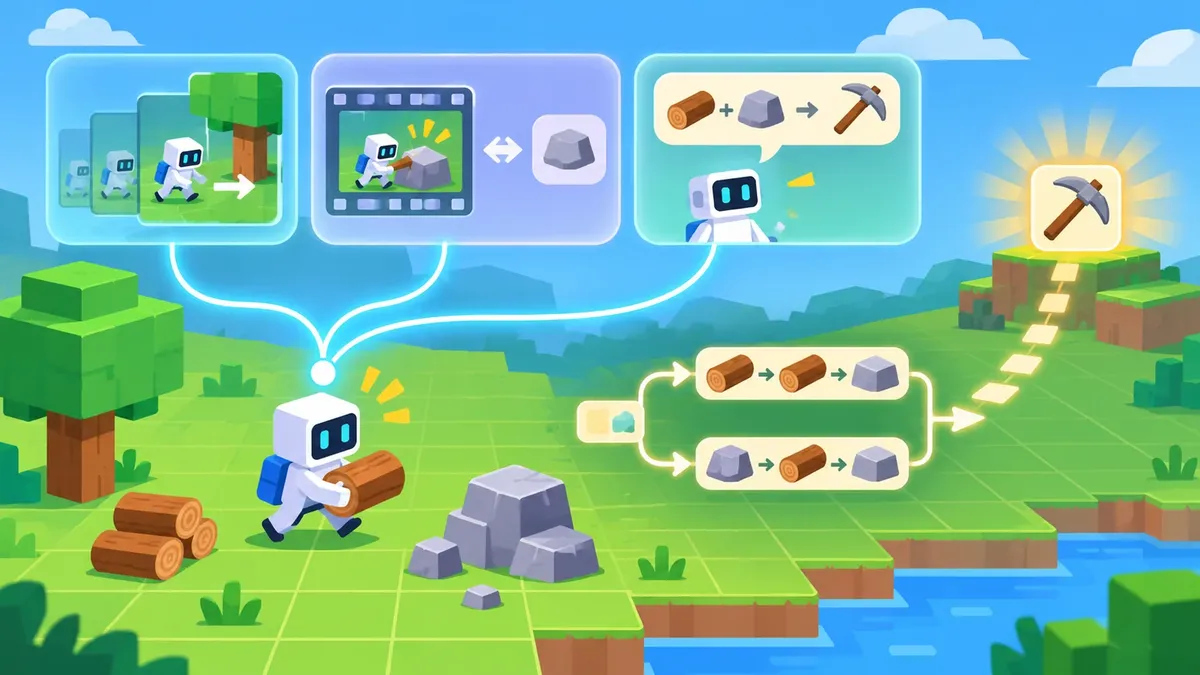
Training an AI agent to survive, gather resources and craft tools means learning actions that may only pay off many steps later. CrafterDojo aims to make that challenge easier to study by supplying foundation models and training data for Crafter, a compact, Minecraft-like environment. Its early results suggest that combining a planner with a trained action policy can help on longer tasks—but also show how difficult the longest goals remain.
A smaller world for studying embodied agents
An embodied agent is an AI system that senses an environment and acts within it. Researchers often use Minecraft to study agents that must follow instructions, plan ahead and respond to changing surroundings. But its 3D visuals, control demands and engineering overhead can make experiments slow and hard to diagnose: a failure might come from perception, movement or planning.
Crafter offers a more controlled alternative. It is a 2D grid world with resource gathering, crafting, survival and procedurally generated maps. Its tasks still involve sparse rewards and chains of prerequisites, but the simplified setting makes it easier to inspect and modify experiments. The catch is that Crafter has far less existing gameplay data and fewer pretrained models than Minecraft.
In this paper, Junyeong Park, Hyeonseo Cho and Sungjin Ahn introduce CrafterDojo, a collection of models, datasets and tools designed to fill that gap. The question is practical: can researchers create a reusable foundation-model toolkit for Crafter, and can its components be combined to tackle tasks that require several steps?
Building training data automatically
CrafterDojo provides three models with different roles. CrafterVPT learns action patterns from demonstrations, serving as a behavioral starting point. CrafterCLIP connects short video clips with language descriptions. CrafterSteve-1 uses those foundations to follow instructions by choosing actions toward a stated goal.
Because human demonstrations are scarce in Crafter, the team built tools to generate synthetic training examples in Craftax-Classic, a fast implementation of Crafter’s mechanics. An expert-behavior generator trains policies and records their actions, producing CrafterPlay. A caption generator matches selected events to descriptions, producing video-language examples in CrafterCaption. The authors also use a language model to create paraphrases of the rule-based captions, expanding the wording available during training.
The models are tested separately for their intended jobs: action performance, matching video with text, and completing short instructed tasks. The paper reports that CrafterVPT performs strongly on the environment’s achievement-based evaluation, while CrafterCLIP retrieves relevant clips for both held-out paraphrases and a small set of captions outside the original rule set. CrafterSteve-1 performs better than an unconditional action model on short tasks such as crafting or placing an item under a tight step limit. These tests support the idea that the components learn useful, distinct capabilities in this setting; they do not show that any one model is a general-purpose agent.
Why planning and acting are separated
The paper’s longer-task test highlights a distinction between knowing what to do and carrying it out. To obtain advanced items, an agent must first collect resources and make tools. A policy given only the final target may struggle to discover the whole sequence. A hierarchical agent instead uses a high-level planner to break the goal into smaller subgoals, while CrafterSteve-1 handles the lower-level actions for each one.
In the reported experiments, flat agents had near-zero success on the tested long-horizon goals. Hierarchical versions using CrafterSteve-1 did better on the iron-pickaxe and iron-sword tasks. For the diamond task, however, the reported success rate remained low. The authors also found that an LLM-based planner could make plans based on Minecraft conventions that do not fit Crafter’s mechanics; a heuristic planner performed better on some tasks. The results therefore illustrate both the value of combining planning and execution and the errors that can arise at either level.
What the results do—and do not—establish
CrafterDojo’s main contribution is research infrastructure: a way to run controlled studies with reusable models and automatically generated data in a relatively lightweight environment. The authors release code, models and datasets, making the suite available for further work.
The simplification is also a boundary. Crafter removes much of the 3D perception and continuous-control difficulty found in Minecraft, and the authors explicitly say that transfer to larger environments remains an open empirical question. The synthetic data’s coverage depends on the expert policies, reward designs and caption rules used to generate it. And the diamond results show that long chains of actions remain challenging even with a planner and a learned controller.
The source is an arXiv preprint listed as a NeurIPS 2026 paper in the supplied paper text. A preprint is not, by itself, proof that every result has undergone peer review; readers should check the current publication record and paper version. More broadly, results on a benchmark show what happened under its particular tasks, data and evaluation setup—not that the same system will work reliably in a different simulation or in the physical world.
- CrafterDojo
- embodied AI
- AI agents
- foundation models
- Crafter
- synthetic data
- hierarchical planning
Reviewed cross-references
These connections were reviewed by a model, not independently fact-checked by a human. Similarity does not imply agreement; consult the original papers and the evidence below.
Can Minecraft agents find what they cannot see?
Supporting evidence: Both papers show that measured embodied-agent performance depends on evaluation setup: CrafterDojo reports hierarchical agents outperforming flat baselines on selected long-horizon Crafter tasks, while EviCraft finds large Survival-score differences when only the rule governing access to hidden world state changes. These results support the bounded point that agent evaluations should specify their interaction and information-access assumptions; the environments and tested agents differ, so the results are not directly comparable.
Model review: · openai-codex/gpt-6-luna
Evidence and provenance
Selected excerpts, not complete papers. PDF extraction can omit figures or damage equations, tables and reading order; sources may be preprints.
2508.13530v2 — Original paper
Excerpt reference:
static/papers/2508.13530v2.md:980-1047
Basis: Paper text
Source SHA-256:b8259c2fc500bf3025558e6122397b452e670e933db922cab9baf71a60a0b8b52508.13530v2 — Original paper
Excerpt reference:
static/papers/2508.13530v2.md:1048-1096
Basis: Paper text
Source SHA-256:b8259c2fc500bf3025558e6122397b452e670e933db922cab9baf71a60a0b8b52611.32765v1 — Original paper
Excerpt reference:
static/papers/2611.32765v1.md:101-166
Basis: Paper text
Source SHA-256:0af16ca4f267f68a039532679fbc0387f1c65e96b46fa85b3760b957c83b3ccc
Why a robot’s interface can matter as much as its AI
Supporting evidence: CrafterDojo presents a lightweight setting for controlled agent studies and reports gains from composing a learned executor with a high-level planner; RUIBench independently reports that changing the robot-use interface alone shifted success rates in its manipulation experiments. Together they illustrate that agent performance can depend on system composition and action interfaces, but the tasks, platforms, and interventions differ, so neither result validates the other.
Model review: · openai-codex/gpt-6-luna
Evidence and provenance
Selected excerpts, not complete papers. PDF extraction can omit figures or damage equations, tables and reading order; sources may be preprints.
2508.13530v2 — Original paper
Excerpt reference:
static/papers/2508.13530v2.md:980-1047
Basis: Paper text
Source SHA-256:b8259c2fc500bf3025558e6122397b452e670e933db922cab9baf71a60a0b8b52508.13530v2 — Original paper
Excerpt reference:
static/papers/2508.13530v2.md:89-135
Basis: Paper text
Source SHA-256:b8259c2fc500bf3025558e6122397b452e670e933db922cab9baf71a60a0b8b52611.31115v1 — Original paper
Excerpt reference:
static/papers/2611.31115v1.md:171-242
Basis: Paper text
Source SHA-256:bdc2fa80a91e68dd525fa49ca781241b98ef855cb54203a9c5ff1fbccc98b2bb
Related reading
Automatically matched by shared topic keywords. These links do not imply that the sources agree or establish a consensus.
Robots Learn From Teachers, Then From Failure
Source published
Shared keywords: embodied ai
How well do synthetic training tasks match real tables?
Source published
Shared keywords: synthetic data
OpenRFM aims to make relational-data prediction more open
Source published
Shared keywords: foundation models, synthetic data
Why a robot’s interface can matter as much as its AI
Source published
Shared keywords: embodied ai
When shorter instructions trip up embodied AI agents
Source published
Shared keywords: embodied ai