TRANSMISSION // 2508.06493v2
Why a hotter Bose gas can produce a narrower impurity spectrum
Source published
Spectroscopy of mobile impurities in a Bose gas reveals that strong interactions can leave a narrower spectral signature as the bath warms. Near condensation, many-body effects remain important.
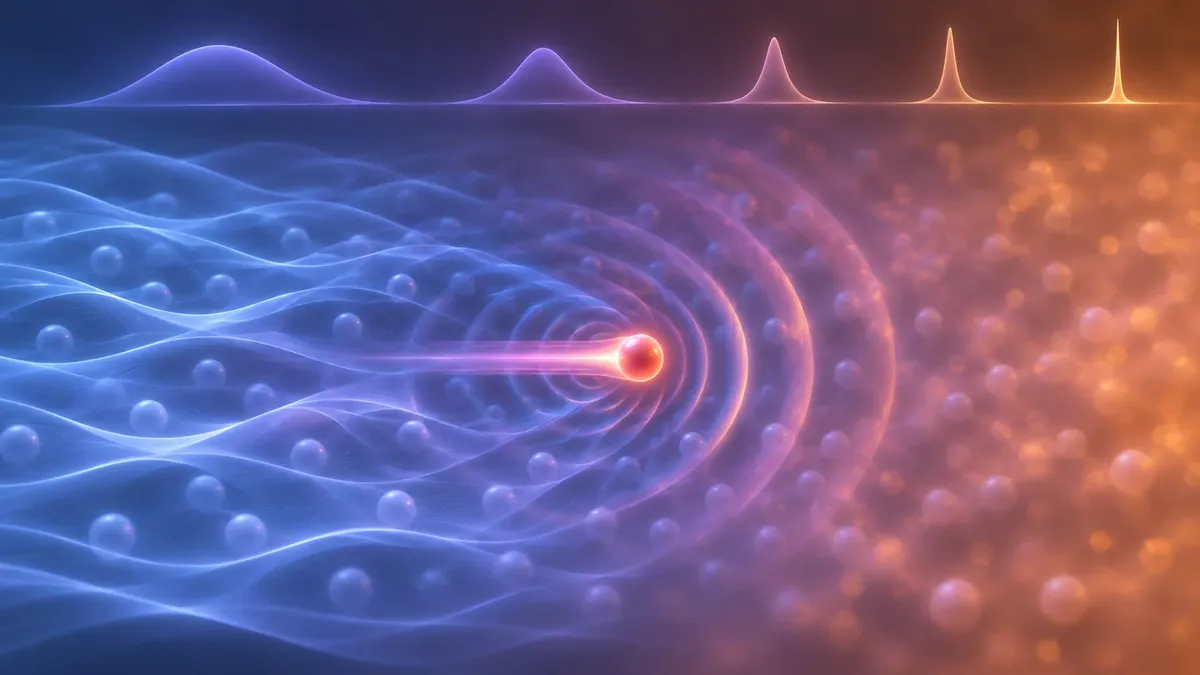
Heat does not always blur the spectral response of an impurity in a quantum gas. In experiments with potassium atoms, researchers found that at strong impurity–bath interactions, spectra narrowed as the surrounding Bose gas warmed, while interaction-related energy shifts weakened. The results also show why a gas near its condensation threshold cannot yet be treated as a simple classical collection of particles.
A lone atom moving through a gas may seem like a simple system. But the atom can disturb its surroundings, becoming dressed by excitations of the gas. Physicists describe this combined object as a polaron. Its spectral response can reveal how strongly it interacts with the bath and how quantum properties of the bath shape that interaction.
In Fate of an impurity strongly interacting with a thermal Bose gas, Jiří Etrych and colleagues ask how this response changes as a bosonic bath warms from a nearly pure Bose–Einstein condensate to a hotter, more classical gas. The question matters because bosonic impurities at strong coupling can produce broad, complex spectra, and the role of temperature—especially around the transition to condensation—has been debated.
Injecting an impurity and reading its response
The team used potassium-39 atoms in a box-shaped optical trap. Most atoms formed the bath; a small fraction were transferred into a different internal state, making them impurities. Radio-frequency pulses drove that transfer. By changing the pulse frequency and measuring how much transfer occurred, the researchers mapped the impurity’s injection spectrum: in effect, how the gas responds at different energy offsets from the bare atomic transition.
They varied the bath temperature and tuned impurity–bath interactions using a magnetic field near a Feshbach resonance. They compared the resulting spectra with measurements from a nearly pure condensate and with calculations using an ideal Bose-polaron model. That model treats the bath as noninteracting and assumes a stationary, infinitely massive impurity; it can include many bath excitations, but does not capture impurity motion or short-range correlations caused by interactions among bath atoms.
A counterintuitive temperature trend
At strong coupling, the measured spectra became narrower as the bath temperature increased. The energy shift associated with the impurity was also generally smaller in thermal gases than in the nearly pure condensate. Near the condensation temperature, the response still showed substantial many-body character: the impurity was not simply scattering from independent, classical particles.
The spectra changed character as the bath became hotter. Near condensation, their widths varied asymmetrically with interaction strength, and the attractive spectral branch extended across the resonance. At the hotter conditions studied, the branches connected more continuously across resonance and the width became more symmetric. These trends are consistent with a gradual move toward a regime dominated by two-body scattering—not an abrupt switch exactly at the condensation threshold.
The highest-temperature sample had a temperature about four times the critical temperature. Its measured energy shifts approached the researchers’ classical Boltzmann-gas prediction. The comparison suggests that the simple two-body picture works only once the bath is essentially nondegenerate. Near the critical temperature, quantum many-body effects remain important.
The ideal-polaron calculations reproduced the main qualitative features, including the broad temperature trends. But agreement was not exact: for thermal baths, measured widths were about 50% larger than the calculated ones, and near criticality the measured energy shift on the repulsive branch was about 30% larger than predicted. The model also produced multiple separated peaks in a strongly attractive regime where the experiment showed one broad feature. The authors note that omitted impurity motion and realistic short-range bath correlations may help explain such differences; their role is not settled by this comparison.
What the result does—and does not—show
The narrowing does not mean that heating generally makes quantum systems simpler. It is a measured feature of this particular impurity spectrum and interaction regime. Nor does the study show that the impurity becomes a long-lived, sharply defined quasiparticle: the spectra remain broad under strong interactions. The measurements instead chart how the broad response and its energy shifts evolve across different bath conditions.
The source is the v2 arXiv paper, dated August 8, 2025. This account is grounded in its supplied paper text; it is not an independent assessment of the work or of subsequent discussion. The paper itself highlights limitations in the idealized theory and open questions about correlations and impurity motion. Its findings are therefore best read as experimental evidence for temperature-dependent many-body behavior, alongside a model that captures broad qualitative trends rather than every detail.
- Bose polarons
- Bose gas
- ultracold atoms
- quantum many-body physics
- spectroscopy
- thermal effects
Related reading
Automatically matched by shared topic keywords. These links do not imply that the sources agree or establish a consensus.
A Raman route to anyon-like behavior in a one-dimensional lattice
Source published
Shared keywords: ultracold atoms
A Cold-Atom Bath Helps a Trapped Ion Reveal Its Spectrum
Source published
Shared keywords: ultracold atoms
How ultracold atoms reveal an unusual insulating state
Source published
Shared keywords: ultracold atoms
A quantum cluster that carries its own current
Source published
Shared keywords: ultracold atoms
A shortcut for studying sparse random quantum systems
Source published
Shared keywords: quantum many body physics