TRANSMISSION // 2507.17438v2
How Warm Axion Inflation Could Leave a CMB Fingerprint
Source published
A proposed axion–U(1) model uses a hot gauge-field plasma to slow inflation. CMB fits favor sub-Planckian decay constants, but depend on demanding assumptions.
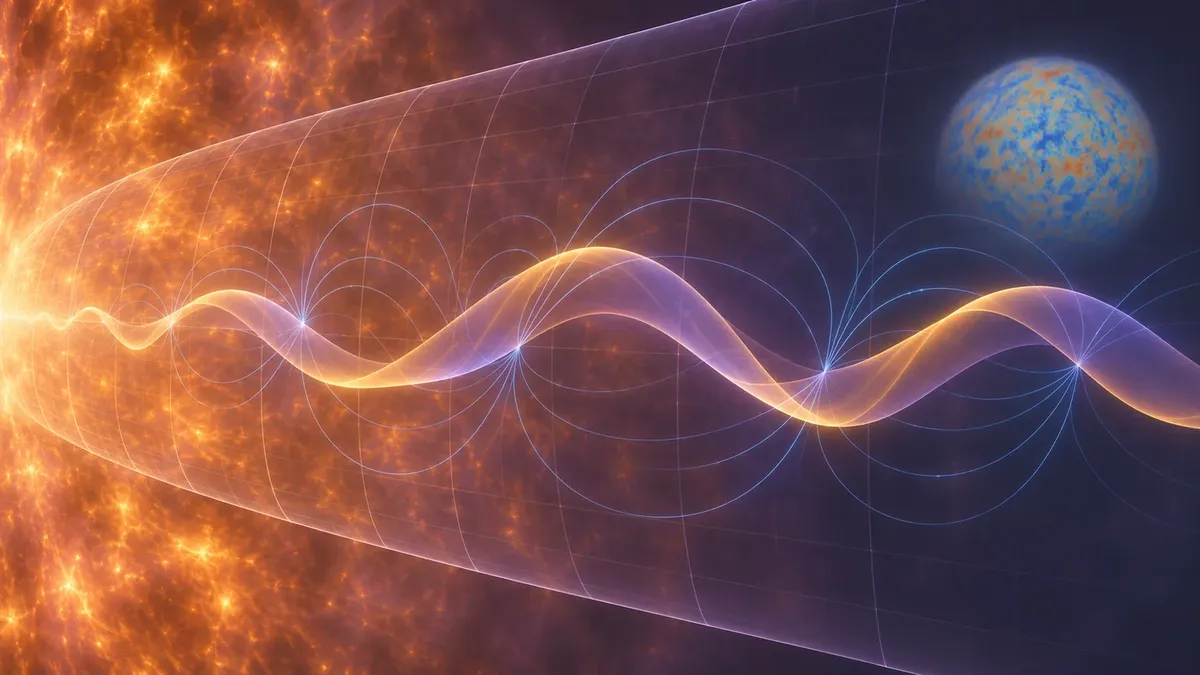
Could the early universe have stayed hot while it expanded rapidly? A preprint proposes a version of inflation in which an axion-like field transfers energy to a plasma of U(1) gauge fields and charged fermions. The authors calculate how this friction could affect the cosmic microwave background (CMB), then compare the model with cosmological data.
Inflation with a thermal bath
Inflation is a proposed brief period of accelerated expansion in the very early universe. In the familiar “cold” picture, the universe’s contents are diluted during inflation and a hot radiation-filled era follows. Warm inflation instead allows the field driving expansion—the inflaton—to transfer energy continuously to radiation while inflation is under way.
The new study examines a specific warm-inflation model: an axion-like inflaton coupled to a U(1) gauge field through a Chern–Simons interaction. A U(1) field is the mathematical framework behind electromagnetism, though the model does not establish that this sector is ordinary electromagnetism. The authors include charged fermions in the plasma, which affect how the gauge fields respond to the moving inflaton.
The central question is whether this proposed thermal friction can support inflation and produce primordial fluctuations compatible with CMB measurements—even when the axion decay constant, a scale describing the strength of the axion’s interactions, is below the reduced Planck scale.
Calculating friction and comparing with the sky
The authors estimate dissipation using linear-response theory: in broad terms, they calculate how a thermal plasma responds to a slowly changing inflaton. They use real-time thermal field theory and a high-temperature effective description of the plasma to obtain the response of the gauge fields. In their calculation, charged fermions give the gauge field a thermal mass and help produce the friction term. Without charged fermions, the paper finds that this particular local thermal-friction mechanism vanishes.
They then build a warm-inflation background and calculate a model-dependent spectrum of primordial scalar fluctuations. The model includes a periodic axion potential and a dissipation parameter, conventionally called Q, that measures friction relative to the expansion rate. The analysis assumes a sufficiently strong dissipative regime and treats Q as nearly constant during inflation.
For the observational comparison, the authors implement their spectrum in CAMB and sample parameters with CosmoMC. They use Planck 2018 temperature and polarization data, Planck lensing data, and baryon acoustic oscillation measurements from SDSS. The fit varies the model’s axion parameters alongside standard cosmological parameters. The paper also discusses newer CMB-related data, but its stated main parameter analysis uses the Planck 2018, lensing, and SDSS combination.
What the fit suggests
Within this setup and data combination, the authors report that decay constants at or above the reduced Planck scale are excluded at greater than three standard deviations. Their preferred fit is sub-Planckian: the reported mean decay constant is about 0.49 times the reduced Planck scale, with a 68% uncertainty of roughly 0.16. The corresponding mean dissipation parameter is about 208, with an uncertainty of about 59. These are results of the paper’s statistical fit, not direct measurements of axions or evidence that warm inflation occurred.
The paper also finds a dependence between the decay constant and dissipation strength: the CMB-compatible region does not allow Q to grow without limit, and the authors infer a lower bound on the decay constant within their chosen assumptions and parameter ranges. They emphasize that the resulting thermal friction relies on the charged plasma response; a simpler U(1) sector without charged fermions would not produce the same mechanism in their calculation.
What remains uncertain
These conclusions are conditional on a theoretical model and its approximations. The analysis assumes the plasma is already thermalized, uses a linear-response calculation and an adiabatic treatment, and approximates Q as constant. The authors themselves note that the constant-Q approximation can require caution, particularly for large field excursions. They also describe the transition from a cold initial state to the assumed warm state as an unresolved problem, and leave further study of non-Gaussian signals for future work.
The reported constraints also depend on the selected data, parameter priors, and model for the primordial spectrum. In particular, the authors note that a different, more recent data combination can favor very large values of the decay constant and Q, complicating the analysis. That is a reminder that “consistent with the CMB” does not mean uniquely supported by it.
This account is based on the arXiv preprint’s text. A preprint is a public research manuscript and may not have completed peer review; the source provided does not establish peer-review status. The paper presents a theoretical proposal and a data fit, not an experimental detection. Its calculations make warm axion inflation a testable possibility, while leaving important questions about the plasma, the model’s assumptions, and how inflation began in a warm state for further investigation.
- warm inflation
- axion-like particles
- cosmic microwave background
- U(1) gauge fields
- early universe
Related reading
Automatically matched by shared topic keywords. These links do not imply that the sources agree or establish a consensus.
Two gravitational routes narrow a warm-inflation dark matter model
Source published
Shared keywords: early universe, warm inflation
A Different Kind of Friction for Warm Inflation
Source published
Shared keywords: early universe, warm inflation
A hot-plasma challenge for minimal warm inflation
Source published
Shared keywords: early universe, warm inflation
Could dark matter’s cosmic history shape a rare LZ recoil?
Source published
Shared keywords: axion like particles
Cosmic background light complicates a proposed escape route for gamma rays
Source published
Shared keywords: axion like particles