TRANSMISSION // 2507.15110v3
Why black-hole inspirals may be smoother than expected
Source published
A model of ultralight boson clouds finds that many weak resonances can cancel abrupt changes previously attributed to cloud ionization, though important differences with relativistic calculations remain unresolved.
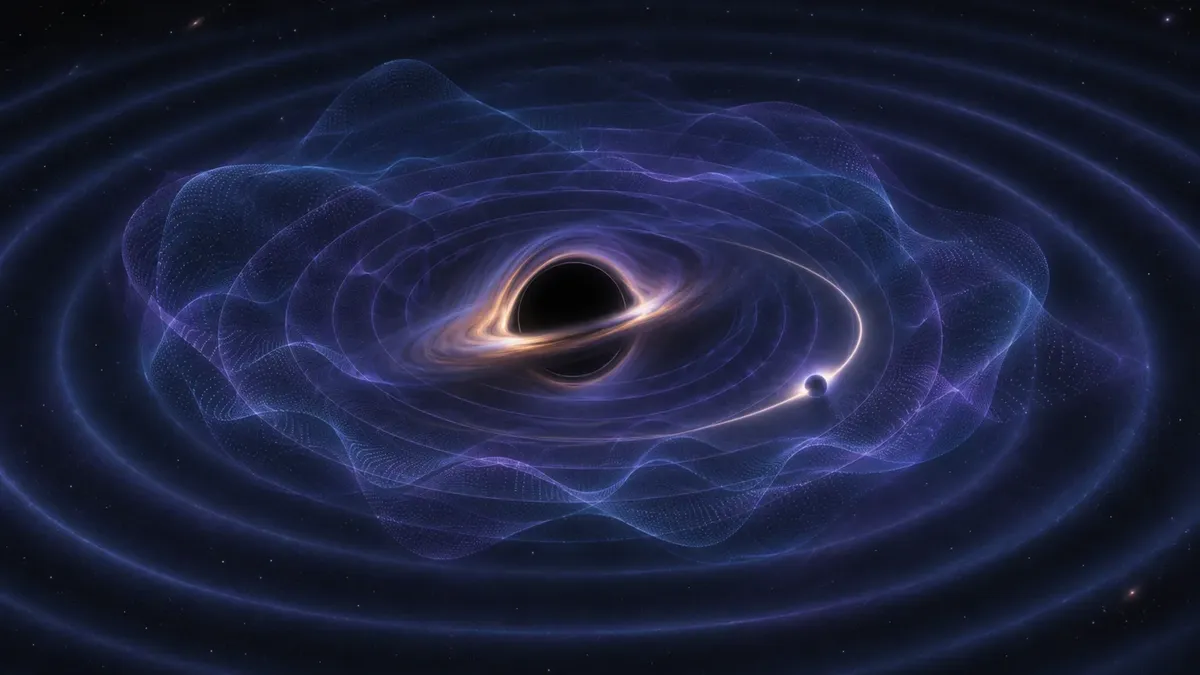
Could a cloud of ultralight particles around a black hole leave sudden kinks in a companion’s orbit—and in the gravitational waves we might detect? Giovanni Maria Tomaselli revisits how resonances and cloud loss affect inspiralling binaries. The analysis suggests that a dense sequence of weak resonances can erase the sharp features predicted when ionization is considered alone.
A cloud around a black hole
A rapidly rotating black hole could, in theory, build up a cloud of ultralight scalar particles through a process called superradiance. The cloud is sometimes compared to an atom: its particles occupy distinct bound states around the black hole. If another compact object orbits nearby, its changing gravitational pull can move particles between those states or eject them from the cloud.
These interactions may alter the orbit and the gravitational waves it produces. Earlier studies had suggested that ionization—the escape of cloud particles into unbound states—could create abrupt changes in the binary’s orbital evolution. Tomaselli’s paper asks whether that picture holds when resonant transitions into bound states are included more completely.
Treating broad resonances
The paper develops an effective way to calculate the influence of resonances involving states that decay over time. In a simplified picture, a resonance occurs when the binary’s orbital rhythm matches the energy gap between two cloud states. The match need not be exact for long: a state’s decay gives the resonance a finite width, like a musical note that occupies a range of frequencies rather than one perfectly precise pitch.
For resonances wider than the rate at which the binary’s orbital frequency changes, the author derives an effective quantity called resonance power. It describes energy exchanged between the orbit and the cloud, including the effect on the orbit itself. This approach can replace a more computationally demanding direct solution of the cloud’s quantum-state evolution in the cases where its assumptions apply.
The study applies the method to circular and more general orbits, accounting for eccentricity and inclination. It also calculates an upper bound on how much cloud mass can remain by the late stages of an inspiral in some configurations. The bound follows from a broad resonance involving the cloud’s lowest-energy, spherically symmetric state: if the cloud is too massive, the resonance can hold up the inspiral until the cloud loses enough mass for the binary to move on.
Many weak resonances change the picture
The central result concerns resonances with high-energy bound states. As the energy of these states approaches zero, their resonances become increasingly weak and closely spaced, accumulating near the frequency at which ionization begins. Considering only a few strong resonances would miss this growing sequence.
In the paper’s treatment, the combined contribution of the accumulating resonances cancels the discontinuity in the ionization effect. The predicted sharp kinks in the binary’s evolution therefore disappear when both processes are included. The cloud can still influence the orbit and its gravitational-wave signal; the result is that this influence should not be represented by the abrupt features attributed to ionization alone.
What remains uncertain
This is a theoretical calculation, not a detection of boson clouds or evidence that they occur around observed black holes. The analysis uses a Newtonian, nonrelativistic description for much of its work, and its effective treatment has limits: when a resonance is narrower than the changing orbital frequency sweeps across it, the simplified formula does not reliably describe the instantaneous evolution. The paper notes that the orbital frequency and cloud response feed back on each other, making a fully general solution challenging.
The comparison with recent relativistic calculations is also not settled. Some results agree in broad features, but the paper reports substantial discrepancies in calculated resonance-related fluxes, including differences in magnitude and, for some contributions, sign. The author discusses possible explanations but does not resolve them. In particular, the predicted cancellation of sharp features is not reproduced at the expected strength in the relativistic comparison discussed in the paper.
The work is a preprint posted on arXiv, rather than a result whose peer-review status is established by the supplied source. Its conclusions are therefore best read as a proposal for how resonance physics should be incorporated into future models, not as a final account of what gravitational-wave observations will show. A key next step is reconciling the nonrelativistic and relativistic calculations and improving treatments of narrow resonances before making firm predictions for signals.
- black holes
- boson clouds
- ultralight scalars
- gravitational waves
- orbital resonances
- binary inspirals
Reviewed cross-references
These connections were reviewed by a model, not independently fact-checked by a human. Similarity does not imply agreement; consult the original papers and the evidence below.
How a boson cloud could alter black-hole inspiral signals
Supporting evidence: Both studies find that resonances associated with scalar clouds can affect inspiral evolution and gravitational-wave signals, but they examine different mechanisms: Tomaselli finds accumulated cloud-state resonances smooth previously predicted sharp features, while Takahashi estimates dephasing from conservative environmental resonances in EMRIs. This supports only the bounded point that resonance effects merit waveform modeling; it does not establish that the mechanisms or predicted signal shapes are the same.
Model review: · openai-codex/gpt-6-luna
Evidence and provenance
Selected excerpts, not complete papers. PDF extraction can omit figures or damage equations, tables and reading order; sources may be preprints.
2507.15110v3 — Original paper
Excerpt reference:
static/papers/2507.15110v3.md:72-132
Basis: Paper text
Source SHA-256:f75d212a62963caf8dbb8735110f1af7472b28f56c70a4181187a5db6fd18ab52611.33550v1 — Original paper
Excerpt reference:
static/papers/2611.33550v1.md:872-992
Basis: Paper text
Source SHA-256:48ff94c7e9c569c27aa982a73e191b3e9384601112c29afe91fbbab8415c84d5
Related reading
Automatically matched by shared topic keywords. These links do not imply that the sources agree or establish a consensus.
How a boson cloud could alter black-hole inspiral signals
Source published
Shared keywords: black holes, boson clouds, gravitational waves
Tiny primordial black holes may leave a many-peaked gravitational-wave signal
Source published
Shared keywords: gravitational waves
Two cosmic signals could reveal how massive black holes grow
Source published
Shared keywords: gravitational waves
LISA could find elusive black holes long before their companions fall in
Source published
Shared keywords: gravitational waves
A crowded peak, then a possible gap: the black-hole masses in gravitational-wave mergers
Source published
Shared keywords: black holes, gravitational waves