TRANSMISSION // 2507.13231v5
A robot policy that starts with what it sees
Source published
VITA replaces random-noise starting points with visual representations to generate robot actions. In selected simulated and real-world manipulation tests, the approach was faster than a conventional flow-matching baseline while achieving comparable or higher success on many tasks.
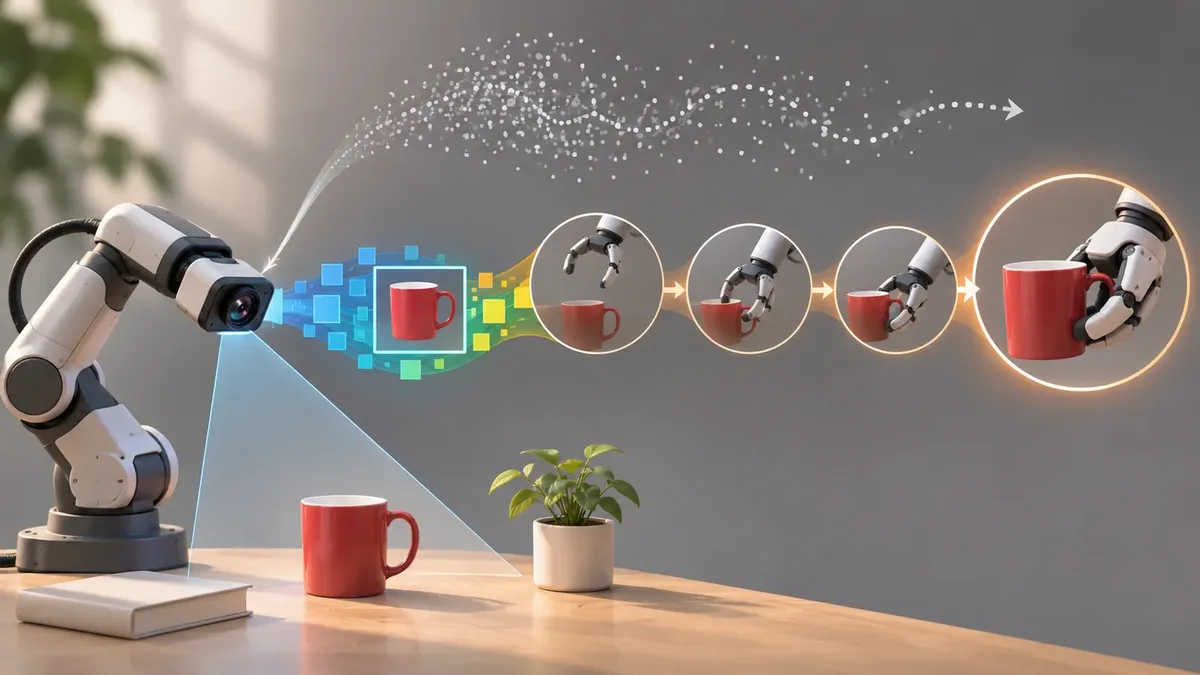
Robot-control models often generate actions through repeated refinement, while repeatedly feeding in visual information. VITA takes a different route: it starts its generation process from a representation of the robot’s current view. The researchers report faster inference on their tests, but the results cover a defined set of tasks and hardware—not every robot or deployment setting.
Turning a camera view into a robot action
A robot policy has to turn what a camera sees into movements: which way to reach, how to grasp, or how to position an object. One way to do this is with flow matching, a generative modeling method that learns how to transform one distribution of data into another. In many robot policies, generation starts with random noise and proceeds through several computational steps. Visual information is fed into the model repeatedly as it refines its proposed actions.
The authors of VITA—short for Vision-to-Action—ask whether that process can be simplified. Their central idea is to start from a learned representation of the current visual observation, rather than random noise. Because the starting point already reflects the scene, the policy can generate actions without repeatedly injecting visual information during the flow.
Making vision and action fit
There is a practical obstacle: visual representations and robot actions are different kinds of data, and typically have different dimensions. Flow matching requires its source and target to have the same dimensionality. Raw action sequences may also be less structured than visual representations.
VITA addresses this mismatch with an action autoencoder. An encoder maps action sequences into a higher-dimensional latent space—the model’s internal representation—while a decoder maps those latent actions back into usable movements. The researchers train this system jointly with the flow-matching model, rather than relying on a fixed, pre-trained action representation.
Joint training introduces another risk: the latent action space can collapse, leaving the model unable to generate useful actions. To counter this, the team proposes flow latent decoding. During training, the model runs its flow process and decodes the resulting latent action; a reconstruction loss then compares the decoded action with the demonstrated action. Crucially, the loss is backpropagated through the flow’s ordinary differential equation (ODE) solver, helping anchor the generated latent actions to real examples.
What the tests found
The researchers evaluated VITA on nine simulated tasks and five real-world tasks using ALOHA and Robomimic setups. The tasks included single-arm and bimanual manipulation, among them inserting an object, transferring a cube, and threading a needle. The paper reports that VITA’s inference was 1.9 times faster than a conventional flow-matching policy with visual-conditioning modules, while matching or surpassing leading comparison methods on success rates in the tested tasks.
That speed figure is not a universal property of every VITA model. The paper measures latency under specified conditions, using particular model architectures and GPUs. For example, one comparison of vector-based models used a single-item batch on an NVIDIA RTX 4090; other settings produced different speedups. The authors also report a training cost for flow latent decoding, so the approach’s efficiency gains at inference do not mean every stage of model development is cheaper.
The results highlight a design trade-off. VITA aims to make generation more efficient by starting from action-relevant visual features, but it depends on learning a useful alignment between visual and action representations. The paper’s ablations show that omitting flow latent decoding can prevent successful learning. The authors also report that using a variational, stochastic visual encoder degraded performance in their tests, which they attribute to loss of detail that matters for precise manipulation. These findings are specific to the examined setup; they do not establish that stochasticity is harmful for robot control generally.
What remains uncertain
The evaluations span a meaningful mix of simulation and physical-robot tasks, but they do not establish how VITA would perform across different robot designs, much larger task collections, or less controlled environments. Some reported simulation results are the best validation success rates across training, averaged over three seeds, rather than a single measure of performance in every deployment condition. Real-world tests also covered a finite number of episodes. The paper reports a small evaluation on unseen objects, but that is not a broad test of generalization.
The paper is identified as published at ICLR 2026, so it is not merely an unreviewed preprint according to the provided source text. The versioned arXiv record is still the source used here, and the article relies on the authors’ reported experiments rather than an independent replication. Overall, VITA offers evidence that visually grounded starting points can reduce inference cost in these robot-manipulation settings; whether the same advantage holds more widely remains an open question.
- robotics
- robot learning
- flow matching
- robot manipulation
- imitation learning
- artificial intelligence
Related reading
Automatically matched by shared topic keywords. These links do not imply that the sources agree or establish a consensus.
Teaching a robot model to predict what its actions will change
Source published
Shared keywords: robot learning, robot manipulation
How RoboEvo² trains robots from verified repairs
Source published
Shared keywords: artificial intelligence, robot learning, robot manipulation
Teaching robots without demanding an exact copy
Source published
Shared keywords: imitation learning, robot learning, robot manipulation
Choosing Robot Policies Without Testing Every Checkpoint
Source published
Shared keywords: imitation learning, robot learning, robot manipulation
How uncertainty can help robots adapt their movements
Source published
Shared keywords: imitation learning, robot manipulation