TRANSMISSION // 2506.10895v2
When image and text directions diverge
Source published
A study of contrastive vision-language models finds that image and text transformations can point in different directions. Its proposed fix, AIR, refines text guidance and is reported to help across two application areas.
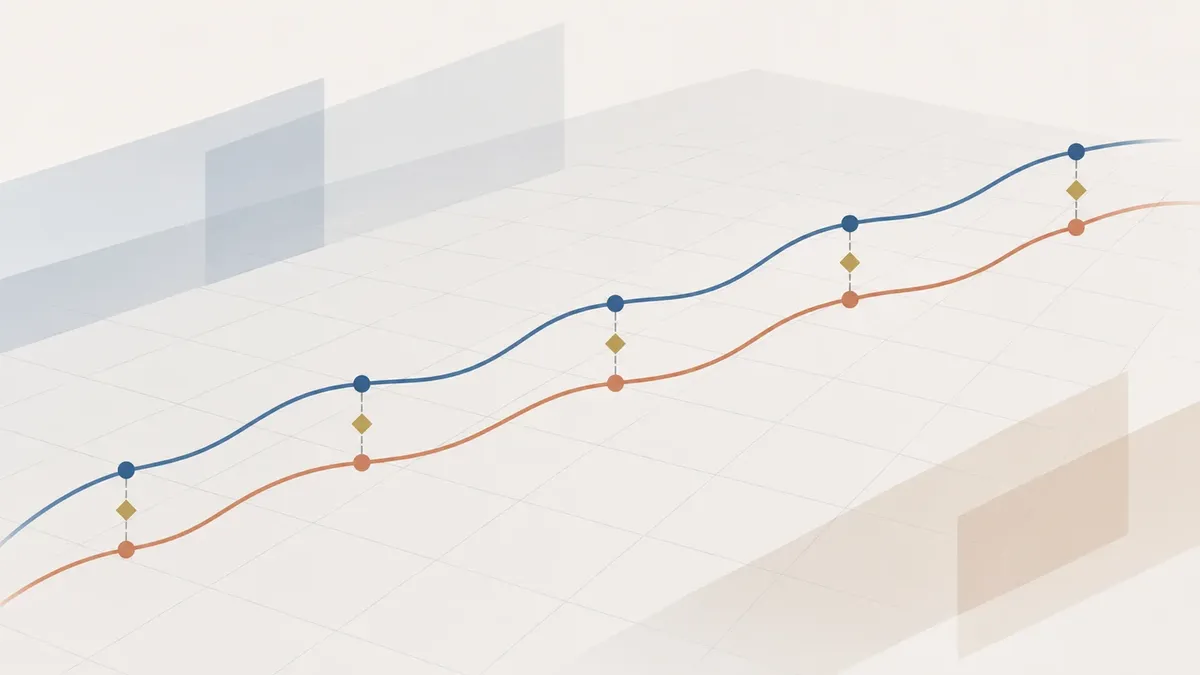
Many image-editing systems assume that a change described in words corresponds to a change in an image. A new preprint examines that assumption in multimodal models and proposes a method to refine text-based guidance.
The question behind image edits
Text-guided image tools rely on more than matching words with pictures. When a description changes, the system must also relate that change to a corresponding transformation in its visual representation. The authors call this relationship image-text offset alignment: the consistency between directions of change in image and text representations.
This matters for applications that use text to guide visual transformations, such as adapting a generative model to a new domain or editing an object in an image. The paper asks whether the assumed alignment holds in contrastive vision-language models, which learn representations of images and text in a shared space.
How the study examines alignment
The researchers report an empirical analysis across six large datasets and eight contrastive vision-language models. They examined whether visual transformation directions corresponded to textual transformation directions, and whether the degree of mismatch was associated with semantic distance between concepts.
The available source is the paper’s abstract. It does not name the datasets or models, explain the exact measures, or provide individual benchmark results. That means the abstract supports an overview of the reported approach and conclusions, but not a detailed comparison of particular systems or a close assessment of how mismatch varied across settings.
What the authors report
The authors report noticeable misalignment: image and text offsets did not consistently point in corresponding directions. They also report a positive correlation between the amount of misalignment and semantic concept distance. Put simply, concepts farther apart semantically tended to have more mismatched offsets in their analysis. This is an association reported by the researchers, not evidence that semantic distance causes misalignment.
To address the issue, the paper proposes Adaptation with Iterative Refinement (AIR). It iteratively refines text offsets using anchor sampling and a technique the authors call concept description learning. The stated goal is to mitigate the effects of mismatch and improve the accuracy of text guidance.
The abstract reports evaluations in two application areas: zero-shot generative-model domain adaptation and text-guided object-centric image editing. Across 40 setups, the authors say qualitative, quantitative, and user-study evaluations consistently showed state-of-the-art performance. The abstract does not give scores, explain the setup of the user studies, or provide enough detail to assess the reported gains independently.
What the evidence can—and cannot—show
The findings challenge the assumption that placing images and text in a shared representation space guarantees that their directions of change will match. The authors report that AIR improved guidance in the application areas they tested. The abstract alone, however, does not allow readers to determine the size of those improvements or how the results varied among datasets and models.
Other details needed to evaluate the work—including the specific baselines and measures, and the study designs—are also not available in the abstract. It therefore does not provide enough information to assess statistical uncertainty or how well the findings might extend beyond the reported experiments; these are unanswered questions in this source, not documented flaws in the study. “State of the art” is the authors’ characterization of their results, not an independently verified conclusion here.
This article is based on an arXiv preprint abstract. The supplied source does not establish the paper’s peer-review status. Its claims should be understood as findings reported by the authors, rather than settled evidence about all vision-language models or image-editing systems.
Source: Guimeng Liu, Milad Abdollahzadeh and Ngai-Man Cheung, “AIR: Rethinking Image-Text Offset Alignment in Multimodal Contrastive Representation Space,” arXiv:2506.10895v2, posted June 12, 2025.
- vision-language models
- image editing
- multimodal AI
- contrastive learning
- image-text alignment
- generative models
Related reading
Automatically matched by shared topic keywords. These links do not imply that the sources agree or establish a consensus.
Giving image tokens more building blocks when they need them
Source published
Shared keywords: image text alignment, multimodal ai
MMCOMET gives commonsense knowledge a visual anchor
Source published
Shared keywords: multimodal ai, vision language models
Why certificate forgery detectors struggle with some images
Source published
Shared keywords: multimodal ai
Why a personal AI assistant needs to find the right person first
Source published
Shared keywords: multimodal ai, vision language models
When Audio and Video Don’t Tell the Same Story
Source published
Shared keywords: contrastive learning, multimodal ai