TRANSMISSION // 2506.09195v2
Teaching drone teams to balance coverage and battery life
Source published
A graph-based reinforcement-learning system lets simulated drones coordinate from local information while prioritizing wireless coverage and treating battery life as a secondary goal. Tests show a coverage–endurance trade-off, but the results come from simulations and do not establish readiness for real flights.
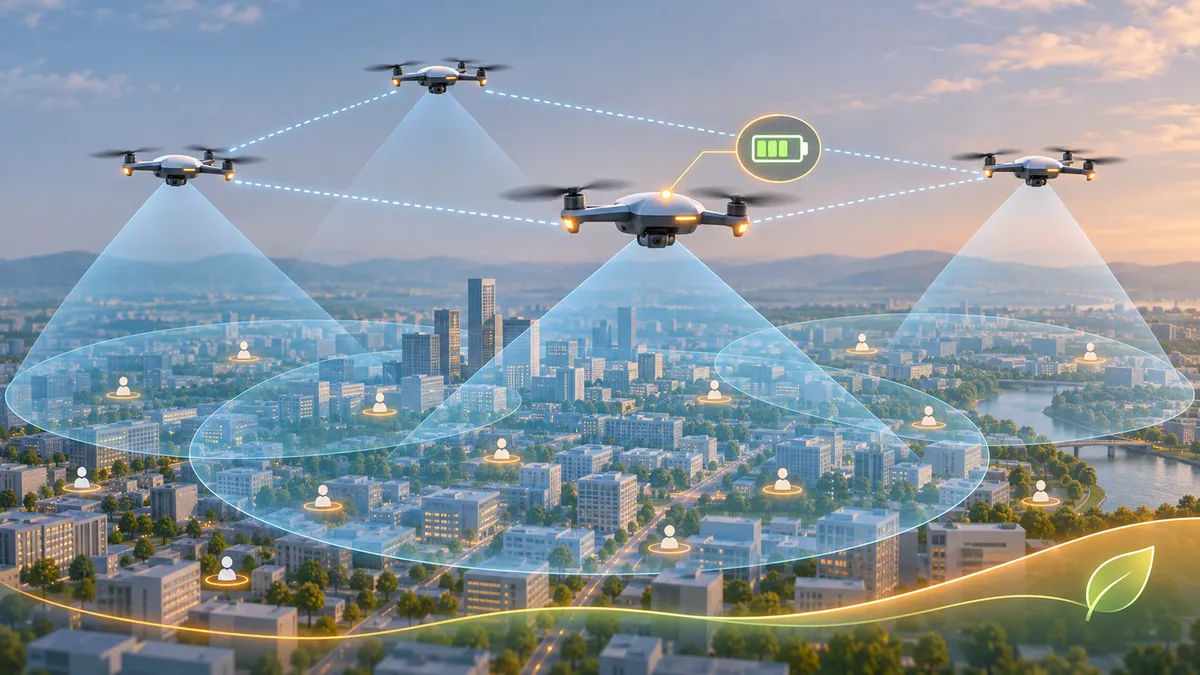
A fleet of wireless-network drones faces a practical dilemma: moving to serve more people uses energy, and the first drone to run out of battery can end the network’s mission. A new controller called GADC aims to manage that tension without requiring every drone to know the whole network.
A coordination problem with competing goals
Unmanned aerial vehicles can act as temporary wireless base stations, extending service where ground infrastructure is limited. But each aircraft has a restricted view of the network and a finite battery. A drone that serves many users may use energy quickly; meanwhile, other drones may be poorly positioned to fill the gap if it stops operating.
The study asks whether a decentralized learning system can improve service coverage while also extending the network’s lifetime. The authors make coverage the primary objective and battery life the secondary one. They define network lifetime as the time until the first UAV’s battery is depleted—a measure that can be affected by the most heavily burdened aircraft, not just average battery use.
How GADC works
The proposed method, Graph Attention-based Decentralized Actor-Critic (GADC), gives each drone a policy that acts on local observations and information from nearby drones. A graph-attention network combines information from a variable number of neighbors into a fixed-size representation. Two graph layers allow information to travel indirectly from drones two communication links away. A recurrent component, a type of memory, helps the controller use information across time.
The system uses two critics—components that estimate the value of actions for learning. One guides a coverage-focused policy update; the other helps refine that policy toward better energy outcomes. Rather than combine coverage and energy into a single weighted score, GADC updates for coverage first and then applies a clipped, replay-based energy refinement. In everyday terms, the design tries to improve the main goal before adjusting for the secondary one.
That ordering is a design choice, not a guarantee that coverage will be preserved. The paper’s mathematical bound on coverage change applies only if a candidate policy satisfies a specified condition on how far it deviates from the coverage-focused policy. The implemented clipping step does not enforce or verify that condition, and the authors explicitly say the bound is not a performance guarantee for their replay-based update.
What the simulations found
The researchers compared GADC with several reinforcement-learning baselines and a computationally intensive sampled-search reference. In an idealized simulator, GADC and a graph-based weighted-reward method had similar held-out coverage results: about 88 served user terminals for each. GADC’s normalized lifetime was also slightly higher in that test. Removing graph aggregation lowered coverage in the tested comparison, though ablation results show performance of particular components in this setup rather than proving that graph attention will help in every deployment.
At a larger tested fleet size, the trade-off was visible: one baseline served somewhat more users, while GADC and another graph-based method had higher normalized lifetime. The study also tested different clipping settings, fleet sizes, observation noise, user mobility and other changes. In the tested sensitivity study, coverage varied less across GADC’s clipping settings than across the tested weighted-sum coefficients. This is a comparison over the specified parameter ranges, not evidence that GADC is insensitive to all operating conditions.
The authors also evaluated the controller using NVIDIA Sionna ray tracing, which models radio propagation using urban scene geometry. In the held-out Munich evaluation, GADC had higher mean coverage than the MADDPG baseline, while MADDPG had higher mean normalized lifetime. A separate illustration used only one random seed in Munich and Etoile; it should be read as a visualization, not broad evidence across cities.
What remains uncertain
These are simulations, not flights. The ideal model simplifies radio service and energy use; the ray-tracing environment adds realistic propagation features but does not establish that the aircraft can safely fly the commanded paths. The paper notes that flight dynamics, obstacle avoidance, trajectory smoothing, embedded-hardware performance and real communication delays need separate evaluation. It also says computational energy and the physical cost of exchanging graph messages are not measured directly. The lifetime metric is capped by the simulation horizon, so it cannot show endurance beyond that limit.
The paper is available as an arXiv preprint. The supplied source does not establish whether this version has undergone peer review. Its results are therefore best treated as evidence about a proposed controller under specified simulated conditions, not a demonstration of operational performance. The authors report that code is available, which may help others inspect and reproduce the experiments.
- multi-UAV networks
- reinforcement learning
- graph attention
- wireless coverage
- battery lifetime
- simulation
Related reading
Automatically matched by shared topic keywords. These links do not imply that the sources agree or establish a consensus.
A New Geometry for Graphs Whose Neighbors Differ
Source published
Shared keywords: graph attention
OmniPiano tests AI control with up to five virtual piano-playing hands
Source published
Shared keywords: reinforcement learning
Teaching reinforcement-learning agents to predict across sensors
Source published
Shared keywords: reinforcement learning
WorldMind tests spatial reasoning without turning every imagined view into an image
Source published
Shared keywords: reinforcement learning
OdorSpaces tests how virtual robots can trace hidden gas leaks and fires
Source published
Shared keywords: reinforcement learning