TRANSMISSION // 2506.06901v4
Can a cosmic bounce create the right primordial pattern?
Source published
A theoretical study finds that quantum fluctuations in a particular bouncing-universe model can produce a nearly scale-invariant spectrum. But unresolved instabilities remain a major obstacle.
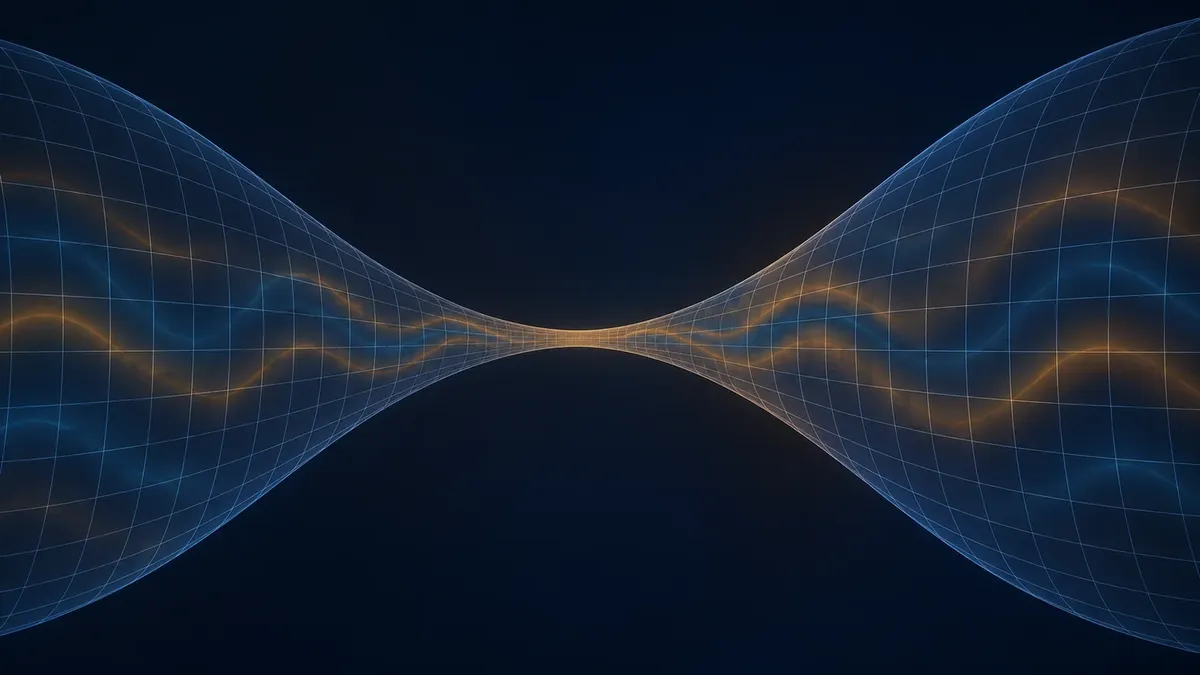
Could the early universe have contracted before expanding, avoiding a beginning in a singular Big Bang? Researchers calculate how quantum fluctuations in one such scenario might become seeds of cosmic structure—and explain why a serious problem in the underlying theory leaves the result provisional.
Cosmologists commonly describe the early universe as expanding from a hot, dense state. Some models instead propose that the universe first contracted, reached a smallest size, then bounced into expansion. Could such a history produce the primordial fluctuations whose patterns are imprinted in the cosmic microwave background, the afterglow of the early universe?
Idaiane L. Machado, Dêivid R. da Silva and Nelson Pinto-Neto investigate this question in a framework called mimetic cosmology. Their calculations suggest that quantum fluctuations in certain bouncing models can yield a nearly scale-invariant spectrum, with an amplitude compatible with observations under particular assumptions. But this is a theoretical result, and the framework has unresolved instability problems that prevent it from being considered a complete, healthy theory.
Modeling contraction and a bounce
In this framework, a scalar field can behave like a dark-matter component. The researchers study a family of possible cosmic histories, focusing on nonsingular cases where contraction turns into expansion without the scale factor—the quantity that tracks the universe’s size—reaching zero. They examine the background evolution, including the expansion rate, energy density and curvature, and calculate small perturbations in the scalar field and metric.
For the perturbation calculation, they assume quantum vacuum fluctuations in the distant contracting phase, when the model’s spacetime approaches a nearly flat state. They then evolve those fluctuations through the contraction and bounce. The work combines analytical calculations of perturbation modes with numerical solutions using SciPy. It examines the power spectrum of metric perturbations: a measure of how fluctuation strength varies with scale.
The bounce scenarios build on an earlier proposal. The authors explore a wider range of model parameters and test a small change to the scalar-field potential. This is a calculation within a specified theoretical setup—not an observation of a bounce or a data analysis showing that the model is preferred over alternatives.
A nearly level spectrum, conditionally
For the models examined, the calculated spectrum is scale-invariant, meaning its strength is approximately the same across scales. The authors report that its amplitude can be compatible with observations if the bounce’s characteristic length, called t₀, falls between 10⁵ and 10⁹ Planck lengths. This range is reported under the assumptions used in their calculation, including a small sound speed for the perturbations.
With the potential used in the original setup, the authors obtain a scale-invariant spectral index. They also show that a slight modification to the potential can produce a red-tilted spectrum: one with relatively more power on larger scales. They describe this as yielding the observed red tilt, while reporting the same amplitude constraints. However, the paper does not present a data-driven exploration of the model’s parameters or a statistical comparison with observations. The authors identify those analyses as future work, so the result should not be read as showing that the modified model fits the data.
The authors treat the bounce as classical: they calculate quantum fluctuations on a classical background rather than quantizing the background itself. They argue that choosing t₀ well above the Planck time keeps the curvature below the Planck scale in their scenario, while also requiring the bounce timescale to be much shorter than the characteristic timescale of nucleosynthesis. The quoted range of t₀ is tied to matching the fluctuation amplitude under their assumptions; it is not, by itself, proof that every relevant high-energy effect has been accounted for.
A serious unresolved stability problem
The central caveat concerns the theory’s stability. The authors note that the reduced Hamiltonian for scalar perturbations in the minimal higher-derivative mimetic theory is not bounded from below. This signals a kinetic ghost instability—a problem in the theory’s dynamics that could make it physically unacceptable. Their parameter range avoids a separate gradient instability associated with an imaginary sound speed, but that does not resolve the ghost problem.
The paper treats the model as a low-energy effective description and suggests that additional terms or a more complete theory might stabilize it. Whether a healthy completion exists, and whether it would preserve the calculated large-scale predictions, remains unknown and is outside this study’s scope. A broader parameter exploration and comparison with cosmological data are also outstanding.
The work therefore shows that a particular mathematical setup for a nonsingular bounce can produce a potentially interesting primordial spectrum—not that a viable bouncing cosmology has been established. The source is an arXiv preprint; the available material does not establish its peer-review status. Its findings are conditional theoretical results, especially given the explicitly acknowledged stability problem.
- bouncing cosmology
- mimetic dark matter
- quantum fluctuations
- primordial power spectrum
- early universe
- cosmological perturbations
Related reading
Automatically matched by shared topic keywords. These links do not imply that the sources agree or establish a consensus.
A cosmic bounce can match the expansion—but not its fluctuations
Source published
Shared keywords: bouncing cosmology, early universe
No convincing cosmic ripple yet
Source published
Shared keywords: primordial power spectrum
Could ancient cosmic walls have left a gravitational-wave background?
Source published
Shared keywords: early universe
Inflation models face a small-scale test—and a black-hole problem
Source published
Shared keywords: early universe
Could an unusual quantum starting state ease inflation’s ACT tension?
Source published
Shared keywords: early universe