TRANSMISSION // 2506.01676v2
How well can multimodal AI handle school-level science?
Source published
K12Vista tests multimodal AI on Chinese school questions and evaluates reasoning steps as well as final answers. The results reveal weaknesses, while the benchmark’s scope and automated scoring shape what they can tell us.
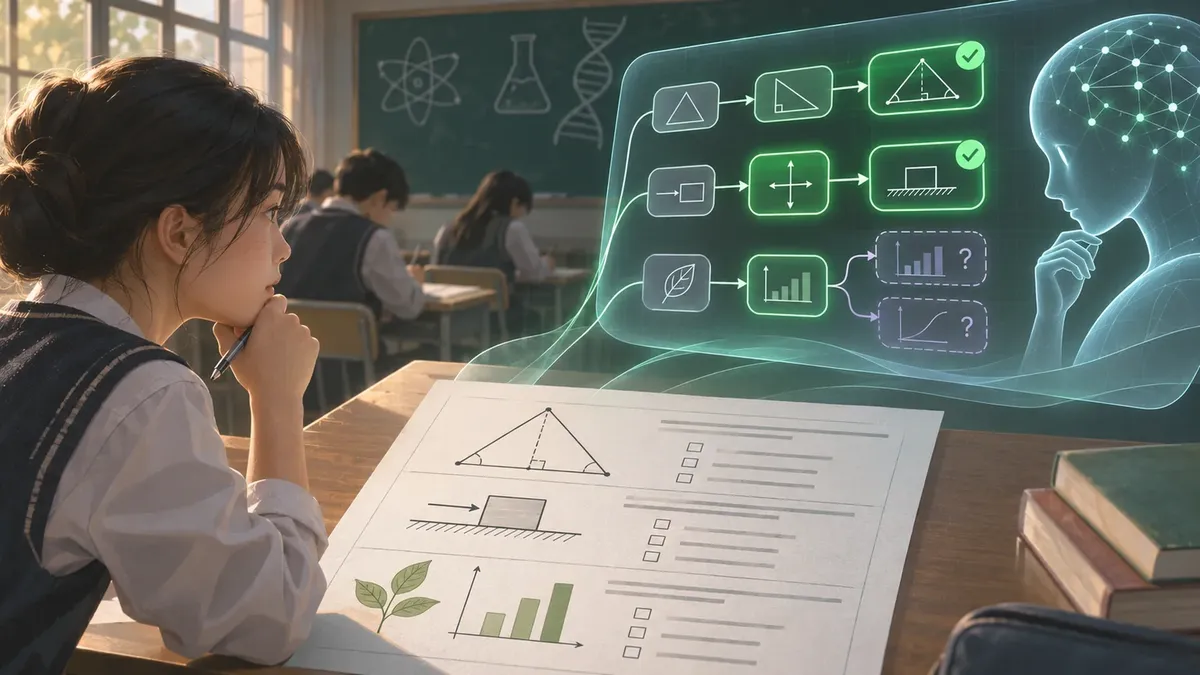
A model can reach the right answer for the wrong reason—or make a mistake after misreading a diagram. K12Vista, a benchmark of Chinese school questions, examines both final answers and the reasoning steps behind them.
Testing more than the final answer
Multimodal large language models (MLLMs) process text and images together. They can answer questions involving diagrams, charts and written prompts, but a score on a particular question is not the same as reliable understanding. A correct answer may conceal faulty reasoning; an incorrect one may follow from misreading an image, misunderstanding a question or making a calculation error.
In the arXiv preprint K12Vista: Exploring the Boundaries of MLLMs in K-12 Education, Chong Li and colleagues introduce a benchmark to test models on Chinese school subjects. They ask both how well current models answer questions across a broad curriculum and whether their intermediate reasoning can be evaluated.
A broad set of questions, plus a process judge
K12Vista contains 33,660 questions in mathematics, physics, chemistry, biology and geography, spanning grades 1–12. Questions are multiple choice, fill-in-the-blank or free response. Each comes with metadata such as grade, knowledge point and difficulty, as well as a reference answer and solution steps. The authors say the questions came mainly from authorized, non-public school exams, rather than textbooks or online question banks, to reduce the risk that models had encountered them during training.
The researchers collected a larger pool, filtered it and sampled questions to cover subjects, grades, formats and knowledge points. Ten undergraduate reviewers checked questions, images and reconstructed solutions. In a separate quality check of 1,000 sampled items, reviewers rated 99% of questions, 96% of answers and 94% of reference solutions as high quality.
To assess more than final answers, the authors created K12-PEM-800K, a dataset of 840,175 model-generated reasoning examples annotated step by step. They used it to train K12-PEM, a model designed to judge reasoning. Its process score is the share of a response’s steps judged correct. The researchers assessed the approach on K12-PEBench, a separate set of about 3,000 examples annotated by people.
The annotation pipeline relies substantially on AI: models generated solutions, another model split them into steps, and a panel of models judged those steps, using majority voting for labels. Human review adds a check, but does not mean every annotation was written or verified by a subject-matter expert.
Models struggled, especially on harder work
Among the tested systems, Gemini2-thinking had the highest overall scores reported in the paper: 55.47% for direct answers and 57.36% under step-by-step evaluation. These are results on this benchmark, not general measures of school knowledge. Scores generally declined from primary to high-school questions. The authors also report that fill-in-the-blank questions were harder than multiple choice, and that free-response questions produced wider differences between models.
The study identifies recurring mistakes, including image-reading errors, misunderstandings of prompts, weak knowledge application, faulty logic, calculation mistakes and incomplete answers. Step-by-step scores were lower for most tested models than direct-answer scores; reasoning-focused models were exceptions. Examining steps can therefore reveal problems that a final-answer score alone might miss. It does not, by itself, establish why a model made a particular mistake.
What the results do—and don’t—show
K12Vista is a Chinese benchmark covering five subjects, not a test of every curriculum, language, classroom or real-world learning situation. Its questions were selected and filtered, including by removing items that some models could answer. That helps create a challenging test, but also shapes what the scores represent. The process evaluator was trained on machine-generated annotations, so its judgments may inherit errors or preferences from the models involved. Human checks are useful evidence, not a guarantee that every step label is correct. The paper reports different agreement figures across evaluation setups, underscoring that automated scoring is not interchangeable with human judgment.
The results support a limited conclusion: on this collection of Chinese school questions, tested models often struggled, and evaluating reasoning steps exposed further weaknesses. They do not show that AI cannot help students or establish how these systems perform as tutors in ordinary classrooms.
The source is an arXiv preprint. The supplied paper text does not establish its peer-review status, so no conclusion about that status should be drawn here. The authors say they have released the resources through the K12Vista project. Independent checks of the benchmark and scoring methods could help clarify how well the findings generalize.
- multimodal AI
- K12Vista
- AI benchmarks
- education
- reasoning evaluation
- Chinese science education
Reviewed cross-references
These connections were reviewed by a model, not independently fact-checked by a human. Similarity does not imply agreement; consult the original papers and the evidence below.
A lab AI benchmark finds a gap between seeing a procedure and locating where to act
Supporting evidence: K12Vista reports flaws in MLLMs’ reasoning on Chinese K–12 questions, while BEAKER reports difficulties with action-grounded judgments and procedural reasoning in chemical-laboratory images and videos. Together, these benchmark results support the bounded point that models show reasoning limitations on specialized multimodal tasks; the domains, tasks, and evaluation settings differ, so they do not establish the same failure mode or a general performance level.
Model review: · openai-codex/gpt-6-luna
Evidence and provenance
Selected excerpts, not complete papers. PDF extraction can omit figures or damage equations, tables and reading order; sources may be preprints.
2506.01676v2 — Original paper
Excerpt reference:
static/papers/2506.01676v2.md:95-162
Basis: Paper text
Source SHA-256:1ad13c1d17df99c1f27cd3a6428f61184abcf42358f512053af6643f7652d19e2611.06911v1 — Original paper
Excerpt reference:
static/papers/2611.06911v1.md:106-157
Basis: Paper text
Source SHA-256:ab7d81704d93dec61524a415d4d6c06cc626bf0a9187f1cae3cdfb07ca80f1fa
Related reading
Automatically matched by shared topic keywords. These links do not imply that the sources agree or establish a consensus.
Can AI benchmarks renew themselves? VeRA’s answer
Source published
Shared keywords: ai benchmarks, reasoning evaluation
A Reconstruction-Based Test for AI Image Descriptions
Source published
Shared keywords: ai benchmarks, multimodal ai
Can AI read artistic intent in audiovisual art?
Source published
Shared keywords: ai benchmarks, multimodal ai
Why AI Gets Lost Between Seeing a Grid and Solving It
Source published
Shared keywords: ai benchmarks, multimodal ai
Can AI agents build tougher tests for AI?
Source published
Shared keywords: ai benchmarks, multimodal ai