TRANSMISSION // 2505.21956v4
How AI Can Build an Image from Several Visual Clues
Source published
Cross-modal RAG breaks complex image prompts into parts, retrieves images that supply different details, and guides a generator to use the relevant features. Tests report gains on several benchmarks, with important limits around databases and captions.
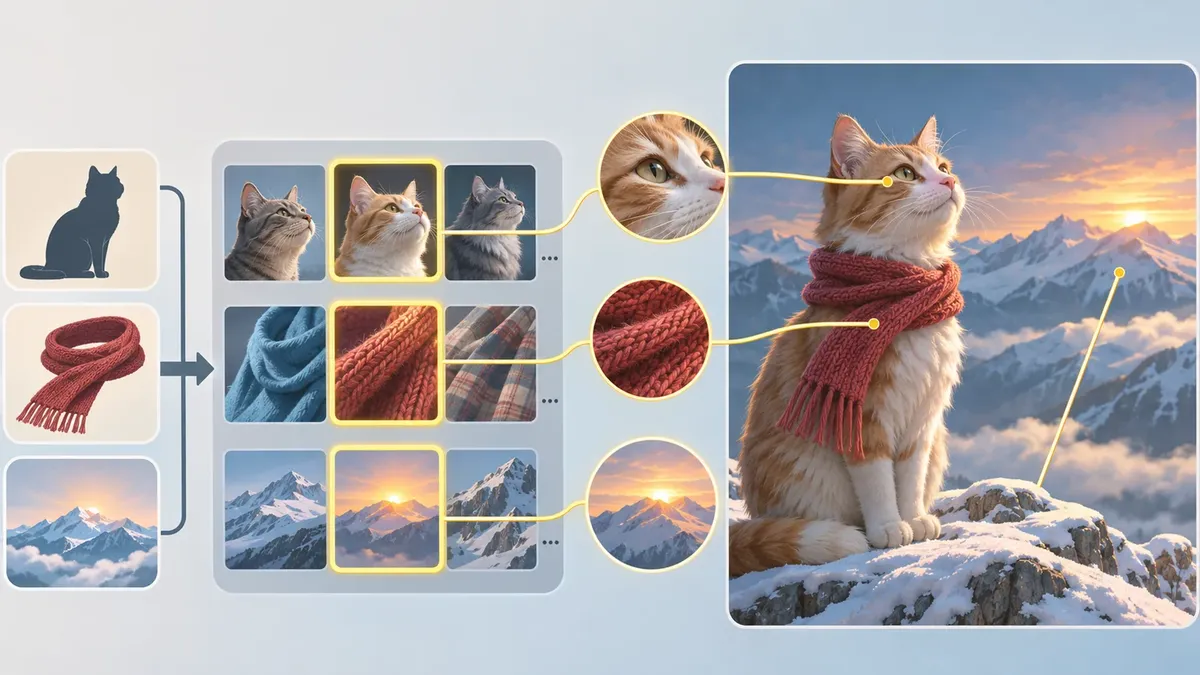
A single reference image may not contain every detail in a complicated prompt. Cross-modal RAG tries to solve that problem by splitting the prompt into smaller requests, finding images that match different parts, then telling an image generator which details to use from each one.
Text-to-image systems can produce striking images, but they may struggle with unusual subjects, precise attributes or combinations of details that were not well represented in their training data. Retrieval-augmented generation (RAG) offers one possible aid: before generating, a system searches an external image collection for useful examples.
The challenge is that a single retrieved image may match only part of a request. A prompt might describe a particular vehicle, a specific toy on its roof, a storefront and an unusual setting. Searching for the whole prompt at once can return several images that share the most obvious elements while missing the less common ones. And if the generator is simply shown those images, it may borrow irrelevant features as well as useful ones.
In Cross-modal RAG: Sub-dimensional Text-to-Image Retrieval-Augmented Generation, Mengdan Zhu and colleagues propose a system designed to match and combine details at a finer level. The work is an arXiv preprint; the source material provided here does not establish that it has been peer reviewed.
Breaking a prompt into parts
The method first uses a language model to divide a query into subqueries, each describing an aspect such as an object or an attribute. It also represents candidate images in terms of those aspects. A learned adapter built on a pretrained CLIP image encoder produces visual representations aligned with the subqueries, rather than treating each image as one undivided unit.
Retrieval then combines two approaches. A sparse, text-based stage checks whether image captions contain the subqueries. A dense stage compares learned visual representations with text representations, aiming to capture semantic matches that may not be expressed in exactly the same words. The system uses a multi-objective selection procedure to find images that offer different useful matches, rather than simply choosing the images most similar to the full prompt overall.
Finally, a multimodal language model receives the original prompt and the selected images, along with instructions identifying which subqueries each image satisfies. The intention is to preserve the relevant contribution of each reference while avoiding unrelated details.
What the tests report
The researchers evaluated image retrieval on MS-COCO and Flickr30K, and image generation on WikiArt, CUB bird images and ImageNet-LT, a dataset with a long-tailed distribution of categories. For retrieval, they report that their sub-dimensional dense retriever scored higher than the tested baselines on Recall@1, @5 and @10 in both retrieval datasets. Recall measures how often a relevant image appears among the first specified number of results.
For generation, the authors report that Cross-modal RAG achieved the highest scores among the compared methods on the three generation datasets, using image-similarity measures and, for WikiArt, a style measure. In an ablation test using the GPT Image generator, removing retrieval or either of the two retrieval stages reduced the reported scores across the datasets. The paper also describes tests with a different generator, LaVIT, in which adding the retrieval framework improved its scores on the reported measures.
These results suggest that, on the evaluated tasks and datasets, selecting references by prompt component can help both retrieval and generated-image similarity. They do not show that the approach will improve every prompt, image model or real-world application. The generation metrics compare image representations with ground-truth images; they are not a complete measure of whether people find an image faithful, useful or aesthetically successful.
What remains uncertain
The approach depends in part on breaking prompts into sensible subqueries. The authors manually reviewed samples of these decompositions and found some errors, including modifiers treated as separate entities and occasional omissions. Such mistakes could affect what the system retrieves and what it tells the generator to preserve.
The sparse retrieval stage also assumes that candidate images have captions. The paper notes that captions may be missing, noisy or incomplete. The dense stage can work directly from image representations, but bypassing sparse filtering may add computational cost. And, like other retrieval-based systems, this one cannot find useful evidence if its image database contains no relevant examples.
The reported results come from the authors’ chosen datasets, models, baselines and evaluation measures. They are evidence for performance under those experimental conditions, not a guarantee of broader reliability. The preprint should be read as a research proposal with promising benchmark results, rather than as settled evidence about image-generation systems in general.
- image generation
- retrieval-augmented generation
- multimodal AI
- image retrieval
- computer vision
Reviewed cross-references
These connections were reviewed by a model, not independently fact-checked by a human. Similarity does not imply agreement; consult the original papers and the evidence below.
Finding the right circuit, whether it’s drawn, described or coded
Shared method: Both papers use retrieval-augmented generation: Cross-modal RAG conditions image synthesis on retrieved images, while AnalogRetriever supplies retrieved circuit references to AnalogCoder. Their retrieval designs and application domains differ, so this connection is limited to the shared RAG method.
Model review: · openai-codex/gpt-6-luna
Evidence and provenance
Selected excerpts, not complete papers. PDF extraction can omit figures or damage equations, tables and reading order; sources may be preprints.
2505.21956v4 — Original paper
Excerpt reference:
static/papers/2505.21956v4.md:147-209
Basis: Paper text
Source SHA-256:404d4b914973fe1f0172a80a41e1cae2b161dabb331e3831a6a862ec69ae69602604.23195v2 — Original paper
Excerpt reference:
static/papers/2604.23195v2.md:212-271
Basis: Paper text
Source SHA-256:5d5210f61992582f3c7573a574e24b2b0b8c88c8bbbd439f60f33b8a0e96da6c
Related reading
Automatically matched by shared topic keywords. These links do not imply that the sources agree or establish a consensus.
Testing Vision-Language AI Across Seven Languages
Source published
Shared keywords: image generation, image retrieval
A Reconstruction-Based Test for AI Image Descriptions
Source published
Shared keywords: multimodal ai
Reconstruction Alignment: Teaching Models to Rebuild Images
Source published
Shared keywords: image generation, multimodal ai
Can an image generator learn from its own critiques?
Source published
Shared keywords: image generation, multimodal ai
Prism uses a model’s own text and images to guide further training
Source published
Shared keywords: image generation, multimodal ai