TRANSMISSION // 2505.14548v4
After the Storm, FEMA Aid May Help Renters Stay Housed
Source published
A Florida study links hurricanes with more evictions and finds model-based differences in eviction and payday-loan outcomes by FEMA assistance measures. The evidence has important limits.
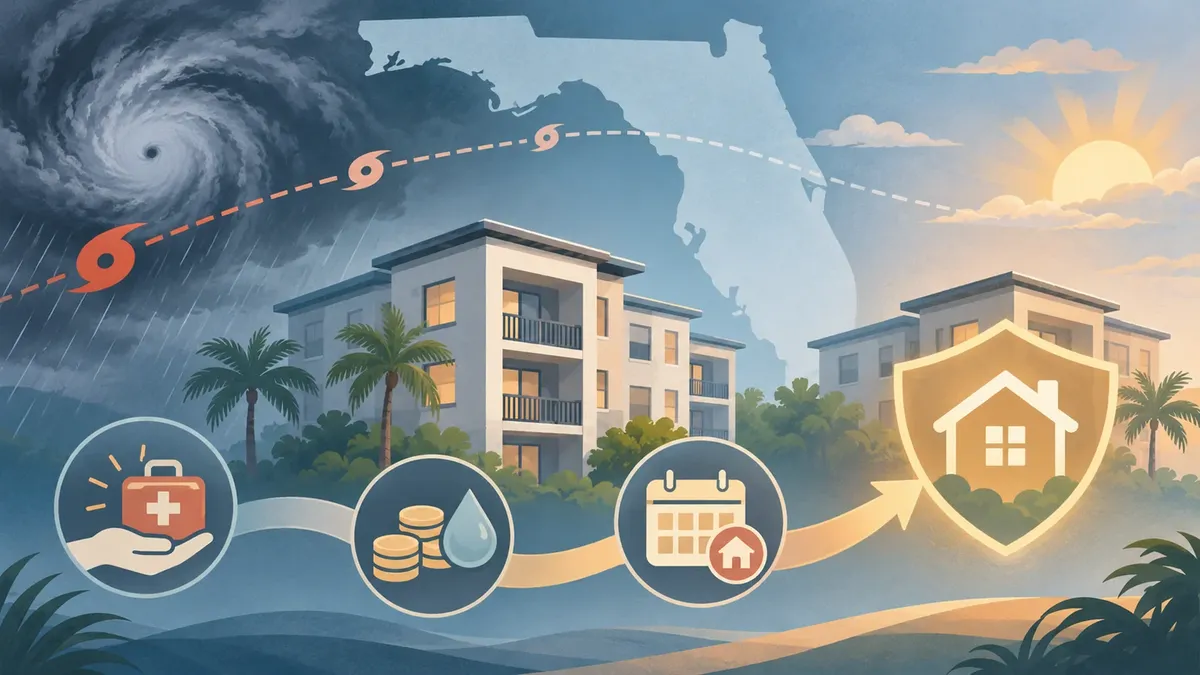
Storm damage and disrupted finances can make rent harder to pay. A working paper by Bilal Islah and Ahmed Zoulati examines how hurricanes, FEMA rental assistance and payday-loan activity relate to evictions in Florida. Its comparisons suggest a possible role for emergency aid, but do not establish that aid alone caused the differences.
When a hurricane damages a home or disrupts household finances, rent may become harder to pay just as other expenses rise. Federal emergency assistance can help with some disaster-related needs. Bilal Islah and Ahmed Zoulati ask whether Florida communities affected by hurricanes saw different eviction and payday-loan patterns depending on FEMA rental assistance.
The authors combine eviction records, FEMA assistance data, hurricane tracks and payday-loan transactions. The underlying datasets cover different periods: eviction records span 2003–2017, payday-loan records 2002–2018, and the storm-track analysis draws on Florida storms over the period studied, with forecast-cone data available from 2008 and supplementary track information used for earlier years. These coverage dates do not mean every year or every dataset contains the same storms or observations.
Comparing places near storm paths
The researchers define exposed ZIP codes by proximity to a hurricane’s path and compare them with Florida ZIP codes outside a buffer around the track. Event-study and difference-in-differences analyses compare outcomes before and after storms while accounting for place-specific differences and event-specific time changes.
For the FEMA analysis, the paper examines whether exposed ZIP codes had renters receiving assistance and separately uses county-level FEMA eligibility in an instrumental-variable approach. Eligibility is determined at the county level, while assistance also depends on individual applications and assessments. These are related but distinct measures: eligibility is not the same as receiving aid, and ZIP-code comparisons do not track every renter’s aid and housing outcome.
In the main hurricane analysis, the authors report a 10.9% increase in monthly eviction rates in exposed areas relative to the baseline. Event-study estimates show an increase lasting up to six months, with a rise around months two to five. The authors note that eviction can follow a sequence from missed rent to filing and then a court order. The estimated pattern varies with the geographic radius used to define exposure.
When the researchers include tropical storms alongside hurricanes, the combined eviction estimate is no longer statistically significant. That does not show that the effect disappeared: estimates for hurricanes and tropical storms considered separately differ, and the paper reports a positive hurricane-associated estimate at narrower exposure radii and negative estimates for tropical storms at some of those radii. Pooling event types can obscure variation in the estimates.
FEMA comparisons and payday borrowing
The paper’s comparisons by FEMA assistance measure suggest that eviction outcomes differed across exposed ZIP codes. In the ordinary least-squares analysis, the interaction between storm exposure, the post-storm period and FEMA assistance is negative at some wider radii, consistent with a smaller increase in evictions in ZIP codes with assistance. The pattern is not consistent across all radii. In the instrumental-variable estimates, several corresponding interaction estimates are not statistically significant, and signs vary by radius. The results do not support a simple claim that FEMA assistance reduced evictions in every comparison. They are model-based evidence consistent with a possible protective role, not proof that assistance caused the differences.
The authors also examine payday-loan transactions and defaults. In the overall hurricane comparison, transaction volume falls in exposed areas at several radii. In the triple-difference analysis, the estimated treatment-by-post change in transaction volume is positive at some radii but negative at the 100-nautical-mile radius in both the ordinary least-squares and instrumental-variable results. The interaction associated with FEMA assistance is negative across the reported radii. These conditional estimates should not be read as an unqualified rise in borrowing in all areas without assistance.
Defaults show a less straightforward pattern. In the triple-difference estimates, the interaction associated with FEMA assistance is positive, while the treatment-by-post estimate is negative in several specifications. The authors suggest borrower composition may help explain the pattern, but the analyses do not establish that explanation.
What remains uncertain
FEMA assistance is not randomly assigned: disaster declarations, geography, damage assessments and individual eligibility all matter. The instrumental-variable strategy uses county eligibility and its interaction with distance from the storm path to predict FEMA assistance. This is a specific attempt to address selection, but its estimates vary across geographic specifications, so they should be interpreted with that variation in view.
The study is limited to Florida and historical data; it does not evaluate current FEMA policy, and findings may not generalize to other places, disasters or policy settings. ZIP-code-level measures also cannot show whether a particular renter who received aid avoided eviction. Finally, this is an arXiv preprint, not evidence of peer review. The results suggest emergency liquidity and housing outcomes may be connected after storms, while leaving open how much aid matters, who is missed, and whether similar patterns hold elsewhere.
- FEMA
- hurricanes
- evictions
- rental assistance
- payday loans
- Florida
- disaster recovery