TRANSMISSION // 2505.12707v3
PLAICraft records multiplayer Minecraft for AI research
Source published
PLAICraft links gameplay video, audio and input events to study how people act and interact in Minecraft, then uses a limited test to evaluate AI agents.
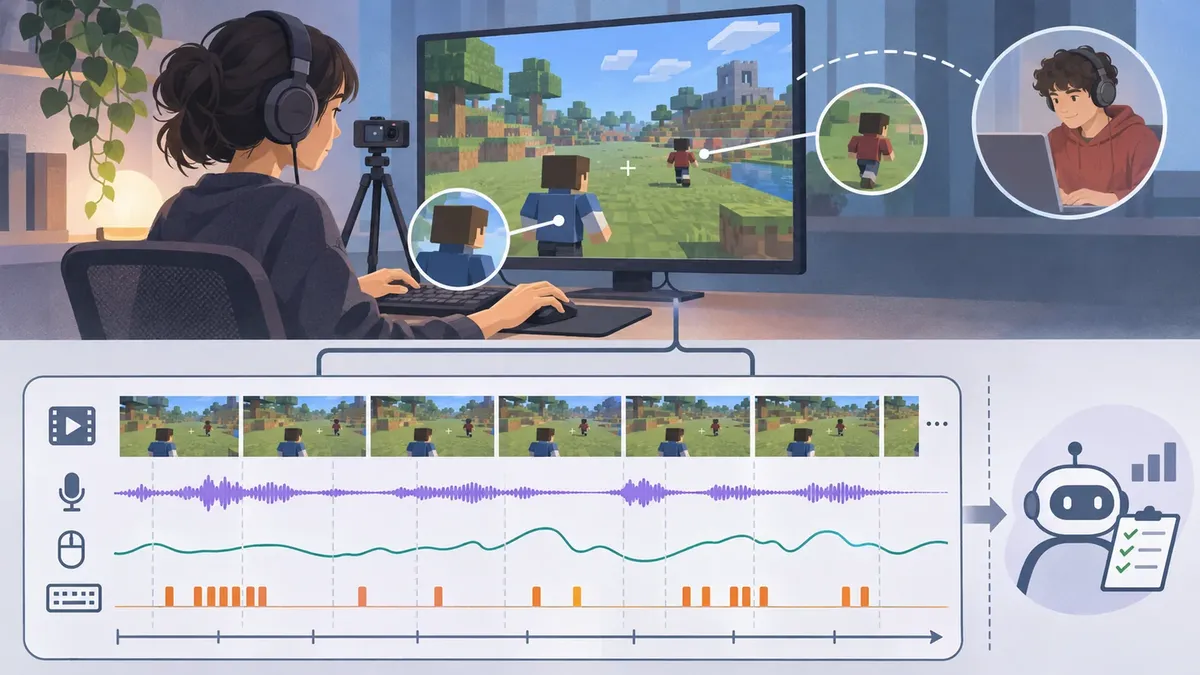
To act well, an AI agent needs to connect what it sees and hears with its actions and their consequences. PLAICraft records those streams during human multiplayer Minecraft sessions. The paper also tests agents on short prompts originally spoken by players—but gives the agents transcripts, not audio.
A dataset built around timing and interaction
Many AI systems interact through text prompts and delayed responses. But in an interactive environment, an agent must perceive events, act and adjust as things unfold. Studying that loop calls for data that connects sensory input to action over time. Other people matter too: speech, cooperation and shared surroundings can shape what an action means.
PLAICraft is a platform and dataset designed to capture these dynamics in multiplayer Minecraft. It records five streams: screen video, game audio heard by the player, microphone audio, mouse movement and keyboard and mouse-button events. The paper says the streams are timestamped to millisecond precision. The released collection contains 5,525 hours from 232 players, selected from more than 13,300 collected hours and over 18,000 participants. Only players with at least five hours of total play were included in the release, so it represents a selected subset rather than everyone who tried the platform.
The game world is persistent and open-ended: players are not assigned a specific task, and changes to the shared world can remain between sessions. Player attributes such as position and inventory also carry over, though a player can lose inventory and experience upon dying if those items are not recovered soon enough. Participants could explore, build, fight, trade and talk through proximity-based voice chat. These recordings may help researchers study how actions, speech and social context fit together, rather than only how someone completes a preset challenge.
Recording play, then testing agents
Players accessed Minecraft through a browser-connected virtual machine. The researchers recorded video at 30 frames per second and audio at 48 kHz. Mouse and keyboard events were logged event-by-event, with a maximum polling rate of 100 Hz—not as a continuous stream sampled at every moment. The paper describes aligning the recordings to a common start time and reducing the delay between logged inputs and their effects in the game.
The researchers processed the speech data as well. They used speaker-identification tools to isolate the participant’s voice in microphone recordings, removed overlapping or other speakers’ speech from that track, and generated transcripts. Some utterances were filtered out based on language or audio-quality criteria. For analysis, an LLM labeled transcript segments with categories such as whether they were interactive or gameplay-related. The paper also describes using automated assessments of social interaction to award players extra solo play time. These are distinct uses of automated analysis, not a complete set of human annotations.
The authors provide an evaluation suite of short, time-bounded prompts intended to probe abilities including object recognition, spatial understanding, memory and responses to instructions. But their experiment did not test the four agents across all those abilities. It focused on keypress prompts. Because the tested agents could not handle the full audio-and-speech setting, researchers replaced spoken instructions with transcripts. Each agent predicted a brief action, which was compared with the human player’s keypress in the corresponding response window.
Across 10 keypress prompts and 100 runs per model, OpenHA produced the exact requested key 17 times and JARVIS-VLA did so once; the other two tested models did not produce the exact requested key in those runs. In this evaluation, many predictions contained no keypress, while some included movement keys unrelated to the instruction. These results describe a specific test setup, not a general performance rate for all AI systems or a test of full conversational teamwork.
What the results do—and don’t—show
PLAICraft’s main contribution is a resource for research, not evidence that it has produced human-level agents. Its synchronized recordings could support work on imitation learning, memory, social interaction and real-time control. The keypress experiment illustrates one way to use the data to examine whether an agent’s action matches an instruction.
There are important limits. Minecraft is a game, and performance there does not establish that an agent will behave reliably in a physical environment. Participants were self-selected volunteers, play time was unevenly distributed, and the five-hour threshold further narrows the released sample. The paper also notes occasional conflict and property damage despite moderation. Rich recordings, especially audio, can raise privacy concerns even when identifying information is removed; the authors acknowledge that full anonymization is difficult.
PLAICraft is described in an arXiv preprint. A preprint is a public research manuscript, not by itself evidence of peer-reviewed validation. The results should be read as the authors’ report of a dataset and an initial, limited evaluation—not proof that current agents generally cannot follow instructions or that this dataset will necessarily make future systems more capable.
- PLAICraft
- embodied AI
- Minecraft dataset
- multimodal data
- social interaction
- AI evaluation
Reviewed cross-references
These connections were reviewed by a model, not independently fact-checked by a human. Similarity does not imply agreement; consult the original papers and the evidence below.
A shared virtual world for studying human–AI teamwork
Shared method: Both use shared multiplayer Minecraft environments in which spoken communication and physical actions can occur concurrently. PLAICraft records human gameplay across aligned audio and action streams, whereas EMIP provides interfaces for humans and AI agents to interact; this is a shared interaction setup, not evidence that either approach improves cooperation.
Model review: · openai-codex/gpt-6-luna
Evidence and provenance
Selected excerpts, not complete papers. PDF extraction can omit figures or damage equations, tables and reading order; sources may be preprints.
2505.12707v3 — Original paper
Excerpt reference:
static/papers/2505.12707v3.md:102-163
Basis: Paper text
Source SHA-256:8f67985c0925599ed1584beb207c7b4f19d07ef584de5df8f491d8bd5c2eea8b2611.29333v1 — Original paper
Excerpt reference:
static/papers/2611.29333v1.md:129-167
Basis: Paper text
Source SHA-256:2a5ca1f2fb1c34280ca5d67f00a1c3f2fa89a2e351082414c038444cd5ec8146
Related reading
Automatically matched by shared topic keywords. These links do not imply that the sources agree or establish a consensus.
Robot safety looks different outside the chat window
Source published
Shared keywords: ai evaluation, embodied ai
Virtual shopping benchmark tests whether AI can recommend, listen and guide
Source published
Shared keywords: ai evaluation
When a Robot Experiment Becomes Scientific Evidence
Source published
Shared keywords: embodied ai
When should a robot look ahead before moving?
Source published
Shared keywords: embodied ai
How CoverMem helps embodied AI remember useful views
Source published
Shared keywords: embodied ai