TRANSMISSION // 2504.14015v3
How ‘causal pieces’ could help explain spiking neural networks
Source published
A framework for mapping which subnetworks cause output spikes is linked to final test accuracy in the authors’ reported training experiments.
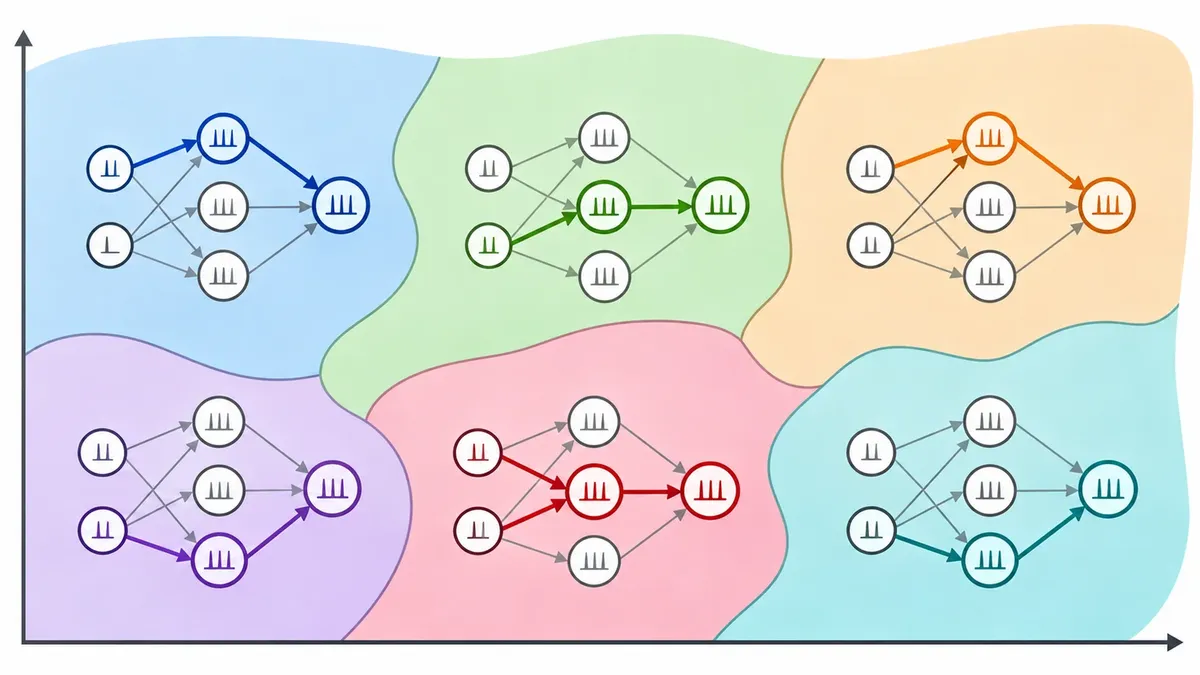
In a spiking neural network, changing an input can alter a neuron’s spike time, change which earlier spikes contribute to it, or stop it from firing. Dominik Dold and Philipp Christian Petersen propose “causal pieces” to analyze these changes. In experiments on three classification benchmarks, the number of pieces represented in training data at initialization correlated with final test accuracy.
Spiking neural networks (SNNs) communicate through discrete events called spikes. In time-to-first-spike coding, a neuron’s first spike time carries information. But spike timing can be discontinuous: a small change in an input or network parameter may alter which incoming spikes contribute to an output, or whether that output spike occurs at all. This makes SNNs difficult to analyze with tools that assume smoother behavior.
Dominik Dold and Philipp Christian Petersen introduce causal pieces, a way to describe this structure. Their idea is inspired by linear pieces, used to study the expressivity and trainability of ReLU-based artificial neural networks. In those networks, different regions are associated with different linear functions. For an SNN, a causal piece is instead a region of input and parameter space in which the same causal subnetwork produces the output spikes.
What changes at a boundary?
A neuron’s causal set consists of the earlier-spiking neurons whose inputs contribute to its spike. In a deeper network, the causal subnetwork traces those contributions back through layers. A causal piece groups inputs and parameters that produce the same causal subnetwork—not simply cases where a generic group of connections is active.
For current-based LIF neurons in the large-membrane-time-constant regime analyzed theoretically, the authors prove that output spike times are locally Lipschitz continuous within a causal piece. In accessible terms, changes in inputs or weights produce bounded changes in spike times while the causal subnetwork stays fixed. Crossing into another piece can bring a discontinuous change, or a spike can disappear. The framework accounts for these transitions rather than assuming they do not occur.
The authors also prove a lower bound on approximation error that depends on the number of causal pieces for a specified class of feedforward networks. This makes piece count a theoretical measure of expressivity under the theorem’s assumptions. It does not show that a high count guarantees a good approximation or successful training.
How the authors tested the measure
The main theory concerns feedforward networks with single-spike coding and current-based LIF neurons in the large-membrane-time-constant limit, also called nLIF. The experiments examine nLIF networks and standard single-spike LIF neurons with finite membrane time constants. For the latter, the evidence is simulation-based; the paper does not prove that the same theorem holds for them.
The researchers counted the distinct causal pieces containing at least one training sample. These are data-based counts, not counts of every piece across the full input space. They compared the count before training with final test accuracy after training. The reported classification benchmarks were Yin-Yang, Fashion-MNIST, and EuroSAT. Inputs were encoded as spike times; image pixel values were converted into latencies. Networks were trained using exact gradients of analytically calculated spike times.
Across the reported configurations, higher initial piece counts were strongly correlated with higher final test accuracy. The paper reports this relationship for both nLIF and simulated finite-time-constant LIF networks. This is an association in those experiments, not evidence that increasing piece count alone causes accuracy to improve or that it predicts outcomes for every SNN.
The authors also tested SNNs whose hidden spiking-network weights were positive, alongside a linear readout that could have positive and negative weights. These networks formed many causal pieces and achieved performance comparable to fully connected artificial networks on the reported tasks. This result concerns those model and task configurations; it does not mean the whole network had only positive weights.
What remains open
The paper’s scope is specific: feedforward networks, single-spike coding, and the reported static classification experiments. It does not establish its results for recurrent networks, surrogate-gradient training, or arbitrary multi-spike dynamics. The authors cite a transference principle that supports an approximation-bound extension and an implied notion of causal pieces for multi-spike settings; they do not directly establish the framework for general multi-spike SNNs.
Causal pieces could offer researchers a way to inspect how a network’s input-to-output pathways vary and to study initialization choices. Whether the measure will be useful across other architectures, training methods, or applications remains an open question. This article is based on the arXiv preprint record and its supplied paper text. The paper also labels an OpenReview version as a published version, but that designation alone does not establish peer-review or publication details here.
- spiking neural networks
- causal pieces
- neural network expressivity
- LIF neurons
- neural network initialization
Related reading
Automatically matched by shared topic keywords. These links do not imply that the sources agree or establish a consensus.
Can One Network Borrow Another’s Learning Bias?
Source published
Shared keywords: neural network initialization
A spiking network learns to forecast connected signals
Source published
Shared keywords: spiking neural networks
When Spiking and Standard AI Train Together
Source published
Shared keywords: spiking neural networks
MADSNet turns spike-camera signals into images
Source published
Shared keywords: spiking neural networks
Spiking AI estimates power-converter wear from current signals in simulations
Source published
Shared keywords: spiking neural networks