TRANSMISSION // 2503.08645v2
A pulse shape that quiets lingering flux signals
Source published
A two-tone flux pulse suppressed lingering control-line effects in one superconducting processor, including when the line’s decay time was overestimated.
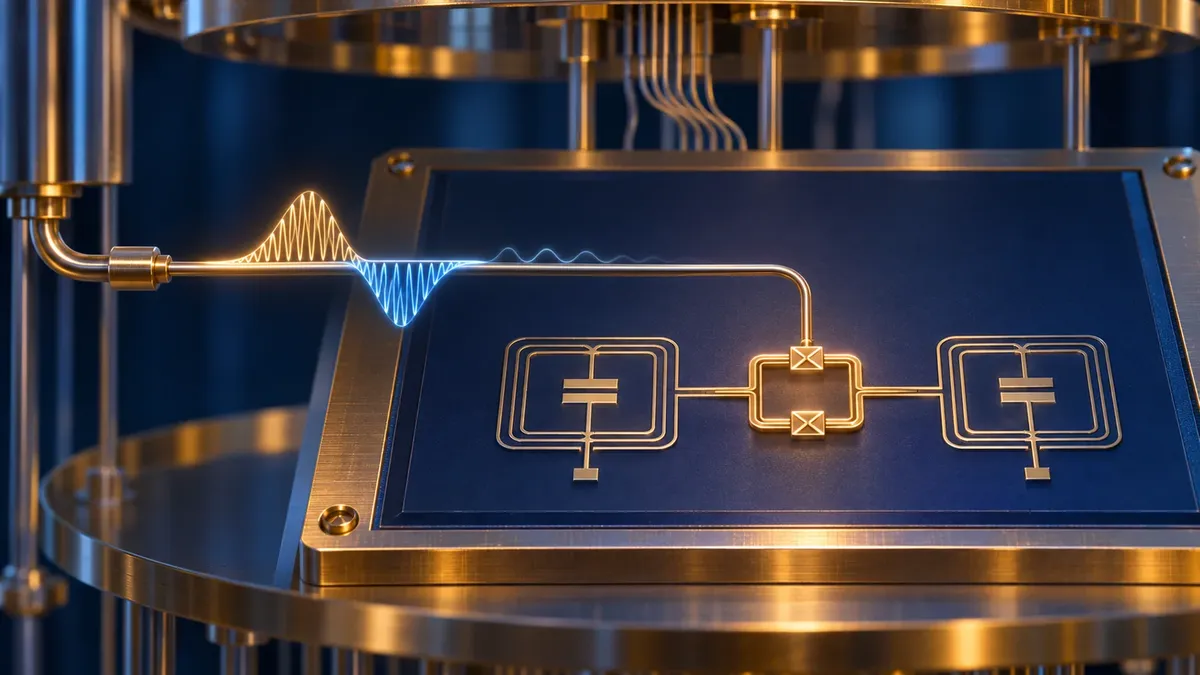
Flux pulses can leave electrical after-effects that disturb later operations on a quantum processor. Researchers tested a specially shaped pulse, designed within a class of net-zero signals, and found evidence that it reduced lingering transients in a tunable coupler.
A control pulse does not always stop affecting a quantum processor when the pulse itself ends. In superconducting processors, current sent through a flux-control line changes the frequency of a qubit or coupler. The line’s response can continue after the pulse, potentially shifting frequencies during later operations.
The paper attributes the dominant long-time effect in its setup to high-pass filtering in the control wiring. It also identifies a slower component that may have a different origin. Correcting distortions often involves characterizing a line and compensating for its response, a process that can be complex as the number of control lines grows. Anuj Aggarwal and colleagues investigated whether pulse design could reduce long-lived transients without precisely measuring the line’s response.
Designing around the line’s response
The researchers modeled the relevant part of the flux-control line as a first-order RC circuit: a simplified arrangement of resistance and capacitance. In this model, a pulse produces a capacitor response that can persist after the input ends. The team derived a condition for choosing pulse components so that this residual response is suppressed.
The proposed rule applies within the class of net-zero pulses—signals whose positive and negative parts balance to give zero net area—and is intended for non-modulated, low-frequency flux pulses. The authors emphasize that zero net area at the signal generator is not enough on its own: the capacitor’s response must also balance appropriately to suppress the modeled transient.
As a practical example, they studied a two-frequency sine pulse, combining a component with another at twice its frequency. Their theoretical analysis considered how the design performs when the decay time assumed during pulse design differs from the actual time constant.
Testing a coupler through a neighboring qubit
The experiment used a device with two fixed-frequency transmon qubits and a flux-tunable coupler. Since the coupler had no dedicated readout resonator, the researchers used a neighboring qubit as a probe. A Ramsey measurement—an interference technique sensitive to changes in qubit frequency—tracked the effects of the coupler’s flux pulse after the pulse ended.
The team measured the transient response and estimated its dominant decay time. They then tested the two-frequency pulse with different assumptions about that time. When the decay time used in the design was overestimated by factors of 10 and 100, the resulting phase distributions showed no statistically significant shift relative to the zero-pulse reference in the reported comparison. Underestimating the time produced larger residual effects.
For the pulse conditions and device tested, the authors also found that a single-frequency sine pulse produced larger transients than the two-frequency pulse. That comparison should not be read as a general ranking of pulse types: it concerns the specific signals and setup in this experiment.
The paper separately reports a two-qubit controlled-Z gate demonstration using a bi-harmonic pulse without predistortion. It reports a gate fidelity of 99.44(4)% for a duration of 180 nanoseconds. This result shows an application in the tested device; it does not establish that the pulse design improves gate performance across processors or operating conditions.
What the result does—and does not—show
The evidence supports a focused conclusion: a pulse-design rule derived from a simple RC model suppressed the dominant long-time transient in the tested setup, even without an exact estimate of the model’s decay time. The authors describe the method as complementary to predistortion, not a replacement for it.
The model does not capture every observed effect. Measurements extended to 300 microseconds revealed a second component with a decay time of 67 microseconds, which the authors suggest may be associated with an impedance mismatch. The first-order model describes the dominant response but not all long-time behavior. The study therefore does not show that the method eliminates every transient or distortion in a flux-control line.
The work is reported as an arXiv preprint, and the available source does not establish its peer-review or publication status. Its experimental evidence comes from one processor and particular pulse conditions. Tests on other devices and more complex control lines would be needed to assess how broadly the approach applies.
- superconducting qubits
- quantum processor
- flux control
- control pulses
- signal transients
- tunable couplers
Reviewed cross-references
These connections were reviewed by a model, not independently fact-checked by a human. Similarity does not imply agreement; consult the original papers and the evidence below.
A quieter route to tunable light–matter interactions
Supporting evidence: Both works show that flux-line response affects superconducting-circuit control: Aggarwal et al. model long-time transients and experimentally mitigate them with a pulse-design criterion on a tunable coupler, while the thesis reports correcting step-pulse distortions with calibrated IIR/FIR filters for a tunable transmon. The results are compatible evidence that line-response compensation can improve control in these specific setups, not a direct comparison of the two techniques.
Model review: · openai-codex/gpt-6-luna
Evidence and provenance
Selected excerpts, not complete papers. PDF extraction can omit figures or damage equations, tables and reading order; sources may be preprints.
2503.08645v2 — Original paper
Excerpt reference:
static/papers/2503.08645v2.md:75-126
Basis: Paper text
Source SHA-256:9d0583bfc0cc3fbc4c6fd265d03a1336cc39a1f790e5c43e1f91a096fd7270672503.08645v2 — Original paper
Excerpt reference:
static/papers/2503.08645v2.md:868-947
Basis: Paper text
Source SHA-256:9d0583bfc0cc3fbc4c6fd265d03a1336cc39a1f790e5c43e1f91a096fd7270672611.10295v1 — Original paper
Excerpt reference:
static/papers/2611.10295v1.md:8476-8608
Basis: Paper text
Source SHA-256:cdcb30fc231cd6af122b11d71852b956f69bb45324af79570d255f86c1c0a460
Related reading
Automatically matched by shared topic keywords. These links do not imply that the sources agree or establish a consensus.
Slow drives could connect distant superconducting qubits through a shared cavity
Source published
Shared keywords: superconducting qubits
A built-in energy drain could help superconducting qubits reset quickly
Source published
Shared keywords: superconducting qubits
A 10-kilometre optical link delivers control to superconducting qubits
Source published
Shared keywords: superconducting qubits
A quantum processor watches electric strings spread
Source published
Shared keywords: superconducting qubits
When a Quantum Computer Finds Good Answers—but Misses the Best Ones
Source published
Shared keywords: superconducting qubits