TRANSMISSION // 2502.11568v2
Could self-interacting ultralight dark matter ease the Hubble tension?
Source published
A proposed dark-matter field could briefly behave like radiation in the early universe, shrinking a cosmic distance scale. The resulting Hubble shift is only a background-level estimate, not a tested solution.
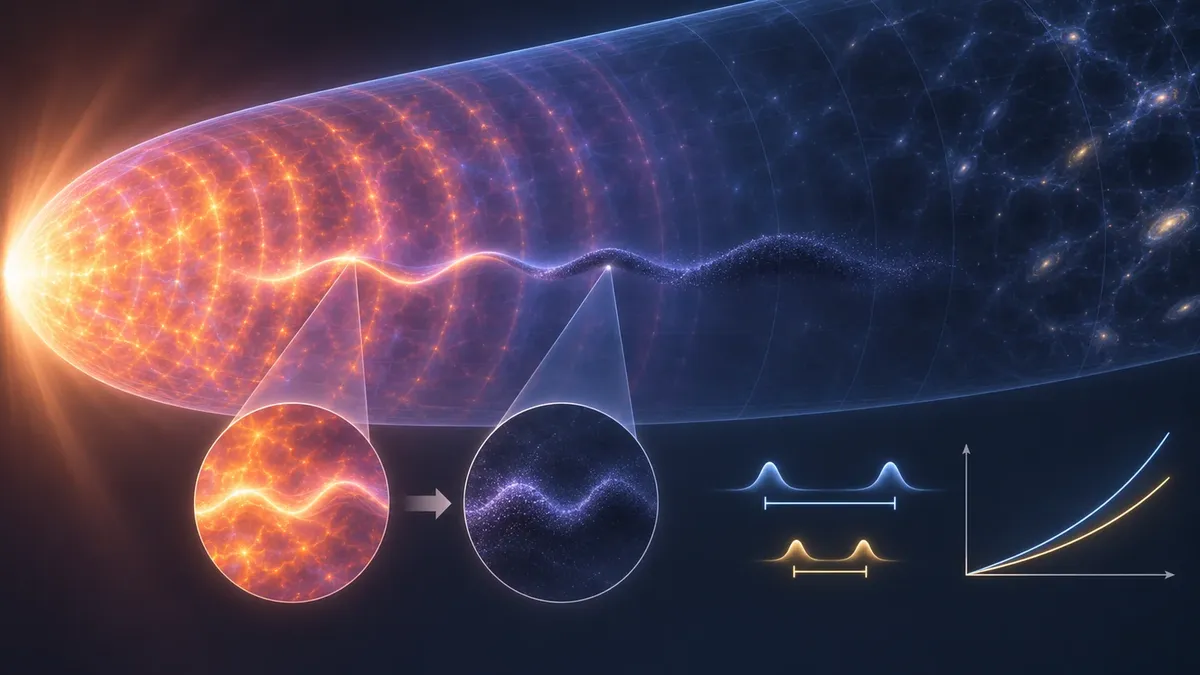
The Hubble tension is a mismatch between estimates of how fast the universe expands today. Jae-Weon Lee explores whether one ultralight dark-matter field, with a self-interaction, could alter the early universe in a way that shifts the value inferred from the cosmic microwave background. The paper presents a simplified calculation, not a full test against cosmological observations.
Cosmologists infer today’s expansion rate, the Hubble constant, in different ways. Measurements based on nearby objects tend to give a higher value than estimates derived from the cosmic microwave background (CMB), the afterglow of the early universe, interpreted using the standard cosmological model. This mismatch is known as the Hubble tension. It could reflect new physics, unresolved measurement issues, or some combination; this paper does not settle its cause.
Jae-Weon Lee investigates a possible early-universe change involving ultralight dark matter (ULDM). The proposal is that the dark matter is a scalar field with a self-interaction. Under the model’s assumptions, the field’s behavior changes as the universe expands: while the interaction term dominates, its oscillations make its average energy density dilute like radiation. Later, when the mass term dominates, it behaves more like ordinary, pressureless dark matter.
That temporary radiation-like phase matters because it adds to the energy density before recombination, when the universe released the CMB. A faster expansion at that time leaves less time for sound waves in the tightly coupled photon–baryon fluid to travel. Their characteristic distance, called the sound horizon, becomes smaller. Since the CMB tightly constrains the apparent angular size of that distance, a smaller sound horizon can correspond to a smaller inferred distance to the last-scattering surface—and, in the paper’s background calculation, a higher present-day Hubble parameter.
The study builds a simplified, piecewise description of the field’s evolution: it is initially nearly frozen, then oscillates in a quartic potential and acts like radiation, before transitioning to a matter-like phase. The author estimates the sound horizon by integrating over this background history. To illustrate the possible Hubble response, the calculation holds selected physical densities fixed and adjusts the cosmological-constant density to keep the CMB acoustic angle at a chosen benchmark. The paper considers a characteristic energy scale around 1 electronvolt and uses a sudden transition between the radiation-like and matter-like phases.
In this illustrative setup, the paper reports that a model with a characteristic scale of 0.9 eV reduces the sound horizon by about 3% relative to its reference calculation. For a 1.5 eV example, it reports an approximately 5% increase in the calculated Hubble parameter compared with the reference background. These figures are conditional outputs of the simplified model. They are not measurements, observationally inferred values, or evidence that the proposed parameters fit the data. The sound-horizon change and the Hubble shift are also distinct quantities: the latter depends on how the rest of the background cosmology is adjusted.
That distinction is central to interpreting the result. The work is a proof of concept about the homogeneous expansion history, not a precision cosmological fit. It does not calculate the field’s perturbations in the way needed to determine its detailed effects on gravitational potentials and the CMB’s acoustic pattern. Nor does it run a full likelihood analysis comparing the model with CMB, supernova, and baryon acoustic oscillation data. The paper says such a perturbation and likelihood analysis is needed before judging whether the scenario is consistent with observations.
Other important checks remain open. The author notes that the sudden-transition approximation could introduce a non-negligible error, and that a nuclear reaction-network calculation is needed to test compatibility with Big Bang nucleosynthesis. The model’s impact on the growth of cosmic structure has not been calculated here, so compatibility with structure-formation constraints is not established. The paper also assumes that the ultralight mass is protected against potentially large corrections from unknown high-energy physics; it does not provide an ultraviolet completion.
The result is therefore a proposed mechanism, not a demonstrated resolution of the Hubble tension. A notable feature is that the field intended to make up dark matter itself supplies the temporary radiation-like contribution, rather than requiring a separate dark-sector component. Whether that economical idea survives detailed tests remains unanswered. This article is based on the arXiv preprint, which may not have undergone peer review; the paper itself emphasizes the need for further calculations and observational analysis.
- Hubble tension
- ultralight dark matter
- self-interacting dark matter
- sound horizon
- cosmic microwave background
- early universe
- cosmology
Reviewed cross-references
These connections were reviewed by a model, not independently fact-checked by a human. Similarity does not imply agreement; consult the original papers and the evidence below.
Two early-universe changes improve a fit to cosmic expansion data—but not across every test
Supporting evidence: Both papers describe an early-universe mechanism in which extra energy before recombination increases the expansion rate and reduces the sound horizon. Lee presents this as a background-level possibility for self-interacting ultralight dark matter and says a full perturbation and likelihood analysis is still needed; Uggerhøj et al. discuss the analogous effect in hot NEDE/DRMD, a different model, so their results do not establish the ULDM scenario’s viability.
Model review: · openai-codex/gpt-6-luna
Evidence and provenance
Selected excerpts, not complete papers. PDF extraction can omit figures or damage equations, tables and reading order; sources may be preprints.
2502.11568v2 — Original paper
Excerpt reference:
static/papers/2502.11568v2.md:89-130
Basis: Paper text
Source SHA-256:153ee7b7b9536e2bfd1a95330d2f2cbf8a0c6bab6c40fb6ecf1016422653dd572611.13756v1 — Original paper
Excerpt reference:
static/papers/2611.13756v1.md:623-674
Basis: Paper text
Source SHA-256:34f4ca298bacf7f6c6f4ccb3436a6fde4037b3165f0e4535fe67659879abdfd2
Related reading
Automatically matched by shared topic keywords. These links do not imply that the sources agree or establish a consensus.
The “shape wall” limits late fixes for the Hubble tension
Source published
Shared keywords: hubble tension
A late-time dark-matter supply could soften a cosmological trade-off
Source published
Shared keywords: hubble tension
Two early-universe changes improve a fit to cosmic expansion data—but not across every test
Source published
Shared keywords: cosmic microwave background, hubble tension
The ‘tail’ of early dark energy may matter for the Hubble tension
Source published
Shared keywords: cosmic microwave background, hubble tension
A Calibration Gap Challenges a Supernova-Based Hubble Constant Claim
Source published
Shared keywords: hubble tension