TRANSMISSION // 2501.01647v2
A vibrating mirror could shuttle complex quantum light
Source published
A theoretical optomechanical scheme uses a moving mirror to bring two optical cavities into resonance, potentially transferring multi-photon states. Its high-fidelity results depend on demanding assumptions and have not been experimentally demonstrated.
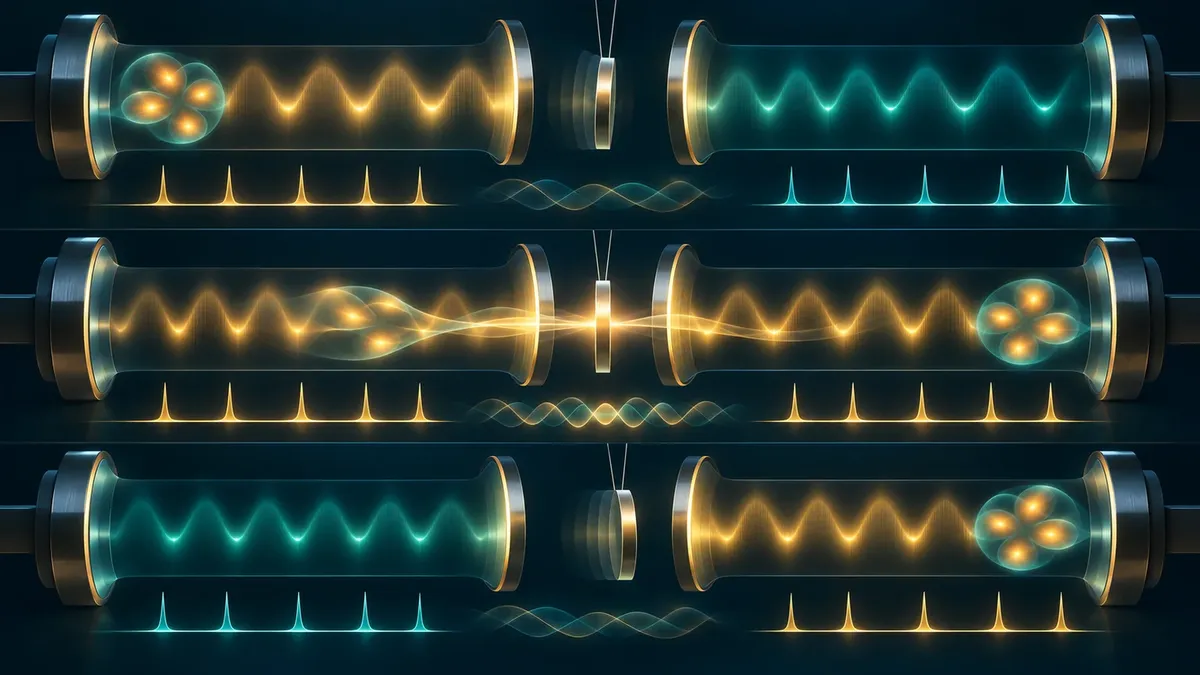
Could a vibrating mirror help move a delicate quantum state of light from one cavity to another? Xuanloc Leu, Xuan-Hoai Thi Nguyen and Jinhyoung Lee propose a theoretical approach in which radiation pressure makes the mirror’s motion tune the cavities into resonance. Their calculations suggest that this could transfer states containing many photons—but only under specific conditions, and the work is not an experimental demonstration.
Moving a quantum state means transferring its full pattern of amplitudes and phases, not merely sending energy from one place to another. That distinction matters for states such as Schrödinger-cat states, which are superpositions of distinct light fields. Many optomechanical transfer schemes use a simplified, linear interaction that is difficult to extend to states with large photon numbers. In a paper posted to arXiv, Xuanloc Leu, Xuan-Hoai Thi Nguyen and Jinhyoung Lee explore a different route: using a vibrating mechanical element to tune two optical cavities into resonance.
A moving mirror as a resonance switch
The model contains two optical cavities separated by a slightly transparent, movable mirror. The mirror acts as a mechanical oscillator. Because its position affects the cavities’ frequencies, its motion can reduce their frequency mismatch and briefly bring them into resonance. At that point, light can pass between the cavities.
The authors call this phonon-induced dynamic resonance. In their proposed cycle, photons in the first cavity exert radiation pressure on the mirror. The resulting motion brings the cavities into resonance, allowing the optical state to transfer to the second cavity. The mirror’s motion then changes the resonance again. The proposal does not require an externally driven switch; the interaction between the light and mirror shapes the motion that tunes the cavities.
This is a nonlinear optomechanical proposal, rather than the linearized beam-splitter approach often used in earlier schemes. The authors’ aim is to extend transfer beyond states with only a few photons.
What the researchers calculated
The paper develops a model for the three interacting modes: two cavity fields and the mechanical oscillator. To make the transfer problem tractable, the authors treat the oscillator as having a large, mostly classical motion, and assume that the optical dynamics follow the changing cavity modes adiabatically—that is, slowly enough to track their evolving resonances. They also assume weak direct coupling between the cavities.
They derive expressions for how the optical field moves between cavities and for the fidelity of transfer: how closely the final state matches a specified target. They examine examples including Fock states, displaced squeezed states and Schrödinger-cat states. The analysis considers two targets: one with the original phase, and another that includes the predictable phase accumulated during transfer. That phase can, in principle, be accounted for by choosing a suitable detection frame or applying a calibrated phase shift.
The calculations indicate that, in the idealized, no-damping case, the proposed mechanism can transfer these example states with high fidelity. The paper reports fidelities up to 0.99 for its chosen parameters, which require operation in an ultrastrong optomechanical-coupling regime. Its results also show a trade-off: as the photon number rises, high fidelity requires tighter constraints on the ratio of cavity coupling to the initial frequency mismatch. Simply increasing photon number does not guarantee an equally faithful transfer.
What remains uncertain
The central limitation is that the headline results rely on approximations. The mechanical oscillator is treated semiclassically, with its quantum and thermal fluctuations neglected in the main fidelity analysis. The ideal state-transfer calculations also omit damping and noise. The paper estimates damping effects separately, but notes that a measure of optical amplitude transfer is not the same as full quantum-state fidelity when losses are present.
The authors identify further practical requirements, including slow mechanical motion relative to optical dynamics, weak cavity-to-cavity coupling and, when damping is considered, a resolved-sideband condition. They argue that suitable parameters may be possible in some platforms, but also describe the required combination as a challenge for current research. Their suggestion that counter-diabatic control might relax the adiabatic requirement is a proposed direction, not a demonstrated result.
Most importantly, this is a theoretical study, not a laboratory demonstration. The authors explicitly leave a full treatment of dissipation and effects neglected by the approximations for future work. The arXiv record identifies the paper as a preprint; the supplied source does not establish peer-review status. The calculations therefore describe a possible transfer mechanism under stated assumptions, not evidence that a device has already transferred large Schrödinger-cat states this way.
The proposal’s significance is consequently conditional: it offers a way to think about moving complex optical states by dynamically tuning resonances, while making clear how much depends on controlling mechanical motion, loss and phase. Whether those requirements can be met together in an experimental system remains an open question.
- quantum state transfer
- optomechanics
- optical cavities
- Schrödinger-cat states
- quantum optics
- mechanical oscillator
Related reading
Automatically matched by shared topic keywords. These links do not imply that the sources agree or establish a consensus.
A geometric route to quantum state transfer
Source published
Shared keywords: quantum state transfer
Weaker end connections could improve quantum energy transfer
Source published
Shared keywords: quantum state transfer
Why a gentler temperature gradient may not improve a quantum-light cavity
Source published
Shared keywords: optical cavities
A hybrid cavity could let light read a molecule’s vibrations
Source published
Shared keywords: quantum optics
How unequal cavity losses could steady single-photon emission
Source published
Shared keywords: quantum optics