TRANSMISSION // 2412.03650v2
A driven superconducting circuit could correct its own quantum errors
Source published
A theoretical proposal uses a strongly driven resonator and a carefully filtered environment to remove quantum errors through dissipation. Calculations suggest substantial lifetime gains, but the device has not been demonstrated experimentally and important noise sources remain unresolved.
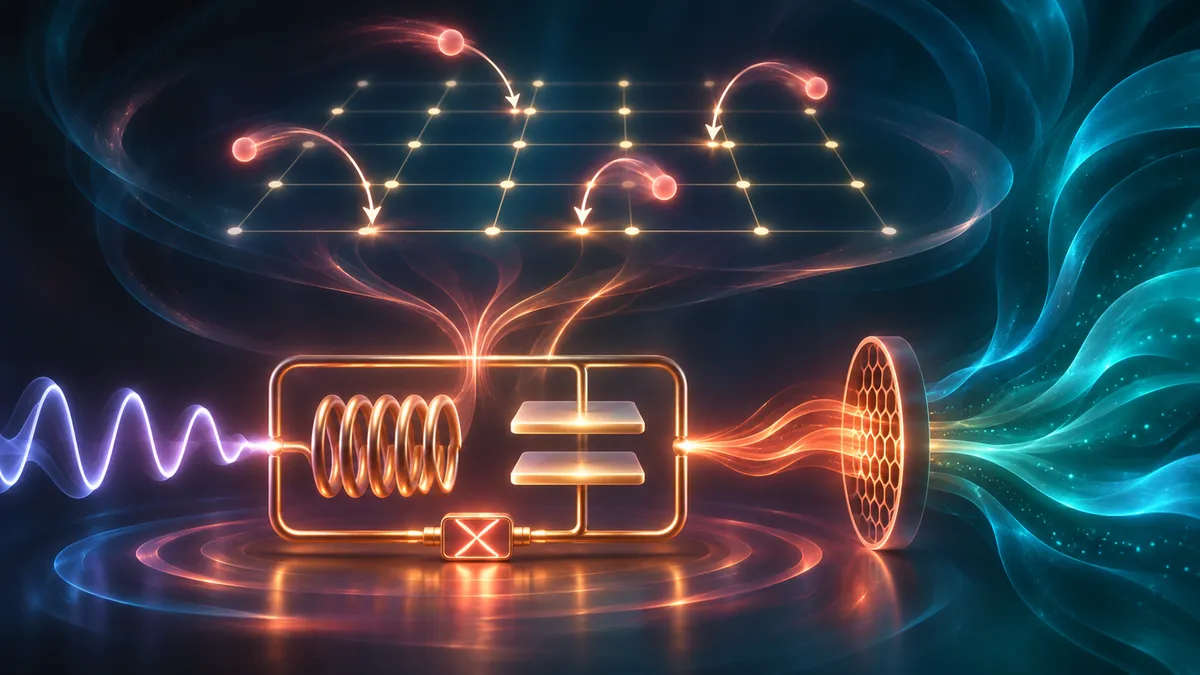
Energy loss usually threatens quantum information. Max Geier and Frederik Nathan propose turning a controlled form of that loss into protection: a superconducting circuit that continuously sheds error-related energy while preserving an encoded qubit.
Encoding information in a grid
The proposal stores one qubit in an LC resonator, a circuit containing an inductor and a capacitor that exchange electromagnetic energy. Rather than assigning the qubit to just two resonator energy levels, it uses Gottesman–Kitaev–Preskill, or GKP, encoding. This spreads the information across a grid-like pattern in the resonator’s quantum state.
The grid lives in phase space: a mathematical description using two complementary variables, here superconducting phase and electrical charge. Small disturbances can shift or distort the pattern without immediately changing the encoded information. Larger disturbances can cross boundaries between logical states and cause errors.
The authors’ central idea is to make correctable disturbances cost energy. Cooling can then remove those disturbances without needing to determine whether the qubit represents zero, one or a quantum superposition. Their analysis addresses both bit errors, which exchange logical states, and phase errors, which alter their relative quantum phase.
How driving makes cooling corrective
The proposed circuit connects a high-impedance resonator to an oscillating voltage through a Josephson junction, a superconducting element that provides a nonlinear response. The required impedance is approximately 12.9 kilohms or higher. One configuration drives the junction near twice the resonator frequency.
Strong periodic driving produces an effective energy landscape that stabilizes GKP states. The authors derive this using Floquet theory, which describes periodically driven systems, together with approximations that average rapid oscillations and identify the most important moments within each drive cycle.
In this landscape, low-energy excitations can retain the same logical information while carrying increasing amounts of error-related energy. An appropriately coupled environment can drain that energy and return the resonator toward its protected operating region.
Crucially, ordinary uncontrolled damping is not enough. The environment must preferentially accept selected frequencies. This enables sideband cooling: energy exchange involving the drive favors corrective transitions over transitions that increase errors. The paper examines filters made from one or several lossy resonators.
“Self-correcting” therefore does not mean an isolated, unpowered device. Protection requires continuous driving and an engineered dissipative environment, although stabilization does not require repeated measurements and feedback decisions.
What the simulations show
To test the analytical picture, the researchers numerically calculated the driven circuit’s evolution and its coupling to the environment. They then simulated an open-system master equation using 1,000 stochastic realizations per parameter set. These calculations did not rely on the initial averaging approximations used to derive the idealized energy landscape, although they retained other modeling assumptions.
For a simulated resonator near 5 gigahertz, initially disordered states approached the GKP encoding region within roughly two microseconds. Comparisons with and without the engineered dissipation showed longer preservation of encoded information when cooling was active, despite an additional photon-loss channel.
The authors report calculations indicating coherence times around 1,000 times the resonator photon lifetime at operating temperatures above 100 millikelvin. Coherence time measures how long quantum information survives; photon lifetime characterizes energy loss from the underlying resonator. This is a predicted performance level, not a measured device result or a guarantee across all parameter choices.
Parameter sweeps reveal operating constraints. For the simulated settings, protection required resonator quality factors around or above 100,000; this dimensionless quantity measures how slowly the resonator loses energy. With the square-grid drive held fixed, error correction tolerated only about a 0.5% relative impedance deviation. The authors describe alternative waveforms that accommodate higher impedances.
Operations beyond storage
The paper also proposes protected single-qubit Clifford gates, a family of basic quantum operations, through changes to the drive. Readout would use the direction of an average supercurrent through an additional weak Josephson junction.
A separate simulation generated a magic state with approximately 90% fidelity, meaning overlap with the desired quantum state. Magic states provide a resource beyond Clifford operations. The reported fidelity exceeds the cited threshold for distillation, a procedure for converting suitable noisy resource states into cleaner ones; distillation itself was not demonstrated here.
What remains unproven
This work is an arXiv preprint presenting theory and simulations, not an experimental demonstration. The supplied evidence does not establish peer-reviewed validation.
The numerical model uses a finite representation of the resonator and a master equation valid under restricted system–environment coupling conditions. The authors acknowledge that some simulated resonances may be numerical artifacts. Finite-drive effects can also directly damage logical information.
Additional unwanted circuit modes were not included and remain an open problem. Quasiparticle tunneling can cause errors outside the protected class, while strong driving must avoid generating those excitations. The proposal therefore offers a concrete route to autonomous correction of specified noise processes—not immunity to every error or a demonstrated scalable quantum computer.
- quantum error correction
- GKP encoding
- superconducting circuits
- LC resonator
- engineered dissipation
- sideband cooling
- quantum memory
- preprint
Related reading
Automatically matched by shared topic keywords. These links do not imply that the sources agree or establish a consensus.
Quantum grid codes could extend direct secure messaging beyond 1,000 kilometres
Source published
Shared keywords: quantum error correction
Moving atoms could make globally controlled quantum computers programmable
Source published
Shared keywords: quantum error correction
A quieter route to tunable light–matter interactions
Source published
Shared keywords: superconducting circuits
A superconducting resonator routes strong microwaves without a bias
Source published
Shared keywords: superconducting circuits
GARI++ splits quantum error correction into a fast first pass and a smaller cleanup
Source published
Shared keywords: quantum error correction