TRANSMISSION // 2410.24035v3
How uncertainty can help robots adapt their movements
Source published
A robot-learning framework combines demonstrations, task context and uncertainty-aware policies. Tests on handwriting and three real-robot scenarios show promise, with important limits.
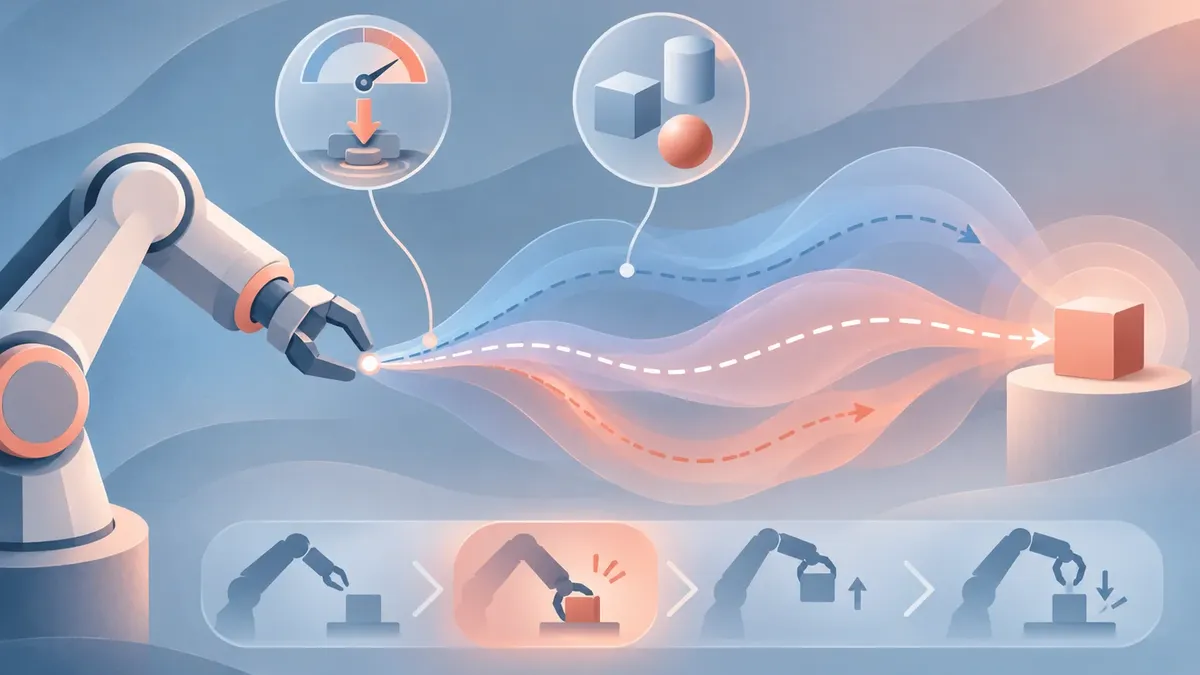
A robot taught to grasp an object may need to adjust its movement to task-specific cues, such as contact force or how an object is held. This study proposes a way to combine learned demonstrations with estimates of where the robot’s predictions are uncertain.
A robot that learns a movement from demonstrations faces two related challenges: it must adjust when task conditions change, and avoid unreliable behavior in situations unlike those in its training examples. Tim R. Winter and colleagues propose a framework that conditions learned movements on simple descriptions of the task context and blends them with additional control policies.
The work is presented as a preprint submitted to Elsevier. Although the source lists a journal DOI, the supplied material does not establish its peer-review status. The results should therefore be read as the authors’ reported findings, not as settled evidence.
Learning a movement while tracking uncertainty
The researchers use learning from demonstration: a robot learns how to perform a task from examples. Their main policy uses Gaussian process regression, which predicts actions and estimates uncertainty about those predictions. In this framework, uncertainty is intended to increase when the robot encounters inputs that are poorly represented in its demonstrations.
The policy takes the robot’s position and orientation, as well as low-dimensional task parameters. Depending on the task, these parameters can describe contact forces, an object’s shape or the phase of an action. This lets the learned movement respond to relevant task information instead of treating every attempt as an identical trajectory.
The researchers combine three policies in a “mixture of experts.” The demonstration-learning policy imitates the examples. A stabilizing policy steers toward regions of lower estimated uncertainty, generally nearer the demonstration data. A goal-attractor policy guides the robot toward demonstrated goal poses. The policies’ contributions vary with the robot’s state, estimated uncertainty and proximity to a goal.
In simple terms, the system gives more influence to learned behavior where the model has relevant examples and uses supplementary policies to shape its movement elsewhere. The stabilizing policy is not a guarantee of safe recovery: the authors report situations where it cannot recover from far-out-of-distribution states or help complete a task when task parameters are outside the demonstrated range.
Tests in simulation and with a real arm
The team evaluated the method on the LASA handwriting dataset, which contains demonstrated letter-shaped movements. Separately, they tested a real seven-degree-of-freedom robotic arm in three manipulation scenarios: grasping conditioned on fingertip forces; placing a deformable fish fillet according to how it was grasped; and grasping selected objects on a conveyor, using object identity and task phase as context.
For LASA, the paper reports that the combined method completed all trials successfully under its evaluation setup. In the two real-robot experiments summarized together in the results table, the authors report success rates of 100% for force-conditioned grasping and 95% for the deformable-food task, across 20 trials per task, with no recorded collisions in those trials. In the third scenario, the system was tested on three selected objects with variations in object and robot poses and on a moving conveyor. Outcomes varied by object and condition; these tests do not establish universal reliability.
Comparisons with other methods require care. The authors optimized the proposed system’s hyperparameters, but they also manually refined task-parameter kernel lengths for the real-robot experiments. They describe the baseline configurations as unmodified, and say they did not comprehensively tune the diffusion-policy baseline because of its computational demands. The results therefore do not show that the proposed method will outperform those alternatives across other tasks, data regimes or tuning choices.
What the results do—and don’t—show
The experiments suggest that uncertainty-guided policy blending can help a robot respond to task information while reproducing demonstrated behavior in the tested settings. But the method has important limits. Its Gaussian-process design is aimed at low-dimensional inputs and relatively small datasets. Complex sensor inputs require separate feature extraction, and inference cost grows with the amount of training data.
The authors also describe possible stalls from false attractors or competing policies, and failures when task parameters fall outside the demonstrated range. In those cases, the stabilizing policy may keep the robot near familiar demonstrations without guiding it to task completion. The paper reports collisions in some object-centric tests, with more collisions at higher conveyor speeds, and identifies limited anticipatory planning and perception errors as concerns.
These are bounded experiments on a particular robot, selected objects and laboratory setups—not evidence that the framework will work reliably in unfamiliar environments. The paper says data are available on request. Further testing across robots and tasks, alongside independent replication, would help establish how broadly the approach transfers.
- robotics
- imitation learning
- robot manipulation
- Gaussian process regression
- uncertainty-aware control
- context-adaptive policies
Related reading
Automatically matched by shared topic keywords. These links do not imply that the sources agree or establish a consensus.
Teaching robots without demanding an exact copy
Source published
Shared keywords: imitation learning, robot manipulation
Choosing Robot Policies Without Testing Every Checkpoint
Source published
Shared keywords: imitation learning, robot manipulation
A map of robot behavior helps people investigate failures
Source published
Shared keywords: imitation learning
Robot-coding agents need better failure diagnosis, not just more feedback
Source published
Shared keywords: robot manipulation
MomentMem teaches robots to save visual memories
Source published
Shared keywords: robot manipulation