TRANSMISSION // 2408.07577v3
How excited atoms could squeeze light during harmonic generation
Source published
A theoretical study finds that high-harmonic generation from initially excited atoms could produce squeezed light and, with heralding, Schrödinger-kitten-like states.
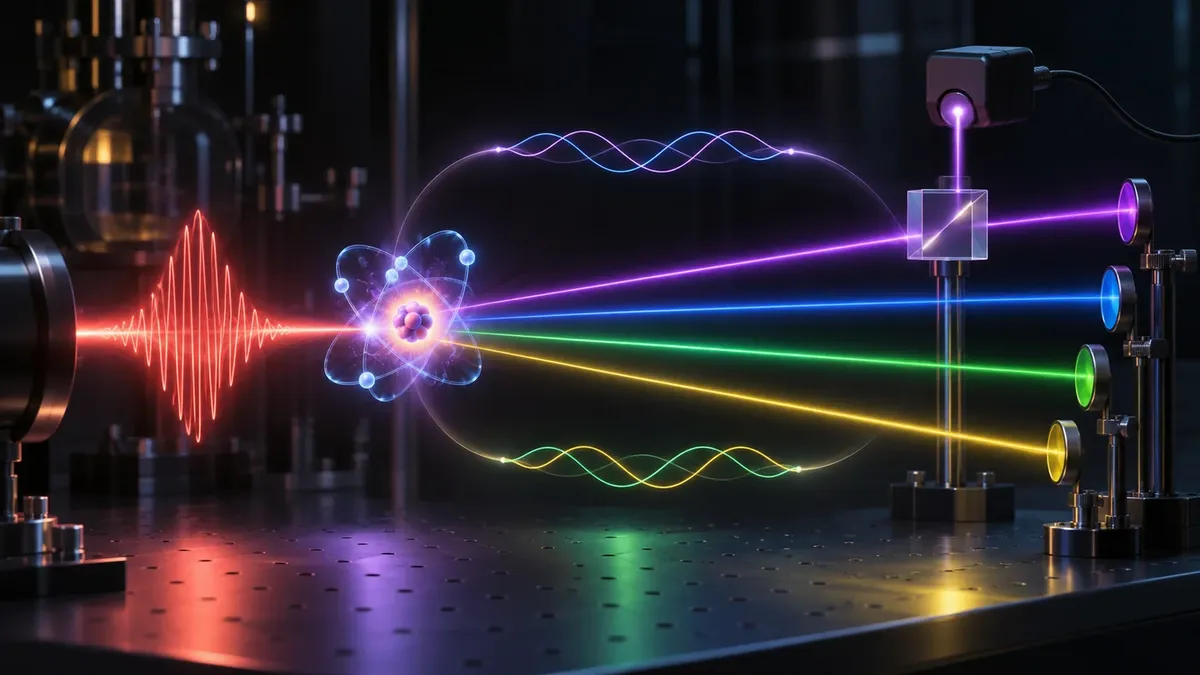
High-harmonic generation can turn infrared laser light into much higher-frequency radiation. A theoretical study asks whether preparing atoms in an excited state before this process can also shape the light’s quantum noise—and whether correlations among the resulting modes could help create unusual optical states.
The question: can harmonic generation shape quantum noise?
In high-harmonic generation (HHG), an intense laser interacts with matter and produces light at higher frequencies, potentially reaching the extreme ultraviolet. The process is usually discussed as a way to generate new light. But researchers are also exploring whether it can produce light with quantum properties useful for precision measurements or quantum technologies.
One such property is squeezing. Light has two related measures of its fluctuations, called quadratures. Squeezing reduces the noise in one quadrature below the level associated with an ordinary coherent state, while increasing uncertainty in the other. It does not remove quantum uncertainty; it redistributes it.
In this study, J. Rivera-Dean and colleagues investigate a specific possibility: whether HHG can generate squeezed light when the atoms are prepared in their first excited state before the laser interaction. Their work is theoretical, not a report of a new laboratory demonstration.
How the researchers modeled the process
The authors modeled an atom interacting with a quantized electromagnetic field, while treating the strong laser’s main driving effect in a semiclassical framework. Their initial setup places the atom in its first excited state and the laser mode in a coherent state. They then calculate how the atom and field evolve, including the effects of interactions between the atom’s ground and excited states.
For their numerical example, they use parameters based on He⁺ and a pulsed laser with an 800-nanometre central wavelength, an intensity of 10¹⁴ watts per square centimetre and a duration of about 16 femtoseconds. The calculations estimate light-field squeezing by examining how the uncertainty in different quadratures changes. The team also analyzes correlations between pairs of modes using covariance matrices and an entanglement measure. Finally, it models a heralding procedure: detecting photons in one mode to condition the state of another.
The analysis relies on approximations. Among them, the authors neglect continuum populations during the modeled evolution, use a Markov-like approximation for changes in the optical state, and assume that different atoms’ time-dependent dipole moments are uncorrelated when extending the treatment to many atoms. These choices make the calculation manageable, but also define the scope of its conclusions.
What the calculations suggest
The model predicts squeezing in both the driving field and harmonic modes. The strongest single-mode effects occur in low-order modes, particularly the fundamental mode and the third harmonic in the reported analysis. Squeezing becomes negligible for sufficiently high harmonic orders in the calculations. Its predicted strength increases with a parameter combining the number of excited atoms and the squared light–matter coupling, though the authors caution that very large values would require additional terms to be considered.
The proposed mechanism depends on the atom’s internal dynamics: interactions between its ground and excited states, mediated by a time-varying dipole moment, generate correlations in the light. The reported squeezing is especially associated with cases where the electron starts and ends in the excited state. The authors say these effects are absent when it recombines with the ground state in the scenarios they analyze.
The researchers also find two-mode squeezing—correlations between different optical modes. Their calculations identify the fundamental and third-harmonic modes as especially strongly correlated, with other pairings also showing features. They then model using one mode as a herald: detecting at least one photon there selects a conditional state in the other mode. Some resulting modeled states have Wigner functions with negative regions, a signature associated with nonclassical light. The authors describe these as optical Schrödinger-kitten-like states.
What remains uncertain
These results are predictions from a model, not experimental confirmation that the proposed squeezed or kitten-like states have been produced this way. The article itself notes that the squeezing terms are small compared with the dominant displacement of the field, so a substantial collective contribution from many atoms is important in its analysis. It also discusses how excitation fidelity and the delay between preparation and the strong laser pulse matter; if the delay exceeds the excited-state lifetime, the predicted squeezing features disappear.
The numerical results depend on simplifying assumptions and selected parameters. The authors suggest that stronger light–matter coupling, for example in a cavity, might enhance the effects, but that is a prospective idea rather than a demonstrated outcome of this study. The heralding protocol is likewise modeled, not shown as an experimental procedure carried out in this work.
The supplied source is an arXiv preprint. A preprint makes research available before or independently of peer review, so its conclusions should be treated as provisional. The paper offers a theoretical route worth testing, not evidence that HHG in excited atoms is already a practical source of these quantum states.
- high-harmonic generation
- squeezed light
- quantum optics
- excited atoms
- Schrödinger kitten states
- heralding
Related reading
Automatically matched by shared topic keywords. These links do not imply that the sources agree or establish a consensus.
How quantum-light fluctuations reshape harmonic generation
Source published
Shared keywords: high harmonic generation, quantum optics
How photon-pair graphs make NOON states
Source published
Shared keywords: quantum optics
A proposed optical “machine gun” for entangled cat states
Source published
Shared keywords: quantum optics, squeezed light
Strong Harmonic Correlations: What These Tests Show
Source published
Shared keywords: quantum optics
How squeezed light can tip the balance of electron emission
Source published
Shared keywords: quantum optics