TRANSMISSION // 2408.00585v2
What Could Northern CMB Surveys Tell Us About Primordial Gravitational Waves?
Source published
An idealized forecast finds that deeper northern-sky CMB polarization maps could sharpen searches for primordial gravitational waves—but foregrounds and real survey details remain to be tested.
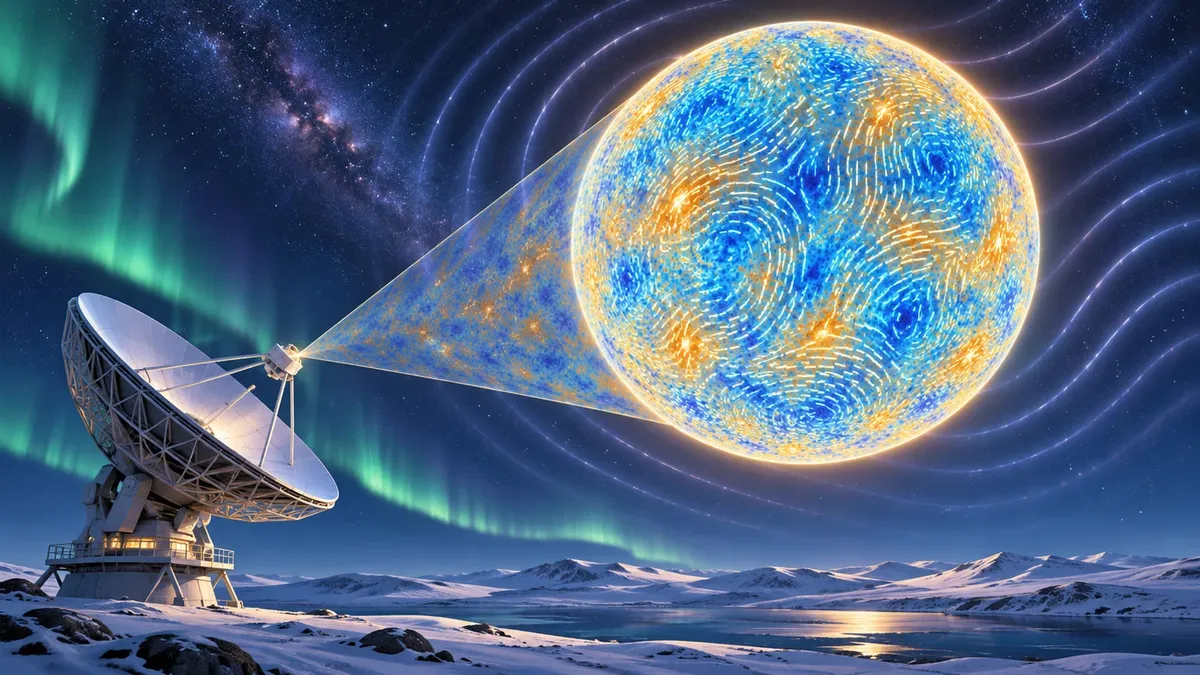
The faint B-mode patterns in the cosmic microwave background may preserve evidence of primordial gravitational waves. A study forecasts how well a telescope observing northern skies could measure their strength, and how the result depends on map sensitivity, sky coverage and access to large angular scales.
A forecast for a different view of the early universe
The cosmic microwave background (CMB) is ancient light whose polarization carries clues about the early universe. One pattern, called B-mode polarization, could be produced by primordial gravitational waves. Researchers describe the strength of these waves relative to the early universe’s density fluctuations using the parameter r. Measuring r would help test ideas about inflation, a proposed period of rapid expansion shortly after the Big Bang.
A new study asks how much a northern-sky survey could contribute to this search. Its authors build an idealized model motivated by the Ali CMB Polarization Telescope, then forecast how the uncertainty in r changes with map depth, sky coverage and the largest angular scales included in the analysis. These are projections from a model—not measurements of a detected signal.
How the forecast works
The researchers model a two-frequency survey, with channels at 95 and 150 gigahertz. Their benchmark assumes a polarization map depth of 40 microkelvin-arcminutes in each channel, an effective sky fraction of 10%, and sensitivity to angular scales corresponding to multipoles from 30 to 1,000. Lower multipoles represent larger patterns on the sky.
They generate simulated CMB power spectra for a standard cosmological model with a chosen fiducial value, r = 0.014. The simulated B-mode signal includes both a primordial contribution and lensing B modes: patterns created as gravity bends CMB light on its way to us. The forecast does not include a reduction in lensing through delensing.
To infer parameter constraints, the team uses a power-spectrum likelihood and Markov chain Monte Carlo sampling, a method that explores which parameter values fit the simulated data. They also test a combination with synthetic, Planck-like information. In the joint model, Planck-like data provide temperature, E-mode polarization and lensing information; they do not add direct B-mode measurements.
A major simplification matters: the analysis assumes that foreground contamination has been removed perfectly, leaving negligible residual foreground power. It also approximates sky coverage through an effective mode count and neglects correlations between multipoles caused by a particular sky mask.
Deeper maps and more sky improve the projected precision
For the benchmark survey alone, the forecast gives an uncertainty of 0.023 on r. Adding the Planck-like mock data reduces that to 0.015. These figures describe the modeled uncertainty around the assumed scenario, not evidence that primordial gravitational waves have been found.
The assumed map depth makes a substantial difference. When the depth is lowered to 10 microkelvin-arcminutes per channel—meaning a more sensitive map—the forecast uncertainty for the northern survey alone falls to 0.0031. In the joint configuration, it is 0.0030. In this model, the northern survey therefore supplies an increasingly large share of the constraint on r as its maps deepen. Planck-like information remains important for constraining the scalar spectral index, nₛ, which describes how the strength of density fluctuations changes with scale.
The study also finds that retaining large-scale patterns matters. Raising the minimum multipole from 30 to 70 increases the benchmark uncertainty from 0.023 to 0.037. In another test, increasing the effective sky fraction from 0.1 to 0.7 at fixed map depth reduces the forecast uncertainty from 0.023 to 0.0071. These are controlled model comparisons; they do not guarantee that a real survey can expand its area without changing its depth or other observing conditions.
The assumed noise model also affects the result. Removing its red-noise component, while keeping the white-noise level the same, changes the benchmark uncertainty from 0.023 to 0.019. This illustrates that sensitivity estimates depend not only on headline map depth, but also on how noise behaves across angular scales.
What the numbers do—and do not—establish
The results show how survey design choices could affect a northern CMB experiment’s statistical reach under the paper’s assumptions. They offer benchmarks for later work combining northern and southern surveys, where actual footprints, overlapping sky, frequency coverage, noise, foregrounds and instrument effects can be modeled together.
Those details are not a small footnote. Real foreground emission, imperfect cleaning, filtering and instrumental systematics could alter the achievable constraints. The paper’s idealized treatment does not establish what a working telescope will ultimately measure, and its forecasts should not be read as a detection or as a new observational limit on r.
The source is an arXiv preprint, a publicly shared research manuscript; the material provided here does not establish whether it has undergone peer review. Its conclusions are therefore best understood as model-dependent projections that motivate more realistic survey analyses.
- cosmic microwave background
- B-mode polarization
- primordial gravitational waves
- inflation
- AliCPT
- cosmology forecasts
Reviewed cross-references
These connections were reviewed by a model, not independently fact-checked by a human. Similarity does not imply agreement; consult the original papers and the evidence below.
Neutrino patterns could leave a different gravitational-wave imprint on the early sky
Shared method: Both studies use Markov-chain Monte Carlo: Zhang et al. describe MCMC sampling for their forecast likelihood, while Saga and Yokoyama use MCMC to analyze current data for the tensor-octupole mode. The shared method does not make forecast uncertainties and data-based limits directly comparable.
Model review: · openai-codex/gpt-6-luna
Evidence and provenance
Selected excerpts, not complete papers. PDF extraction can omit figures or damage equations, tables and reading order; sources may be preprints.
2408.00585v2 — Original paper
Excerpt reference:
static/papers/2408.00585v2.md:13-56
Basis: Paper text
Source SHA-256:8935b81ba930a49728cf9ae24ba259e960c6760f5ca46710cc5cedef8d23d1122607.15335v2 — Original paper
Excerpt reference:
static/papers/2607.15335v2.md:1064-1133
Basis: Paper text
Source SHA-256:425a5e59cf6fa065eec92bf30f7157d03bb8b0cb30d0bb851db1440e5cd0fb95
Related reading
Automatically matched by shared topic keywords. These links do not imply that the sources agree or establish a consensus.
Neutrino patterns could leave a different gravitational-wave imprint on the early sky
Source published
Shared keywords: b mode polarization, cosmic microwave background, primordial gravitational waves
Can gravity seed cosmic structure without an inflaton?
Source published
Shared keywords: cosmic microwave background, primordial gravitational waves
How Warm Axion Inflation Could Leave a CMB Fingerprint
Source published
Shared keywords: cosmic microwave background
No convincing cosmic ripple yet
Source published
Shared keywords: cosmic microwave background
Inflation models face a small-scale test—and a black-hole problem
Source published
Shared keywords: cosmic microwave background