TRANSMISSION // 2406.17596v1
A lab test of UV-driven release from CO₂ ice
Source published
Experiments on pure CO₂ ice found that photon flux affects CO and O₂ release differently from CO₂. The mechanisms remain interpretations, not direct observations.
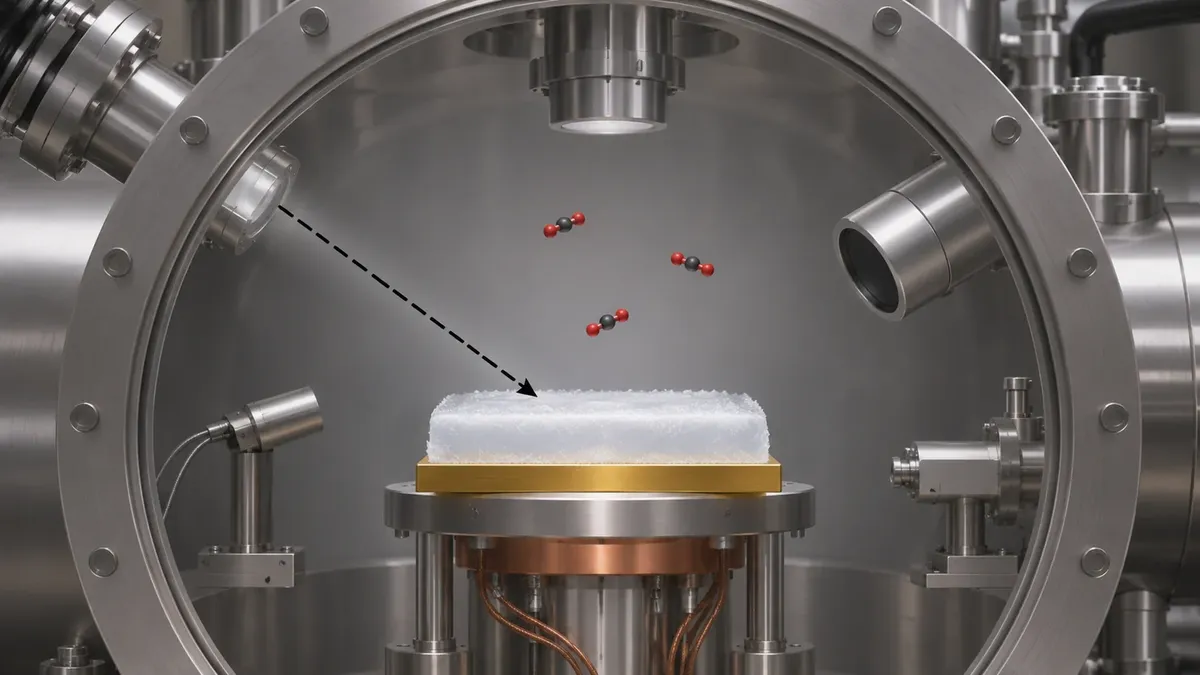
How does the rate of ultraviolet irradiation affect molecules escaping from cold ice? In a laboratory, researchers exposed pure carbon-dioxide ice to vacuum-ultraviolet light and monitored both released gases and changes in the ice. The results point to different processes for CO₂, CO and O₂, but do not conclusively identify the chemistry involved.
In cold regions where stars and planets form, low temperatures make ordinary evaporation inefficient. Vacuum-ultraviolet (VUV) light can nevertheless drive molecules out of ice. To interpret laboratory measurements for space, researchers need to consider not just the total number of photons received, called fluence, but also how quickly they arrive: the photon flux.
A team led by Antoine Hacquard studied the release of carbon dioxide (CO₂), carbon monoxide (CO) and oxygen (O₂) from pure CO₂ ice. They deposited about 50 molecular layers of ice on a gold substrate cooled to 15 kelvin. At the SOLEIL synchrotron in France, they irradiated it with monochromatic VUV light. The flux comparison was made using 12-electronvolt photons at three fluxes: 7.3 × 10¹², 1.3 × 10¹⁴ and 2.2 × 10¹⁴ photons per square centimetre per second. The highest was about 30 times the lowest.
A quadrupole mass spectrometer monitored gases leaving the sample. Infrared spectroscopy tracked changes within the solid, including the formation of CO. After irradiation, the team also gradually warmed the ice and monitored gases released during heating, a method called temperature-programmed desorption. Comparing gas release with changes in the ice helped the researchers assess which processes might be involved.
The gases showed distinct patterns. For CO₂, the researchers found no clear change in desorption yield with flux. At the two higher fluxes, the evolution of CO₂ release and the formation of CO in the ice had similar trends and similar fitted evolution cross sections. The lowest-flux CO-formation measurement did not reach an asymptote, so the team could not extract a comparable chemical cross section there. The apparent relationship between CO₂ release and bulk-ice change is therefore suggestive, not demonstrated across all conditions.
The authors interpret the CO₂ results as consistent with indirect desorption induced by electronic transition, or DIET: a photon is absorbed in the ice, and energy travels through the solid to a molecule near the surface, which then escapes. This energy-transfer event was not directly observed. The authors argue that photochemistry contributes comparatively little to CO₂ desorption under their tested conditions, but the measurements do not make that mechanism assignment conclusive.
CO and O₂ behaved differently. Their desorption yields depended on flux and fluence, and their evolution cross sections differed from those associated with CO₂ release and bulk-ice chemistry. The yields approached steady behavior in some measurements; this should not be taken to mean that every condition reached a steady state. In particular, the lowest-flux desorption data covered a more limited fluence range.
To explain the CO and O₂ patterns, the researchers propose a surface-chemistry scenario. In it, VUV light breaks apart CO₂ near the surface, producing an energetic oxygen atom that may react with a neighboring CO₂ molecule, with CO and O₂ escaping. They further hypothesize that at higher flux, competing reactions—such as oxygen atoms combining with one another or with CO—could reduce the efficiency of this route. The exact reactions were not directly detected, and the proposed competition was not established as the cause of the flux effect. The authors describe flux-dependent measurements as useful clues, not conclusive proof of a mechanism.
The distinction matters because the authors note that photon fluxes in interstellar environments can be far lower than those used in the laboratory. If different processes respond differently to flux, a yield measured under one set of conditions may not transfer directly to another. The work therefore highlights flux, as well as total exposure, as a parameter to consider when applying laboratory results to space.
The scope is limited. The experiments used thick, pure CO₂ ice on gold at 15 K, rather than a mixed mantle on a dust grain. The flux-comparison results discussed in detail used 12-eV photons. The paper also mentions experiments at 8 and 10.2 eV, but says their signals were difficult to disentangle and does not discuss them in detail. The authors estimate systematic uncertainty in the desorption calibration at about 50%, including contributions from mass-spectrometer calibration, background subtraction and photon-flux measurement. Changes to infrared bands also complicated tracking the ice’s chemical evolution.
This is an arXiv version-1 preprint. Its findings come from controlled laboratory conditions, and its mechanism explanations remain interpretations that need further testing—not direct observations of chemistry on interstellar grains.
- astrochemistry
- interstellar ice
- carbon dioxide
- photodesorption
- vacuum ultraviolet
- photon flux
- surface chemistry
Reviewed cross-references
These connections were reviewed by a model, not independently fact-checked by a human. Similarity does not imply agreement; consult the original papers and the evidence below.
Dust-like surfaces sharply reduce UV-driven ice loss in laboratory tests
Supporting evidence: Both laboratory studies show that photodesorption yields depend on the conditions and species examined, cautioning against treating a measured yield as universal. Hacquard et al. report flux dependence for CO and O₂ but no clear flux effect for CO₂ under their tested conditions; Parent and Laffon find water-ice yields vary with substrate morphology. These are complementary results, not a direct comparison: the species, substrates, and experimental variables differ.
Model review: · openai-codex/gpt-6-luna
Evidence and provenance
Selected excerpts, not complete papers. PDF extraction can omit figures or damage equations, tables and reading order; sources may be preprints.
2406.17596v1 — Original paper
Excerpt reference:
static/papers/2406.17596v1.md:698-748
Basis: Paper text
Source SHA-256:ec6dcaee1e189cf92ab066e66ed471635674ce9c71bc33865c0890bcc0c71adc2611.09308v1 — Original paper
Excerpt reference:
static/papers/2611.09308v1.md:16-64
Basis: Paper text
Source SHA-256:1a8f2121a8a9d5383d7e813e4a03013e6c294b09d2685a8178728bb7dd8a3e7a
Related reading
Automatically matched by shared topic keywords. These links do not imply that the sources agree or establish a consensus.
Can Electron Radiation Help Glycine Form Peptide Bonds in Space?
Source published
Shared keywords: interstellar ice
How a laboratory makes and measures interstellar ice
Source published
Shared keywords: interstellar ice
A giant planet’s heavy hydrogen points to unusually cold building blocks
Source published
Shared keywords: interstellar ice
Lettuce takes up more ammonium than nitrate in a hydroponic test
Source published
Shared keywords: carbon dioxide
Root microbes shape how a legume responds to higher CO₂
Source published
Shared keywords: carbon dioxide