TRANSMISSION // 2312.16009v3
How usable is a quantum network?
Source published
A statistical framework estimates how far entanglement can support a chosen task, accounting for randomness, link quality and network topology.
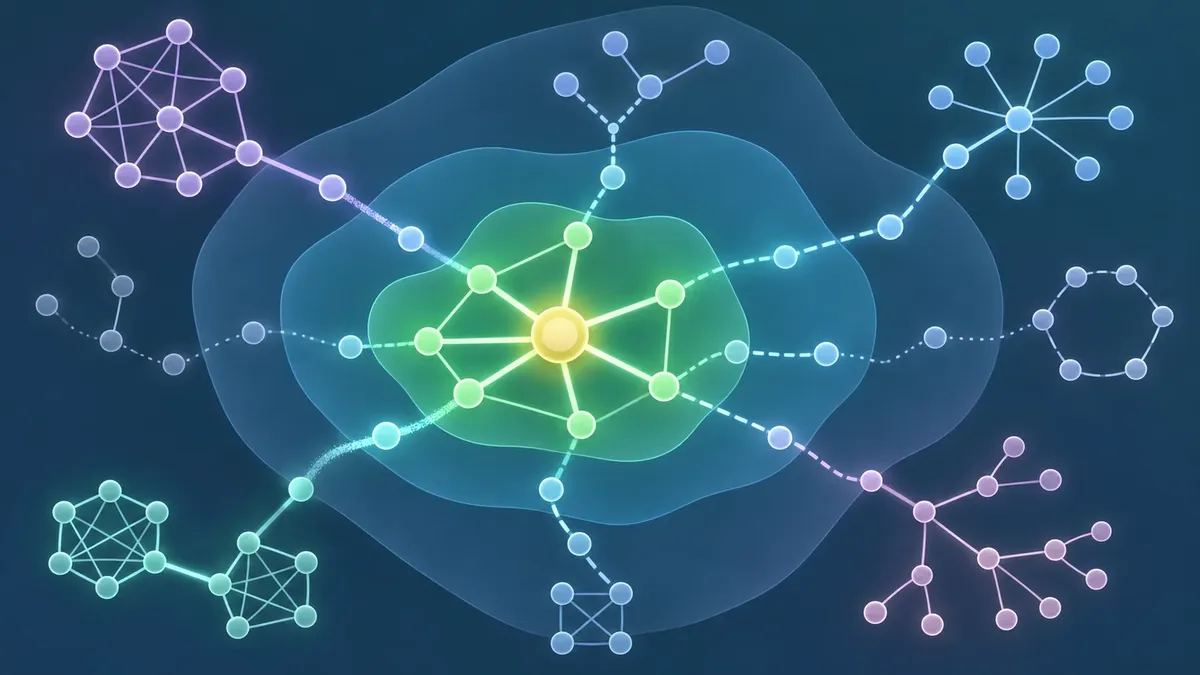
A network may connect distant nodes on paper but still fail to provide entanglement good enough for a particular task. This preprint proposes ways to measure that practical reach and illustrates them using a model of quantum key distribution on random networks.
A map can show which nodes in a quantum network are connected. But that does not tell us whether two distant nodes can share entanglement that meets the needs of a particular task. Entanglement distribution involves probabilistic operations, and a connection’s quality and chance of success can vary. How, then, should we describe the usable size of a network?
Md Sohel Mondal, Vladimir S. Malinovsky and Siddhartha Santra propose a statistical framework that defines network reach in terms of a chosen quantum information task. It considers distributions of link properties and how a distribution protocol combines them to create end-to-end connections. The question is: around a chosen source node, how far out can connections meet the task’s requirements, and with what confidence?
The authors introduce three measures. An absolute viable region is where the task’s specified thresholds are guaranteed to be met. A probabilistic viable region includes connections that meet those thresholds with at least a chosen confidence. Their radii are expressed as graph distances from the source—the shortest-path distance between nodes—even though the protocol used to establish entanglement need not follow a shortest path. The framework’s worked example does use shortest paths.
A third measure, the viable node fraction, is the expected fraction of other nodes whose connections from a particular source satisfy the task’s thresholds. It is an expectation over the modeled connection statistics, not a guarantee that those nodes will be usable in every attempt.
To calculate the measures, the framework starts with probability distributions for link properties, such as entanglement quality and the probability that entanglement is successfully generated. It combines these distributions according to a specified entanglement-distribution protocol to estimate the chance that end-to-end connections meet a task’s requirements. The authors present the framework as applicable to arbitrary protocols, but illustrate it with a particular model.
That example concerns quantum key distribution (QKD), a method for sharing cryptographic keys. The model requires both a minimum concurrence—a measure of two-party entanglement—and a minimum probability of establishing the connection. For the illustrated QKD thresholds, the paper uses concurrence of at least 0.8 and connection probability of at least 1.6%. It assumes uniform link-parameter distributions; the figure’s example uses concurrence from 0.9 to 1 and connection probability from 0.2 to 1. Entanglement swapping is performed along shortest paths. The authors report an absolute viable radius of two graph steps and, at 25% confidence, a probabilistic viable radius of four. These results depend on the model, its link distributions and the chosen task thresholds; they are not general limits for quantum networks.
The example also shows why a radius alone may not describe how much of a network is useful. Networks with the same viable radius can contain different numbers of nodes within that distance because their topologies differ. The viable node fraction captures this distinction. In the modeled Erdős–Rényi random networks, it rises sharply as average link quality improves. The authors describe this as a finite-size threshold effect related to the network topology, not a thermodynamic phase transition. They further report that, in the large-network limit analyzed, the threshold shifts toward ideal link quality.
These are theoretical results, not a demonstration on a physical quantum network. The example assumes independent link-quality and success-probability parameters with uniform distributions, and uses a particular swapping strategy on shortest paths. Real networks may have other topologies, correlated link properties or protocols that use multiple paths. The example does not establish how its specific numerical results carry over to those conditions.
The contribution is best understood as a way to assess network functionality against a specified task, rather than as a prediction of the reach of a particular real-world network. The measures could help compare network designs or distribution protocols when task requirements, link statistics and confidence levels are defined. This article is based on an arXiv preprint; the supplied source does not establish whether it has undergone peer review. Its conclusions should be read in light of that status and the assumptions in the worked example.
- quantum networks
- entanglement
- quantum key distribution
- network topology
- statistical modeling
Related reading
Automatically matched by shared topic keywords. These links do not imply that the sources agree or establish a consensus.
Mapping the Limits of a Quantum Internet
Source published
Shared keywords: quantum key distribution, quantum networks
Majorana memories face a quantum-key hurdle
Source published
Shared keywords: quantum key distribution, quantum networks
Quantum packets take two routing hops without rewriting their address
Source published
Shared keywords: quantum key distribution, quantum networks
A measurement criterion for quantum coherence transfer
Source published
Shared keywords: quantum networks
Choosing the next link can help quantum networks connect sooner
Source published
Shared keywords: quantum networks