TRANSMISSION // 2311.00806v3
Testing multipartite entanglement with total angular momentum
Source published
A theoretical proposal uses probabilities from total-angular-momentum measurements to test for genuine multipartite entanglement in spin ensembles. The authors report that their witness can detect examples such as GHZ states that many angular-momentum-based witnesses miss. They derive exact separable bounds for some cases, give numerical results for others, and conjecture a bound when the total spin is unknown.
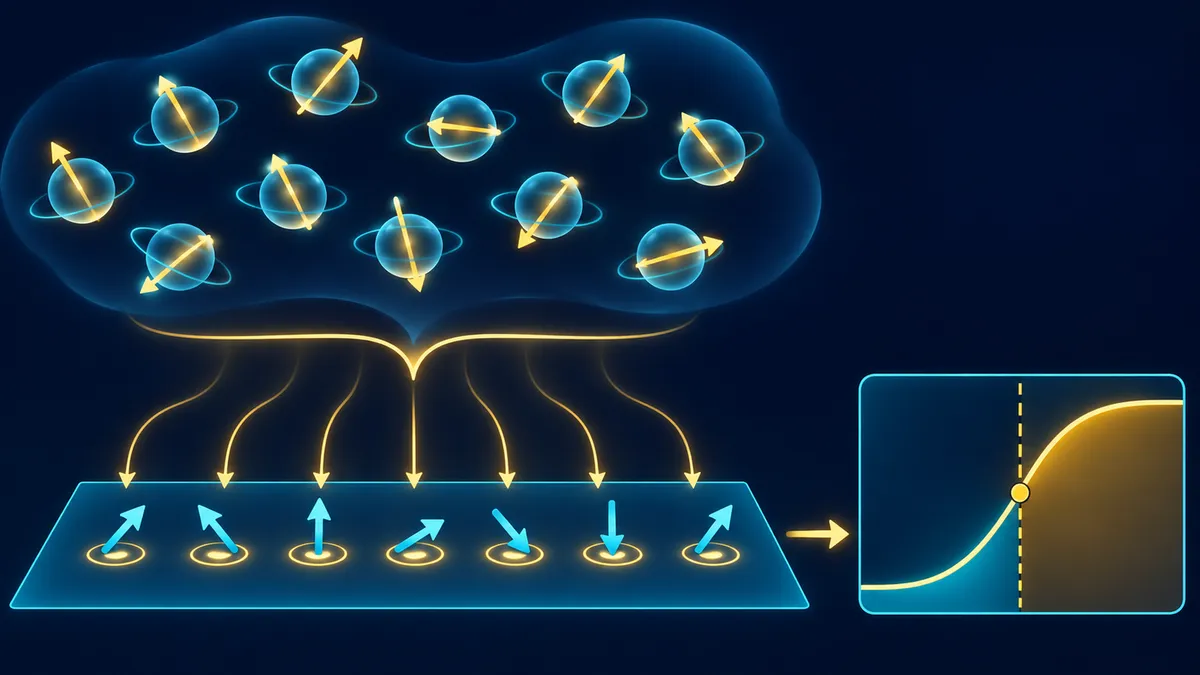
Entanglement is a quantum connection between parts of a system. In its genuine multipartite form, the entanglement involves the full collection of particles rather than only particular subgroups. A paper by Khoi-Nguyen Huynh-Vu, Lin Htoo Zaw and Valerio Scarani asks whether measurements of a collective property—the ensemble’s total angular momentum—can certify this kind of entanglement.
Entanglement can involve many particles, not just pairs. Genuine multipartite entanglement is the stronger claim that the state’s entanglement is not confined to a division of the particles into separate groups. The paper’s abstract does not give a formal definition, but focuses on a way to test for this property using measurements of total angular momentum.
In an arXiv preprint, Khoi-Nguyen Huynh-Vu, Lin Htoo Zaw and Valerio Scarani introduce entanglement witnesses for spin ensembles. A witness is a measurement-based test: researchers calculate a score and compare it with a limit that separable states cannot exceed. Crossing the limit certifies genuine multipartite entanglement. A score that does not cross it is inconclusive; it does not establish that the state is unentangled.
A score from collective measurements
The proposed score is based on the probability that total angular momentum is positive along chosen directions. One version measures along equally spaced directions in a plane. As an alternative, the authors say, measurements could be taken along one direction at different times, if the total spins undergo uniform precession. The resulting score is compared with a separable bound.
The authors aim to address a limitation of many other witnesses based on angular momentum: they can miss some states that have genuine multipartite entanglement. The abstract names Greenberger–Horne–Zeilinger (GHZ) states and certain superpositions of Dicke states as examples their witness can detect effectively. This does not mean the method detects every entangled state, or that every version of these states will necessarily be detected under any experimental conditions.
Bounds, calculations and a conjecture
For spin ensembles whose total spin is a half-integer, the authors obtain exact analytical expressions for the separable bound. They report numerical results for other cases. They also conjecture an expression for the bound when the total spin is not known, and say that numerical results support it.
These are different levels of support. The analytical expressions apply to the cases specified in the abstract. Numerical results provide evidence for the other cases examined, but the abstract does not describe their scope or establish a general proof. The unknown-total-spin expression is explicitly a conjecture. The supplied abstract does not include the equations or calculation details needed to assess these results more closely.
What the abstract leaves open
This is a theoretical proposal, not a report of an experimental demonstration. Because the available source is the abstract, it does not establish how the method performs with measurement noise, how many measurements an experiment would require, or how robust the precession-based option is to departures from uniform precession. It also does not compare the method’s practical effort or efficiency with alternatives.
The main claim is therefore specific: total-angular-momentum measurements can be used in a proposed witness that detects some cases missed by many existing witnesses of this broad kind. A negative result from the test would not rule out genuine multipartite entanglement. The conjectured bound for unknown total spin remains unproven in the evidence supplied here. The source is an arXiv preprint, and its peer-review status is not established by the supplied material. This account relies on the abstract rather than the full paper, so further technical qualifications may be absent.
- quantum entanglement
- spin ensembles
- total angular momentum
- entanglement witnesses
- GHZ states
Reviewed cross-references
These connections were reviewed by a model, not independently fact-checked by a human. Similarity does not imply agreement; consult the original papers and the evidence below.
Quantum cloud test shows why qubit counts are not enough
Supporting evidence: Both papers report measurement-based routes to certifying genuine multipartite entanglement in GHZ states: Huynh-Vu, Zaw and Scarani propose a total-angular-momentum witness effective for GHZ states, while Hernández et al. use GHZ fidelity above 1/2 as a sufficient GME criterion in cloud-hardware benchmarking. The comparison is limited: one is a proposed spin-ensemble witness and the other an evaluation of prepared processor states using direct fidelity estimation.
Model review: · openai-codex/gpt-6-luna
Evidence and provenance
Selected excerpts, not complete papers. PDF extraction can omit figures or damage equations, tables and reading order; sources may be preprints.
2311.00806v3 — Original paper
Excerpt reference:
static/papers/2311.00806v3.md:12-61
Basis: Paper text
Source SHA-256:0f1294806081d38c8ef4cd6c368440564f7b2dc69861ce9144bde5150dce52562311.00806v3 — Original paper
Excerpt reference:
static/papers/2311.00806v3.md:5381-5455
Basis: Paper text
Source SHA-256:0f1294806081d38c8ef4cd6c368440564f7b2dc69861ce9144bde5150dce52562611.14114v1 — Original paper
Excerpt reference:
static/papers/2611.14114v1.md:194-234
Basis: Paper text
Source SHA-256:43d96faa1aa717f464c43a93b1541bf838218da6c08f8f91d8d46838ec80f9a32611.14114v1 — Original paper
Excerpt reference:
static/papers/2611.14114v1.md:235-342
Basis: Paper text
Source SHA-256:43d96faa1aa717f464c43a93b1541bf838218da6c08f8f91d8d46838ec80f9a3
Related reading
Automatically matched by shared topic keywords. These links do not imply that the sources agree or establish a consensus.
A theoretical route to detecting molecular entanglement with spectroscopy
Source published
Shared keywords: entanglement witnesses, quantum entanglement
EntNet learns entanglement signatures from spin correlations
Source published
Shared keywords: quantum entanglement
Reading spin entanglement in a tunneling microscope’s spectra
Source published
Shared keywords: quantum entanglement
For silicon quantum memory, the route can matter as much as the circuit
Source published
Shared keywords: quantum entanglement
Let the measurements choose: adapting quantum entropy estimates
Source published
Shared keywords: quantum entanglement