TRANSMISSION // 2301.08284v2
Why Some Neural Networks Need More Depth
Source published
A mathematical study finds that ReLU networks need depth growing with input dimension to approximate certain product-based functions efficiently. The result concerns specific functions, not neural networks in general.
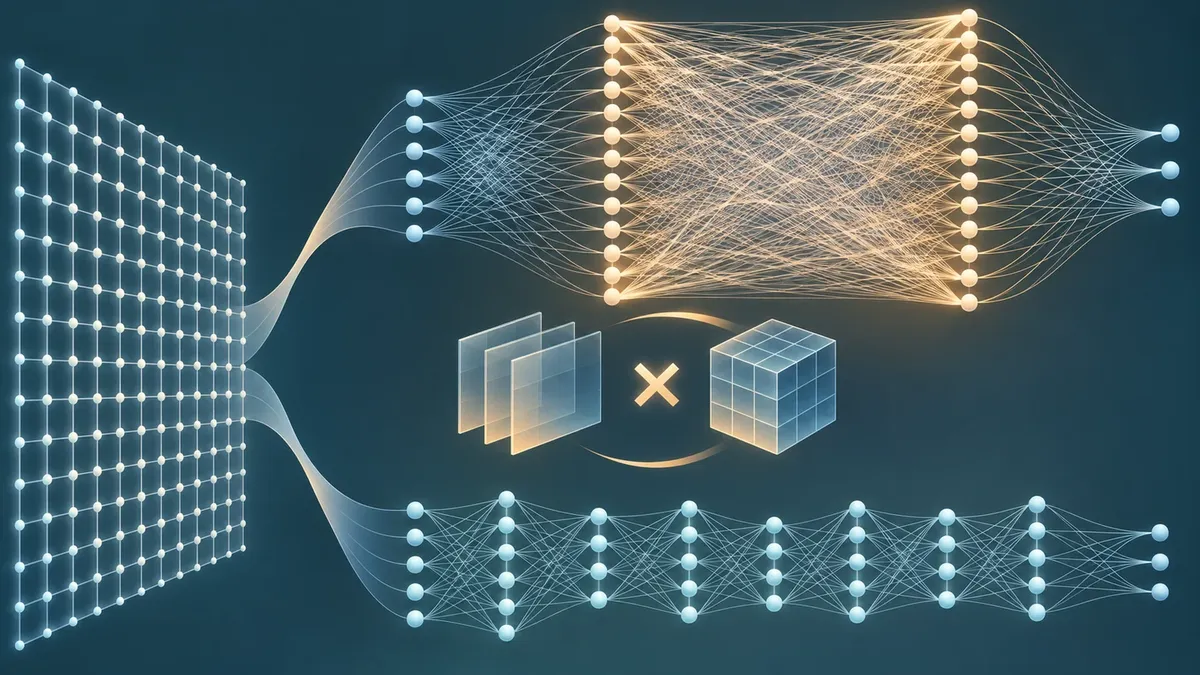
Can a neural network represent a complicated relationship without its size exploding as the number of inputs grows? A mathematical analysis of two product-based functions suggests that, for these examples, adding depth is essential: shallow networks—or networks with a fixed number of layers—require exponentially many parameters in the input dimension, while sufficiently deep ones can use a number that grows only polynomially.
A network may be able to represent a function in principle and still need an impractically large number of adjustable parameters to do so. This distinction matters in high-dimensional problems, where the number of inputs is large. The “curse of dimensionality” describes a broad difficulty in which the resources needed for approximation grow extremely rapidly with the number of dimensions.
In a preprint, Lukas Gonon, Robin Graeber and Arnulf Jentzen investigate whether neural-network depth can change that resource demand. Their focus is not on every possible target function, but on two specific families built from multiplying all input coordinates: the product itself, and the sine of that product.
Comparing network depth
The authors analyze feedforward artificial neural networks using the rectified linear unit, or ReLU, activation. ReLU is a simple nonlinear operation that outputs zero for negative inputs and leaves positive inputs unchanged. The study asks how many real-valued parameters are needed to approximate the chosen functions to a prescribed accuracy as the input dimension increases.
The analysis compares shallow networks with deeper ones. In particular, it distinguishes networks whose number of hidden layers stays fixed as the dimension grows from networks whose depth is allowed to grow with dimension. The abstract also reports a result under a constraint that the absolute values of network parameters are no greater than one.
These are mathematical approximation results, not an experiment in which networks are trained on a dataset. The abstract does not provide numerical tests, a particular training procedure, or evidence about performance on practical tasks.
Depth changes the parameter scaling
For the product function and the sine of the product, the authors report that shallow ReLU networks and networks with a fixed number of hidden layers need at least exponentially many parameters as dimension increases. By contrast, sufficiently deep ReLU networks can approximate these functions using a number of parameters that grows at most polynomially in both the dimension and the inverse of the requested accuracy. The authors say this upper bound still holds when each parameter’s absolute value is limited to one.
In plain terms, for these targets, allowing depth to increase with the number of inputs changes the proven scaling of the required network size. “Polynomial” growth can still mean a substantial number of parameters, depending on the polynomial and the desired accuracy; it does not mean that approximation is free or necessarily easy to compute.
The finding is also narrower than a general claim that deep networks are always better. It concerns two defined function families, ReLU networks and a particular notion of approximation cost. It does not establish that the same depth advantage holds for every smooth function, dataset, architecture or learning setup.
What remains uncertain
The evidence available here is the paper’s abstract, so important technical details are not available for independent discussion: for example, the exact approximation convention, constants in the bounds, and the constructions and lower-bound arguments behind them. The abstract describes a theoretical result; it does not show how the bounds compare in practical training time or whether they predict real-world model performance.
The work is identified as an arXiv preprint, a version of a manuscript posted by its authors. A preprint is useful for sharing research, but its presence on arXiv alone does not establish peer review or independent confirmation. The result is best read as a precise mathematical statement about when depth can avoid exponential parameter growth for two product-based targets—not as a universal prescription for building neural networks.
- neural networks
- deep learning
- ReLU
- function approximation
- curse of dimensionality
- mathematics
Related reading
Automatically matched by shared topic keywords. These links do not imply that the sources agree or establish a consensus.
Random Voronoi Networks turn neighbor geometry into features
Source published
Shared keywords: neural networks
Neural Collapse, Seen Through Unit Connections
Source published
Shared keywords: deep learning, neural networks
How normalization can hide extreme sensitivity in deep neural networks
Source published
Shared keywords: deep learning
A Mathematical Case for Neural Flow Matching
Source published
Shared keywords: neural networks
What Does It Mean for an AI to Learn a Concept?
Source published
Shared keywords: neural networks