TRANSMISSION // 2210.14025v3
Neutron Star Tides Could Complicate Tests of Einstein’s Gravity
Source published
Stephanie M. Brown’s calculations show that neutron star tidal responses can differ substantially from general relativity in selected scalar-tensor models. The largest reported differences concern dimensional deformabilities, not equivalent changes in gravitational-wave signals.
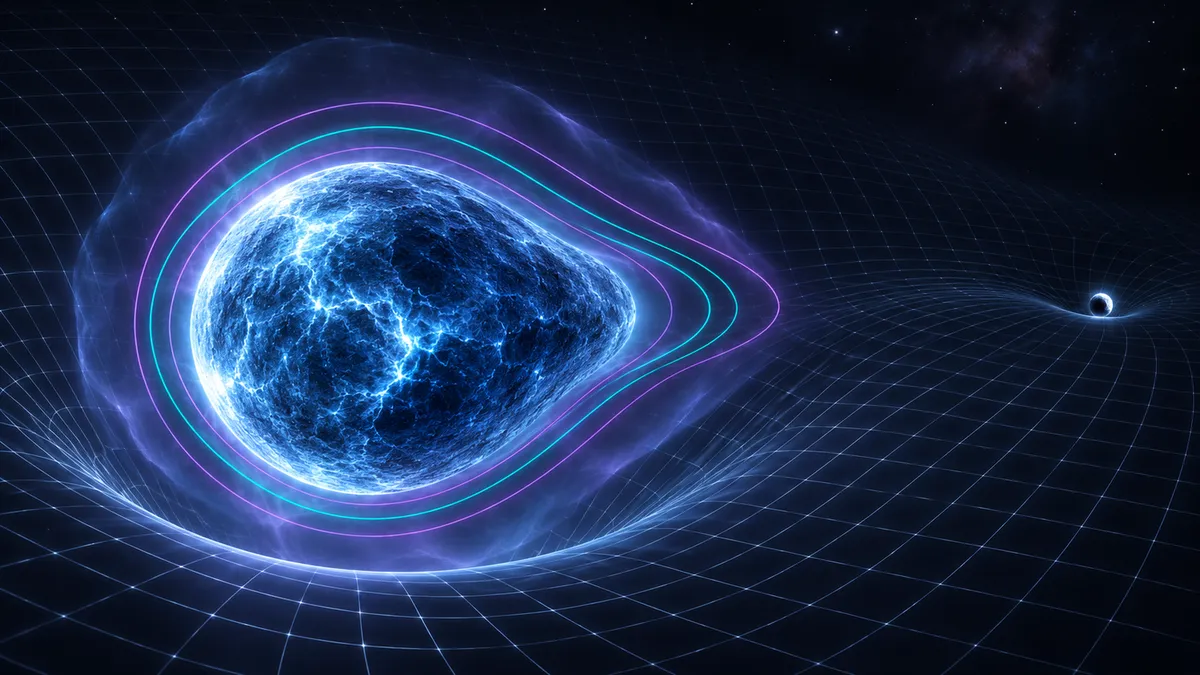
A neutron star’s response to a companion’s gravity carries information about both its dense matter and the laws of gravity. Brown’s study explores how an additional scalar field could change that response—and complicate efforts to distinguish unfamiliar gravity from unfamiliar matter.
One tidal signal, two physical questions
When a companion’s gravitational field distorts a neutron star, the response depends on the star’s internal matter and the theory describing gravity. Tidal deformability measures the relationship between an applied tidal field and the resulting deformation. Related quantities called Love numbers characterize that response.
In Tidal Deformability of Neutron Stars in Scalar-Tensor Theories of Gravity, Stephanie M. Brown calculates these properties beyond general relativity. The supplied paper appeared in The Astrophysical Journal in 2023. Its central concern is interpretation: assuming general-relativistic tidal properties while testing another theory could introduce errors into the analysis of gravitational waves.
Adding a scalar field
The models studied add a massless scalar field to the metric that describes spacetime. Brown focuses on spontaneous scalarization, an effect that can produce substantial departures from general relativity in strong gravitational fields even when weak-field behavior remains closely constrained.
Two parameters specify the cases explored: a coupling parameter, beta, and the scalar field’s value far from the star. Brown examines beta values of −4.5, −5, −5.5 and −6, fixing the distant scalar field at 0.001 for the presented results. The paper describes −4.5 as a conservative comparison and −6 as an optimistic one. The largest departures should therefore not be read as generic predictions for every scalar-tensor model.
The stellar models are nonrotating, spherical equilibrium configurations containing perfect-fluid matter. Three equations of state—SLy, FPS and MS1—provide different relationships between pressure and density, allowing Brown to explore how assumptions about nuclear matter affect the results.
Computing the response
Brown numerically solves modified stellar-structure equations together with equations describing small tidal perturbations. A shooting method adjusts the central scalar field until the solution matches its required value far away. The numerical work uses an eighth-order integration method, with comparisons against two other solvers.
The calculations distinguish electric, magnetic and scalar tidal responses. Here, electric and magnetic label different gravitational perturbations, rather than ordinary electromagnetic tides. For the magnetic response, Brown emphasizes an irrotational fluid treatment, which allows internal motion rather than imposing a completely motionless fluid. The distinction matters: the two treatments yield magnetic Love numbers with different signs.
Calculations are performed in the mathematically convenient Einstein frame, then transformed into the Jordan frame used for physical observables. For the electric response, the exterior solution requires an approximation near the stellar surface. Brown constructs a series solution reported to converge within 0.5%; a simpler surface-evaluation shortcut gives deformabilities agreeing with that calculation to better than 3.7% across the explored cases.
Large differences—with an important distinction
For the stronger-coupling case, beta = −6, Brown reports electric tidal deformability differences reaching approximately 200% relative to general relativity. Magnetic tidal deformability differences reach approximately 300%. These large departures occur for relatively compact stars, broadly at compactness above about 0.2, with details depending on the equation of state. Compactness expresses how much mass is concentrated within a given radius, using the paper’s gravitational units.
Those percentages do not describe every tidal quantity. In the same stronger-coupling comparison, electric Love numbers and dimensionless electric deformabilities differ by at most approximately 25%. Magnetic Love numbers differ by approximately 17%. Dimensional deformabilities, dimensionless deformabilities and Love numbers are related, but their percentage changes are not interchangeable.
The more conservative beta = −4.5 case produces smaller differences: approximately 20% for electric deformability and 15% for magnetic deformability. Brown also finds scalar deformabilities roughly two orders of magnitude below electric deformabilities, even in strongly scalarized cases.
What the study establishes
Brown finds a close fitted relationship between dimensionless electric and magnetic deformabilities across the three equations of state, with coefficients depending on beta. Reported fits have R-squared values above 0.99. No comparable relationship emerges between scalar and electric deformability.
These are theoretical stellar-response calculations, not a detection of alternative gravity or a measurement of bias in an observed merger. The assumptions exclude rotation and describe tides through small perturbations. The study does not establish that a 200% deformability difference produces a similarly sized gravitational-wave difference.
Its practical warning is narrower: gravity and dense-matter physics both influence neutron star tides. Tests using binary neutron star or neutron star–black hole signals need tidal predictions consistent with the theory being tested.
- neutron stars
- tidal deformability
- Love numbers
- scalar-tensor gravity
- spontaneous scalarization
- gravitational waves
- general relativity
- equation of state
Related reading
Automatically matched by shared topic keywords. These links do not imply that the sources agree or establish a consensus.
A dark-star model links a mass ceiling to gravitational-wave signatures
Source published
Shared keywords: general relativity, gravitational waves, tidal deformability
A single stellar vibration captures much of neutron stars’ tidal response
Source published
Shared keywords: general relativity, gravitational waves, neutron stars
Simulated detector network sharpens the search for neutron stars’ faint internal vibrations
Source published
Shared keywords: gravitational waves, neutron stars
Simple patterns emerge in models of magnetic neutron stars
Source published
Shared keywords: equation of state, gravitational waves, neutron stars
AI trained on physics equations speeds up models of spinning neutron stars
Source published
Shared keywords: equation of state, general relativity, neutron stars