TRANSMISSION // 2207.14237v3
A Quantum-Well Proposal for Cooling Electrons
Source published
A proposed semiconductor heat pump cycles electron subband occupancy to move heat at millikelvin temperatures. Its performance estimates come from modeling, not a working device.
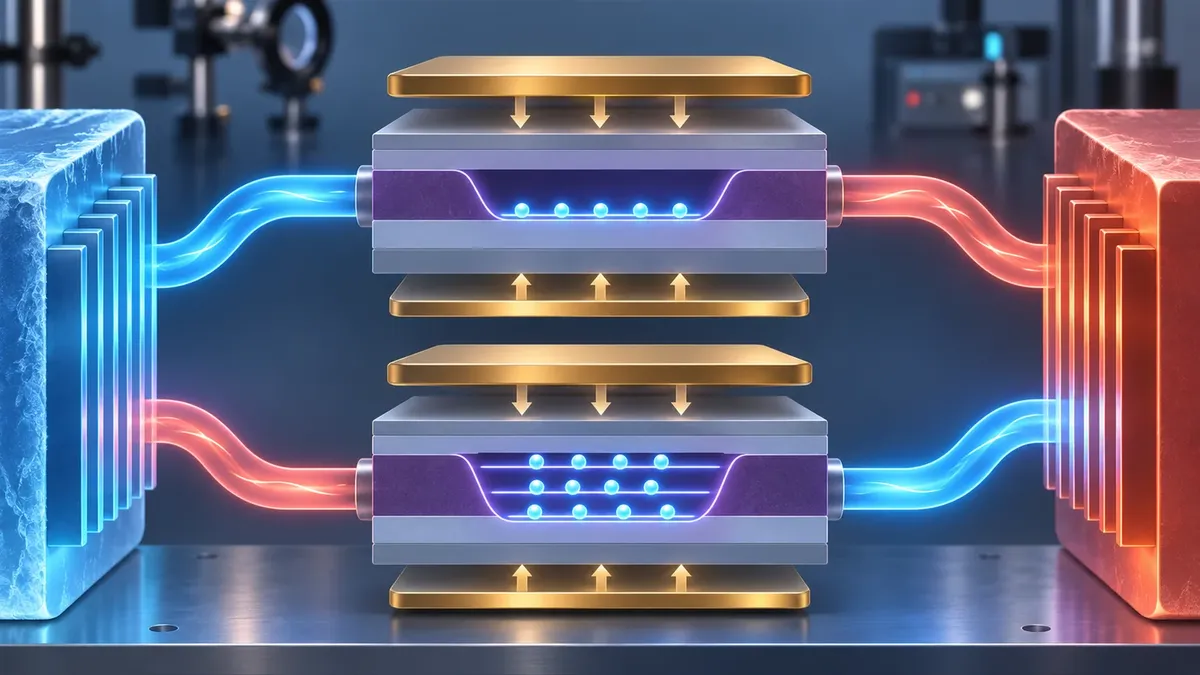
Could a semiconductor device cool electrons directly, rather than relying only on a cryostat’s cold bath? Thomas Douglas, Chulin Wang and Matthew Grayson propose a heat pump that changes how many subbands electrons can occupy. Their calculations suggest it could move heat at millikelvin temperatures, but the device and its projected performance still need experimental demonstration.
At temperatures near absolute zero, cooling the electrons in a device can be harder than cooling its surroundings. Electrons may remain warmer than a refrigerator’s nominal base temperature, in part because they exchange heat only weakly with the material’s vibrations, or phonons. That matters for experiments and technologies that depend on very cold electrons, including quantum devices and infrared detectors.
In Direct electron cooling at millikelvin temperatures with quantum-well heat pump, Thomas Douglas, Chulin Wang and Matthew Grayson propose a way to pump heat directly from electrons in a semiconductor. Their central question is whether a quantum well—a thin region that confines electrons—can be cycled to produce sustained cooling, rather than just a one-time temperature drop.
Changing the electrons’ available states
The proposed device uses a two-dimensional electron system in a gallium arsenide (GaAs) quantum well. Gates on the front and back change the well’s subband structure. In simplified terms, this controls how many low-energy subbands are available to the electrons. The authors describe the change in the number of available states as a change in subband degeneracy.
The device would run through an Otto cycle, a repeating sequence used in thermodynamic engines and refrigerators. First, with its connections to the hot and cold sides switched off, the electron system expands into a configuration with more available subbands. In the model, this lowers its temperature. A gate then connects it to the colder load, allowing heat to flow into the electrons. The system is compressed back to fewer subbands, raising its temperature, and finally connected to a heat sink so it can release heat. Repeating the sequence is intended to provide continuous cooling.
Electrical gates serve as the proposed system’s pistons and switches. The design aims to move heat without creating a direct electrical conduction path between the cold load and the heat sink during the cycle.
What the calculations suggest
The authors model a GaAs device and account for several competing effects: heat transfer between electrons and phonons, heat flowing through the substrate, and heating associated with switching. Their calculations use specific design assumptions, including a 150-nanometre-wide quantum well, a 50-micrometre-thick substrate and an assumed electron mobility. These are model inputs, not measurements from a working refrigerator.
For a stacked design, the authors estimate that operation in heat-pump mode at 100 millikelvin could provide 26 microwatts of cooling per cubic centimetre. In this mode, the cold side and heat sink are at the same temperature: the device is proposed to remove excess heat, rather than create a temperature difference.
For refrigeration, the load is colder than the heat sink. The paper calculates that a four-to-one change in subband degeneracy could bring the electron temperature toward one quarter of the hot-side temperature under suitable conditions. One example is cooling from 30 millikelvin to 8 millikelvin. These figures describe calculated performance, not an experimental result.
The authors suggest attaching the device to a dilution refrigerator or, in a future design, combining stages with other cooling methods. They also discuss possible uses in quantum-computing hardware and infrared detectors. Those are potential applications, not demonstrations of the proposed pump in those systems.
What remains uncertain
The main limitation is that this is a proposal supported by modeling, not a report of a fabricated device or measured cooling performance. Practical operation would require the gates and heat switches to work at the necessary speeds while keeping unwanted heat leaks and switching losses small. The estimates depend on material properties, device geometry and operating assumptions, so actual performance could differ. The authors also note that other thermodynamic cycles might improve performance, particularly at higher temperatures where electron–phonon coupling is stronger.
The supplied paper text identifies itself as a preprint, and the available source information does not establish whether it has been peer reviewed. Search results are incomplete and do not establish consensus or rule out contrary evidence. The findings should therefore be read as a proposed design and model-based estimates—not proof that a new refrigerator has already achieved these results. Experiments will be needed to test whether the projected cooling can be realized despite heat leaks, switching losses and the challenges of integration with a cryogenic system.
- quantum well
- electron cooling
- millikelvin temperatures
- heat pump
- GaAs
- cryogenics