TRANSMISSION // 2201.01096v3
Wavescan Sharpens the Time-Frequency View of Gravitational Waves
Source published
A multiscale wavelet method aims to reduce distortions in time-frequency maps and help identify transient signals in LIGO data.
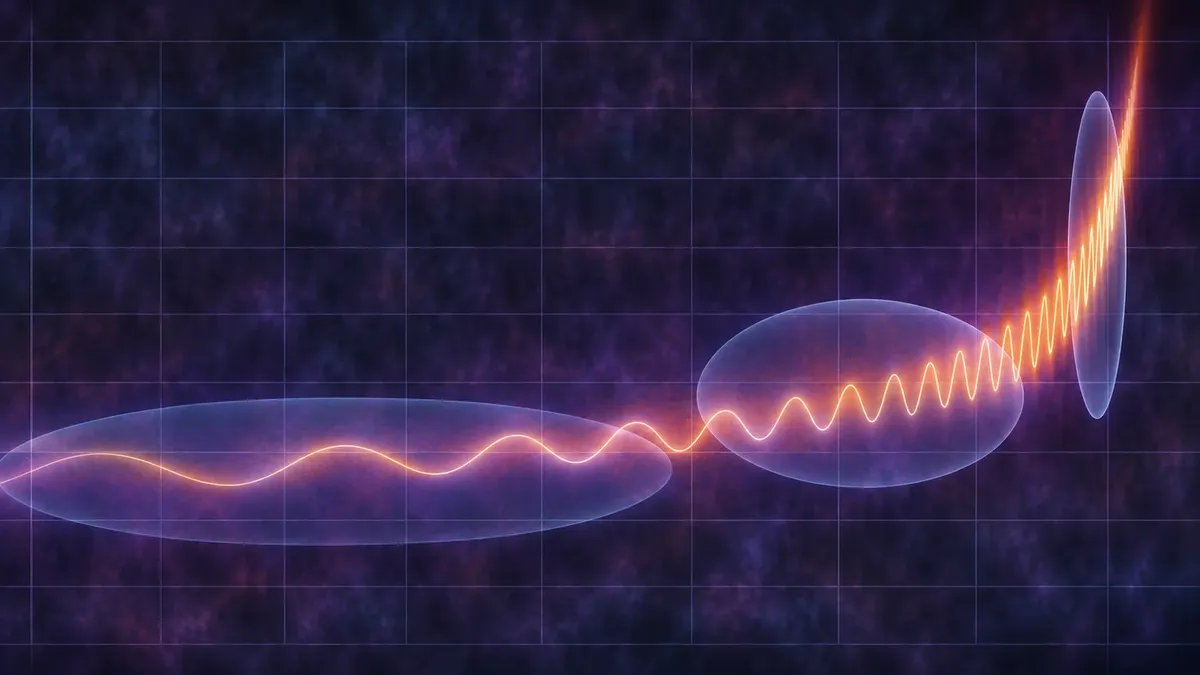
A gravitational-wave signal can rise and change frequency quickly, while detector noise also shifts over time. Wavescan examines data at several time and frequency scales, selecting a wavelet at each location to limit leakage. The paper reports clearer signal localization in tests and describes both the method’s promise and its reconstruction trade-offs.
Gravitational-wave detectors record tiny changes in distance, but their data also contain noise that varies over time. A transient signal—one that appears briefly—can be hard to distinguish from that changing background. A useful first step is to make a time-frequency map: a picture showing how a signal’s power is distributed across time and frequency. The challenge is to make that picture detailed in both dimensions without introducing misleading patterns.
Sergey Klimenko’s paper presents wavescan, a method designed to improve that view. It is a signal-processing technique, not a new detector or a claim of a new gravitational-wave discovery. The work applies the transform to gravitational-wave data from LIGO and describes how it can support transient identification and waveform reconstruction.
Why one view can be misleading
Time and frequency resolution involve a trade-off. A short analysis window can pinpoint when something happens, but gives a less precise estimate of its frequency. A longer window improves frequency detail while smearing events across time. This constraint is expressed by the Heisenberg–Gabor uncertainty principle: a single window cannot achieve arbitrarily fine localization in both dimensions.
Windowed analyses can also suffer from leakage. In broad terms, a feature’s power can spread into nearby time or frequency locations in the map, making a sharp feature look less distinct or altering the apparent background. Conventional wavelet methods use multiple scales, but the paper says leakage remains a problem for existing multiresolution approaches, including the WDM transform used in the coherent WaveBurst gravitational-wave analysis pipeline.
How wavescan works
Wavescan computes multiple short-time Fourier transforms using wavelets with different window durations. These wavelets are arranged in a stack at each sampled time-frequency location. The algorithm then chooses one wavelet from that stack according to criteria intended to identify and avoid leakage-affected estimates. The result is an adaptive map: its time-frequency resolution can vary from place to place rather than being fixed throughout.
The paper describes separate selection logic for stochastic noise and deterministic signals. It also develops statistics based on excess power and on power seen consistently across detector pairs. For a signal whose detailed waveform is not known in advance, these measures help identify time-frequency pixels that stand out from the background and check whether activity is consistent across detectors. The method retains two quadrature amplitudes at each selected location, which carry phase information needed for reconstruction.
What the paper reports
In tests using simulated signals added to white Gaussian noise, the wavescan map shows improved localization and fewer leakage-related artifacts than a map made by simply taking the maximum power across wavelet scales. Its frequency marginal—the power summarized across time—agrees with the WDM reference in the comparison shown, while the maximum-power estimate overestimates the power spectrum. The paper also reports that wavescan mostly preserves the expected exponential distribution of power for Gaussian white noise in this test.
The paper shows the chirping signal GW150914 in data from LIGO’s Hanford and Livingston detectors, describing the characteristic signal as visible in both. It further reports that wavescan replaced WDM in the coherent WaveBurst pipeline and has been used in gravitational-wave searches. These points provide context for the method’s application; the reported comparisons should not be read as evidence that wavescan is best for every signal or analysis task.
Reconstructing a time-domain waveform from the adaptive map is a separate challenge. Because the chosen wavelets vary across the map, their relationships do not provide the same balance as a fixed-resolution transform. The paper therefore uses an iterative approximate inverse. It reports reconstruction errors for Gaussian noise of roughly 1–2%, depending on transform settings, and sub-percent accuracy for the simulated binary-black-hole waveform. Those results are specific to the tests described; the paper notes that accuracy depends on wavescan parameters and that filtering or selecting parts of the map complicates reconstruction.
What remains uncertain
Wavescan processes more time-frequency data than WDM—about five to ten times as much in the configurations discussed—although the paper says overall coherent WaveBurst runtimes were similar for the search configurations considered. It also says a detailed discussion of search performance is outside its scope. The results presented therefore describe particular demonstrations and applications, rather than establishing performance for every signal, noise environment, or pipeline.
This account is based on the arXiv preprint text supplied for the paper. A preprint is a public research manuscript and may not have undergone peer review; the available evidence does not establish its publication or review status. Wavescan offers a way to adapt time-frequency resolution locally and reduce leakage, while practical performance and reconstruction accuracy remain dependent on the data and analysis choices.
- gravitational waves
- LIGO
- wavescan
- wavelets
- time-frequency analysis
- signal processing
Reviewed cross-references
These connections were reviewed by a model, not independently fact-checked by a human. Similarity does not imply agreement; consult the original papers and the evidence below.
Wavelets help LISA analysis bridge data gaps
Supporting evidence: Both papers demonstrate a role for wavelet-based time-frequency representations in gravitational-wave analysis: Klimenko applies wavescan to LIGO transient data for localization and reconstruction, while Mao et al. use signed, noise-scaled WDM coefficients in simulated LISA parameter estimation with gaps. These are complementary applications, not a direct performance comparison; the LISA results are for a particular simulated source and setup.
Model review: · openai-codex/gpt-6-luna
Evidence and provenance
Selected excerpts, not complete papers. PDF extraction can omit figures or damage equations, tables and reading order; sources may be preprints.
2201.01096v3 — Original paper
Excerpt reference:
static/papers/2201.01096v3.md:509-581
Basis: Paper text
Source SHA-256:dd346f762ad89040109cbfc16e65b70db2d2c997d1fce3ec5c04daa91494c3612512.18290v3 — Original paper
Excerpt reference:
static/papers/2512.18290v3.md:322-411
Basis: Paper text
Source SHA-256:151d3ca1b65b7ff0138bf10558f2901ae749a9671475df95f45b7b23993736842512.18290v3 — Original paper
Excerpt reference:
static/papers/2512.18290v3.md:1095-1180
Basis: Paper text
Source SHA-256:151d3ca1b65b7ff0138bf10558f2901ae749a9671475df95f45b7b2399373684
Related reading
Automatically matched by shared topic keywords. These links do not imply that the sources agree or establish a consensus.
Wavelets help LISA analysis bridge data gaps
Source published
Shared keywords: gravitational waves
A New Search Strategy for Gravitational Waves from Eccentric Neutron-Star Binaries
Source published
Shared keywords: gravitational waves
Could LIGO triggers hint at sub-solar objects?
Source published
Shared keywords: gravitational waves
Eccentricity remains uncertain in three gravitational-wave events
Source published
Shared keywords: gravitational waves
How a black hole inside a star could make an eccentric pair
Source published
Shared keywords: gravitational waves