TRANSMISSION // 2104.03722v2
HindSight proposes a graph for image parts and wholes
Source published
HindSight sketches a vision architecture that connects image patches at multiple scales. The paper describes a design, not a tested model or demonstrated results.
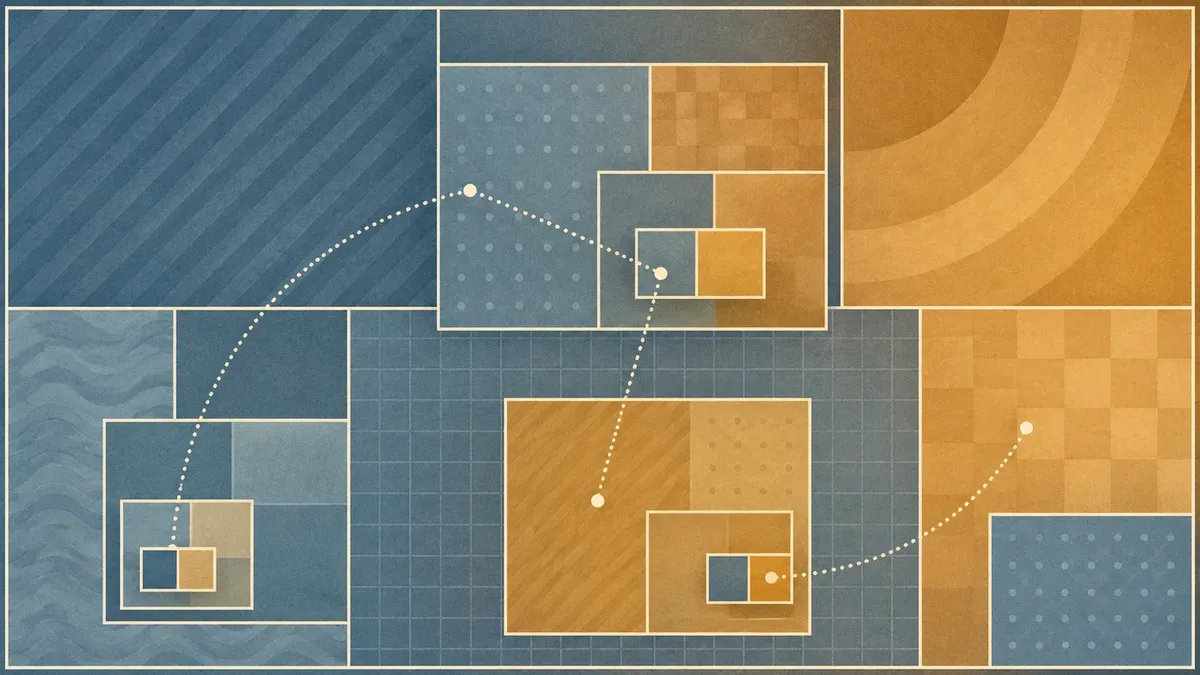
Could an image model represent not just what appears in a picture, but how small regions relate to larger ones? HindSight proposes treating patches at different scales as nodes in a graph. Its author presents an architectural idea, however, not evidence that the approach works in practice.
The challenge: connecting parts to wholes
A picture of a car contains both the whole vehicle and visual details such as its wheels. A model may detect patterns at different scales, but that does not automatically mean it represents a wheel as part of a particular car. The HindSight paper asks how a vision model might encode such part–whole relationships, along with spatial connections among image regions.
The proposal is motivated by a broader ambition: to build image representations that retain local detail and information about the larger scene. The paper also discusses scale variation and high-resolution images as challenges for existing vision systems. These motivations describe problems the architecture is intended to address; they are not findings that HindSight solves them.
A multiscale image becomes a graph
HindSight begins by dividing an image into patches at several levels, from broad regions to smaller sections. Each patch becomes a node in a fully connected graph. In principle, every node can exchange information with every other node—not only with nearby patches or a designated parent or child.
Before graph processing, the design uses several feature extractors to represent each patch. A dynamic feature aggregator combines those representations into one vector, with the option for later graph layers to query the alternatives. The model also encodes each patch’s position and area, so its representation carries information about where the patch lies and how much of the image it covers.
Attention layers pass messages between nodes and update their representations over repeated iterations. In the proposed setup, a layer’s output can also guide a query back to the feature aggregator. The intended effect is to let patches refine their representations using information from other regions and from additional features of the original patch. Broadly, the design aims to represent local content in relation to the larger image.
The paper describes both regular grids and a possible dynamic grid. Regular grids divide the image into patches at each level. The dynamic option uses a quadtree-like procedure: repeatedly subdivide regions that score highly under a simple image statistic, such as deviation from the patch’s average colour. The author proposes this as a way to allocate more patches to visually varied regions and fewer to uniform background. But the statistic is only a suggested proxy for information content; it is not necessarily a measure of object importance.
Training is proposed, not demonstrated
For training, the paper suggests a self-supervised task: mask parts of an image and train a decoder to reconstruct the missing content. Masking at different patch levels is intended to encourage learning across scales. The paper also discusses supervised image classification as a possible route, while arguing that it may not use all the information the architecture could represent.
These are proposals, not reported experiments. The author explicitly says the paper presents the architecture without a working model, and notes that training it as a general-purpose encoder would require substantial data and computing resources. The paper reports no benchmark results establishing performance on classification, object detection, captioning or other tasks. Those are suggested applications, not demonstrated capabilities.
What the proposal does—and does not—show
HindSight lays out a design combining multiscale patches, feature aggregation and attention-based graph processing. The central question remains open: can a trained implementation learn useful part–whole relationships, and would those representations improve vision tasks? Answering that would require building the system and evaluating it, including its accuracy, computing demands and whether its learned representations capture the intended structure.
The source is a 2021 arXiv preprint. The paper describes an architecture proposal without a working model, and the available source text reports no experiments or independent validation. HindSight is therefore best read as a research idea for further development—not evidence that a new vision capability has been achieved.
- computer vision
- graph neural networks
- image patches
- part–whole hierarchy
- self-supervised learning
Reviewed cross-references
These connections were reviewed by a model, not independently fact-checked by a human. Similarity does not imply agreement; consult the original papers and the evidence below.
Teaching image models to notice the parts, not just the scene
Shared method: Both propose multilevel visual representations, moving from finer image regions toward broader structure. HindSight describes patches at multiple grid levels connected in a graph; CAFT progressively groups superpixel tokens and aligns local image-text features before global alignment. These are related but distinct methods, and CAFT’s reported results do not establish HindSight’s performance; HindSight’s paper describes its architecture without a working model.
Model review: · openai-codex/gpt-6-luna
Evidence and provenance
Selected excerpts, not complete papers. PDF extraction can omit figures or damage equations, tables and reading order; sources may be preprints.
2104.03722v2 — Original paper
Excerpt reference:
static/papers/2104.03722v2.md:190-239
Basis: Paper text
Source SHA-256:714b4f8bbd0859cb48c5659a1fde9e3a6547da4cf3b767b7de5739234315cb1b2104.03722v2 — Original paper
Excerpt reference:
static/papers/2104.03722v2.md:738-756
Basis: Paper text
Source SHA-256:714b4f8bbd0859cb48c5659a1fde9e3a6547da4cf3b767b7de5739234315cb1b2602.02977v3 — Original paper
Excerpt reference:
static/papers/2602.02977v3.md:302-358
Basis: Paper text
Source SHA-256:5b90b45aafeacb59eb229717eefb401e0334b567a4ba6a4d8104ea3b8f2ef1f3
Related reading
Automatically matched by shared topic keywords. These links do not imply that the sources agree or establish a consensus.
LEF-JEPA targets object structure without preserving every visual detail
Source published
Shared keywords: computer vision, self supervised learning
S-JEPA learns several possible answers to a hidden image region
Source published
Shared keywords: computer vision, self supervised learning
PhiJEPA tests whether AI can infer hidden visual features
Source published
Shared keywords: computer vision, self supervised learning
Teaching vision transformers where finer image patches matter
Source published
Shared keywords: computer vision
How Event Cameras Learn Depth Without Dense Labels
Source published
Shared keywords: computer vision, self supervised learning