TRANSMISSION // 2026.11.25.769200v1
How EMB1579 helps organize transcription in plants
Source published
A bioRxiv preprint reports that the Arabidopsis protein EMB1579 forms condensates that gather transcription-related proteins and enhance RNA polymerase II phosphorylation.
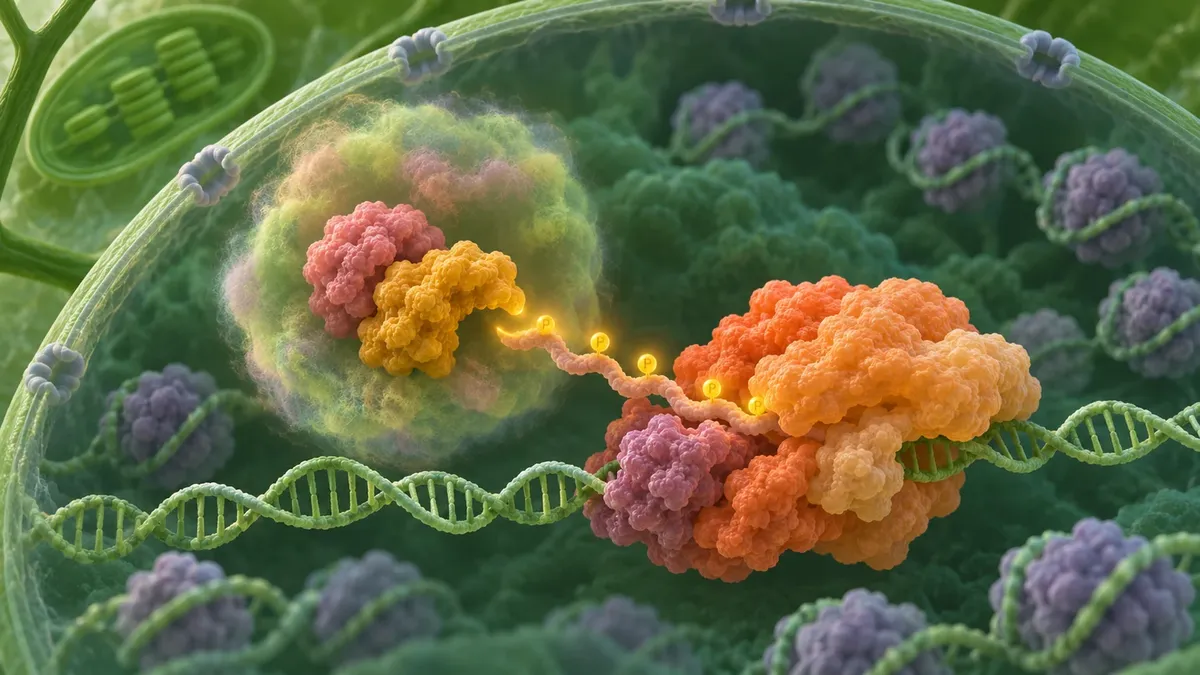
How does a plant cell bring the right transcription machinery together? In Arabidopsis, experiments suggest that EMB1579 forms protein-rich condensates that gather a kinase complex and RNA polymerase II components, helping promote phosphorylation linked to transcription.
RNA polymerase II (Pol II) copies DNA into RNA. Its activity is regulated in part by chemical marks added to its tail, a region called the C-terminal domain, or CTD. One such mark, phosphorylation, helps coordinate transcription and related steps in RNA production. But how the enzymes that add these marks are organized in plant cells is not fully understood.
A bioRxiv preprint by Zhang and colleagues proposes that the Arabidopsis protein EMBRYO DEFECTIVE 1579 (EMB1579) helps organize this process. EMB1579 contains an intrinsically disordered region: a protein segment that does not settle into one fixed shape. Such regions can help proteins gather into biomolecular condensates—localized assemblies without a surrounding membrane. The researchers asked whether EMB1579 condensates bring together Pol II and the kinase machinery that phosphorylates its CTD.
Testing the proposed molecular gathering point
The team combined experiments in Arabidopsis plants and cells with tests using purified proteins. They examined plants lacking EMB1579 or CDKC;2, a cyclin-dependent kinase involved in Pol II phosphorylation, and compared their growth and molecular features. They also measured phosphorylation in plant material and tested kinase activity in vitro, where purified proteins can be studied in a controlled reaction.
To see where the proteins gathered, the researchers used fluorescently tagged proteins and microscopy. They tested whether EMB1579 and CDKC;2 formed condensates together, and whether changing EMB1579’s ability to phase-separate affected CDKC;2’s distribution and kinase activity. Further experiments examined CYCT1-3, a cyclin partner of CDKC;2, and short CTD peptides as potential components of the assemblies.
What the experiments suggest
In Arabidopsis, EMB1579 and CDKC;2 partly overlapped in nuclear foci. In vitro, the proteins co-assembled into condensates, with EMB1579 described as the main driver of their formation. Increasing EMB1579 in these assays increased the amount of CDKC;2 associated with condensates. The researchers also reported that EMB1579 condensates could gather CYCT1-3 and CTD peptides, supporting the idea that they act as local reaction hubs rather than simply holding EMB1579 alone.
The genetic and biochemical results were consistent with a role for EMB1579 in promoting kinase activity. Plants lacking EMB1579 had lower Pol II CTD phosphorylation, and purified EMB1579 enhanced CDKC;2-mediated phosphorylation in vitro. A version of EMB1579 with a deleted RED region, which the study uses to disrupt phase separation, was less effective than the full-length protein at supporting phosphorylation. The authors interpret this as evidence that condensate formation contributes to EMB1579’s effect, beyond its ability to interact with CDKC;2.
Mutant plants lacking EMB1579 or CDKC;2 also shared some features, including delayed flowering and changes in the floral regulator FLC. These results connect the proposed molecular mechanism with plant traits, but they do not show that every developmental effect of EMB1579 is explained by CDKC;2. The paper itself notes that EMB1579 may act through additional partners and pathways.
What remains uncertain
The results support a model in which EMB1579 helps concentrate kinase components and CTD substrates, making phosphorylation more efficient. They do not establish exactly how this organization operates at particular genes inside living plants, or when and where EMB1579 controls CDKC activity. The authors identify those questions as subjects for further study.
There is also an important detail in the reported phosphorylation assays: the paper describes reduced Ser2 phosphorylation in plant material, while its in-vitro kinase experiments report enhancement of Ser5 phosphorylation. These are distinct sites on the CTD, so the findings should not be simplified into a claim that every assay measured the same mark. The experiments provide evidence for regulation of CTD phosphorylation, but the specific site depends on the assay described.
Finally, this work is a bioRxiv preprint, posted on November 26, 2026, and it had not been certified by peer review at the time of posting. Its findings should therefore be treated as provisional until assessed through peer review and further research. The study offers a testable model for how a plant protein condensate can spatially organize transcription machinery; it does not establish that the same mechanism operates in all plants or across eukaryotes.
- Arabidopsis
- EMB1579
- RNA polymerase II
- phase separation
- biomolecular condensates
- transcription
- CDKC;2
Related reading
Automatically matched by shared topic keywords. These links do not imply that the sources agree or establish a consensus.
Cold changes how plants process RNA as genes are copied
Source published
Shared keywords: rna polymerase ii
When warmth becomes heat, seedlings reverse a growth-promoting pathway
Source published
Shared keywords: biomolecular condensates
A cluster-based route to cooler fermion simulations
Source published
Shared keywords: phase separation