TRANSMISSION // 2026.11.25.769118v1
Drought leaves a mark on Camelina seeds—and their offspring
Source published
In six Camelina accessions, drought lowered seed yield per plant while seeds grew larger and heavier. Their progeny germinated less under salt and osmotic stress tests.
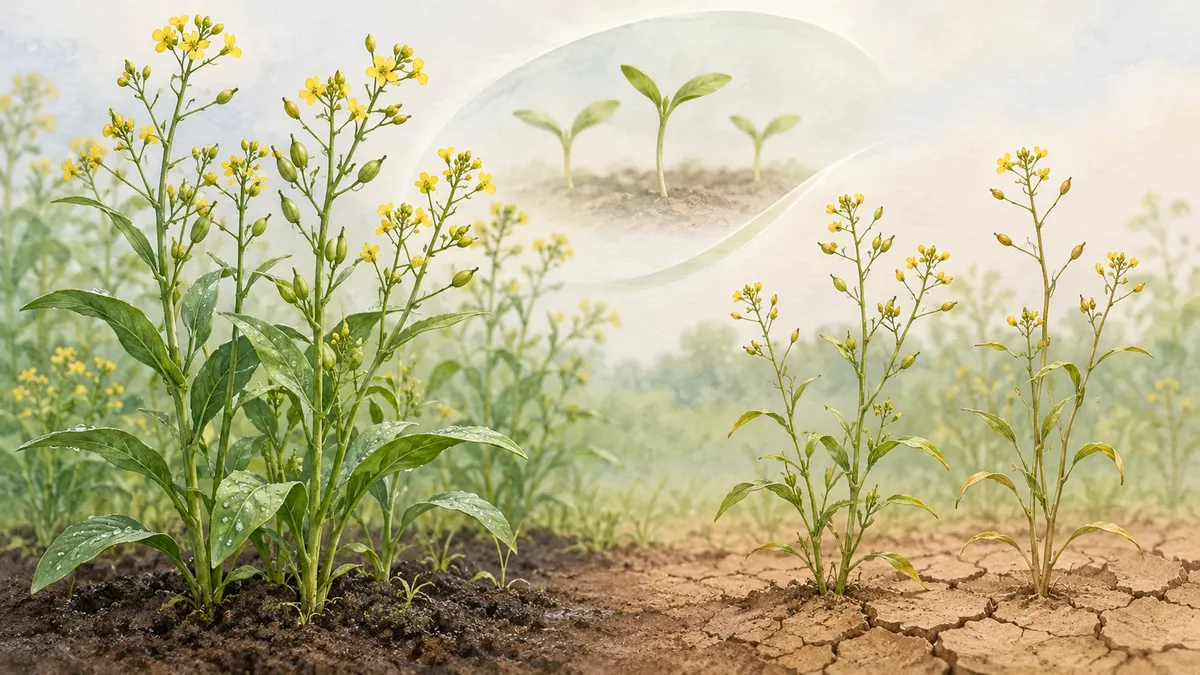
A plant’s response to drought may reach beyond its own growth: the seeds it makes, and how those seeds germinate, may also change. A bioRxiv preprint reports that six Camelina sativa accessions had lower seed yield per plant under water limitation, while their seeds were larger and heavier. Progeny also germinated less well under particular stress tests.
Camelina sativa is an emerging oilseed crop being considered for low-input agriculture. Choosing varieties for dry conditions requires understanding not only how parent plants respond, but also whether drought is associated with changes in their seeds and the next generation’s early performance. A study of six Camelina accessions explores these questions.
Comparing plants under two water levels
The researchers grew six accessions at either 100% or 20% soil water content and followed responses from vegetative growth to seed traits and germination. The abstract reports measurements or assessments of plant growth, seed production, seed mucilage and mucilage sugar composition, as well as tests of progeny germination under salt and osmotic stress.
Because the available source is the paper’s abstract rather than its full text, it does not give details such as the number of plants, how traits were measured, or the exact procedures used in the germination tests. Those details would help readers assess the experiment and interpret the results.
Lower yield, larger seeds
Drought reduced stomatal conductance—a measure related to how readily leaves exchange gases—and increased leaf temperature in all six accessions. Shoot growth responses changed over time and differed among accessions. Drought-stressed plants developed a more compact shoot, with shorter secondary stems, inflorescences and internodes. The abstract reports a 43% increase in secondary stem density.
Seed yield per plant fell by 47%, while seeds were 38% heavier and 28% larger across the accessions. The authors interpret this combination as consistent with plants prioritizing the provisioning of individual seeds over seed number. The abstract does not provide enough detail to evaluate that interpretation or the underlying measurements fully.
Larger seeds did not have a proportionally larger mucilage area: the area was 27% smaller relative to seed size. Drought also shifted mucilage’s sugar composition. In the non-adherent fraction, rhamnose increased and galactose decreased in one accession, CAM230. In the adherent fraction, the proportion of galacturonic acid decreased. These chemical changes could be relevant to seed function, but the abstract does not establish their practical consequences.
A possible cost for the next generation
Despite their greater size, progeny of drought-stressed plants germinated less under salt and osmotic stress. Under PEG at −0.6 MPa, germination fell by as much as 26 percentage points in half of the accessions. The finding points to a possible cost associated with maternal drought exposure under these test conditions. It does not tell us how seedlings would fare in soil or a field, or whether the difference would persist through later growth.
The results also show variation among accessions: their shoot growth responses differed over time, and one reported mucilage sugar shift was specific to CAM230. The findings may inform future crop-selection research, but they do not identify a single best accession or demonstrate performance in drought-prone farming systems.
This report is a bioRxiv preprint. The evidence available for this article is its abstract, so the full methods, statistical details and any subsequent assessment of the work are not available here. Further research, including testing in relevant growing conditions, would be needed before translating these results into recommendations for growers.
- Camelina sativa
- drought
- seed traits
- seed germination
- crop science
- plant biology
Reviewed cross-references
These connections were reviewed by a model, not independently fact-checked by a human. Similarity does not imply agreement; consult the original papers and the evidence below.
How water stress reshapes seed germination signals
Shared method: Both studies used PEG to impose osmotic stress in seed-germination assays: the Camelina study tested progeny germination under PEG, while the Arabidopsis study describes PEG solutions at specified water potentials. This is a methodological overlap, not evidence of equivalent responses; species, seed histories, and assay conditions differ.
Model review: · openai-codex/gpt-6-luna
Evidence and provenance
Selected excerpts, not complete papers. PDF extraction can omit figures or damage equations, tables and reading order; sources may be preprints.
2026.11.25.769118v1 — Original paper
Excerpt reference:
content/articles/2026.11.25.769118v1.md#extra.abstract
Basis: Abstract only; full paper text was not used for this evidence
Abstract text SHA-256:8a68b08076b2ed355a4117761e4ec6b32e530339ba1f8484d78f514081bc28102026.11.16.766966v1 — Original paper
Excerpt reference:
static/papers/2026.11.16.766966v1.md:2252-2374
Basis: Paper text
Source file SHA-256:7975e1596254c8a1e113dc6f3e6865c1e28a36229a94c12dc81e903878713d0b
Related reading
Automatically matched by shared topic keywords. These links do not imply that the sources agree or establish a consensus.
A cellular switch helps plants close their leaf pores
Source published
Shared keywords: plant biology
How water stress reshapes seed germination signals
Source published
Shared keywords: seed germination
AtNBR1 links lipid droplets and seed longevity
Source published
Shared keywords: seed germination
Helmet orchid seeds show uneven germination without fungi
Source published
Shared keywords: seed germination
Climate and arsenic conditions shift cadmium and zinc in rice grain
Source published
Shared keywords: plant biology