TRANSMISSION // 2026.11.24.769068v1
When touch leaves plants more vulnerable to fungus
Source published
Repeated gentle stimulation made Arabidopsis plants more susceptible to a Fusarium fungus in experiments, with the effect linked to jasmonate biology. The result suggests that stress-induced defenses can have trade-offs, but it does not establish what happens in crops or field conditions.
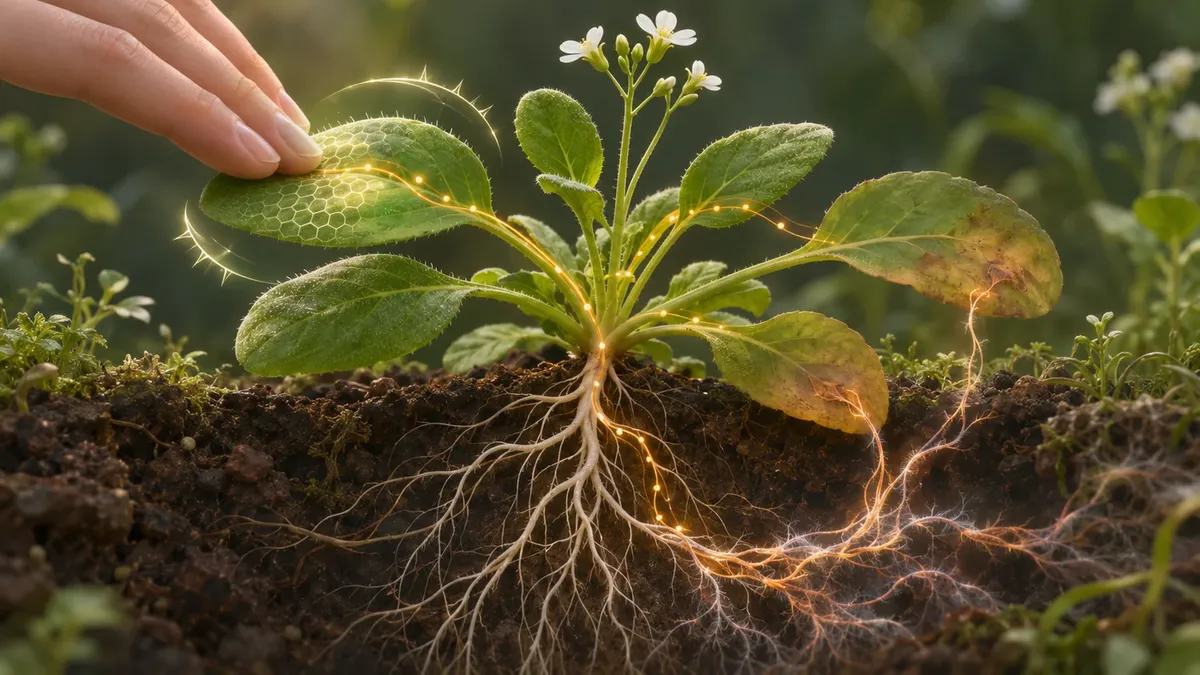
Touch can help plants prepare for some threats. But a defense response that helps against one kind of pathogen may be less useful—or even harmful—against another. A bioRxiv preprint reports that repeatedly brushed Arabidopsis plants were more vulnerable to a Fusarium fungus, and links that pattern to the hormone jasmonic acid.
Plants respond to more than light, water and chemicals: repeated physical contact can also change how they grow and defend themselves. This response, called thigmomorphogenesis, can alter plant shape and activate defense-related processes. A new study asks whether that kind of mechanical conditioning helps against every pathogen—or whether a fungus can take advantage of the changes it brings.
The researchers focused on Arabidopsis thaliana, a small plant widely used in laboratory research, and Fusarium oxysporum f. sp. conglutinans (Foc), a root-infecting fungus. The team describes Foc as hemibiotrophic: it has an early phase in which it lives in plant tissue and a later phase associated with tissue damage. The study’s central idea was that jasmonic acid (JA), a plant hormone involved in stress and defense responses, might affect the outcome differently for this pathogen than for fungi that feed on dead tissue.
Repeated brushing, then fungal infection
To create touch-acclimated plants, the researchers gently brushed young Arabidopsis seedlings twice a day for seven days. They then inoculated the roots of these plants and unbrushed controls with Foc. The team assessed disease symptoms in leaves and measured fungal DNA there as an indicator of the fungus’s spread. They also measured hormone levels and the activity of selected genes associated with JA production and responses.
In the wild-type plants, the brushed group showed more fungal DNA in leaves at the measured time points and more diseased leaves later in the infection. By 15 days after inoculation, the paper reports that 60% of the mechanically stressed plants had died, compared with 35% of unbrushed plants. These outcomes indicate greater susceptibility under the study’s conditions; they do not show that brushing itself is harmful in every plant or setting.
The researchers also tested plants treated with methyl jasmonate, a compound that can activate JA-related responses. Those plants showed increased disease symptoms, resembling the pattern in touch-acclimated plants. This supports a connection between JA and susceptibility, but a hormone treatment is not identical to the plant’s own response to touch.
A hormone pathway implicated
During infection, brushed plants had higher JA levels and stronger expression of several JA-related genes than unbrushed plants. The researchers then examined jar1-11, a mutant with impaired JA-Ile production, where JA-Ile is an active form of jasmonate. These mutant plants were less susceptible overall, and brushing did not produce the same increase in disease symptoms seen in wild-type plants. The mutant also showed weaker induction of the genes tested.
Together, these findings support the authors’ conclusion that the increased susceptibility they observed depends in part on JAR1-related jasmonate biology. They do not fully reveal how the fungus and plant interact at the molecular level. The authors propose that Foc may benefit from JA signaling, but the specific signaling network behind the effect remains unidentified.
The results also underline that hormone levels and defense are not simple measures of protection. In the absence of infection, a single brushing event could induce JA-related processes, while some measured defense genes responded differently in touch-acclimated plants than in unconditioned plants. The response depended on context: the pattern during fungal infection was not simply the same as the response to touch alone.
What the study cannot yet tell us
This is a study of laboratory-grown Arabidopsis and one particular Fusarium strain, using a defined brushing schedule and controlled infection conditions. It does not establish that the same effect occurs in crops, under natural wind or handling, or with other Fusarium strains. The paper itself notes that outcomes of mechanical stress can vary with its type and intensity, plant species and pathogen form. Its experiments also do not establish whether the observed susceptibility would outweigh other possible benefits of mechanical conditioning in agriculture.
The work is posted on bioRxiv as a preprint, meaning it had not been certified by peer review in the version available here. Its findings should therefore be treated as provisional pending scrutiny and replication. The main takeaway is not that touch universally weakens plant defenses, but that a stress response may have different consequences against different pathogens—and that jasmonate-related biology is a candidate explanation for this particular result.
- Arabidopsis
- jasmonic acid
- Fusarium oxysporum
- plant immunity
- mechanical stress
- bioRxiv preprint
Reviewed cross-references
These connections were reviewed by a model, not independently fact-checked by a human. Similarity does not imply agreement; consult the original papers and the evidence below.
A viral warning signal triggers two layers of plant defense
Supporting evidence: Both preprints implicate jasmonate signaling in pathogen outcomes: the Arabidopsis study links JA biosynthesis to greater susceptibility to Fusarium oxysporum, while the Nicotiana benthamiana study reports that COI1-dependent JA signaling is required for dsRNA-induced restriction of viruses. These findings support JA involvement in both settings, not a universal direction of effect; the hosts, pathogens and experimental contexts differ, and neither preprint is peer reviewed.
Model review: · openai-codex/gpt-6-luna
Evidence and provenance
Selected excerpts, not complete papers. PDF extraction can omit figures or damage equations, tables and reading order; sources may be preprints.
2026.11.24.769068v1 — Original paper
Excerpt reference:
static/papers/2026.11.24.769068v1.md:148-256
Basis: Paper text
Source SHA-256:2e4e53bb914b67774ecee7775b6ae58a73237c55095faac395b2fb0f738f23802026.10.29.762747v1 — Original paper
Excerpt reference:
static/papers/2026.10.29.762747v1.md:17-103
Basis: Paper text
Source SHA-256:c4e303b6e03cfb38ae1a3b12d61363cad56374274e3d737ba9e9a083e715ff58
Related reading
Automatically matched by shared topic keywords. These links do not imply that the sources agree or establish a consensus.
A viral warning signal triggers two layers of plant defense
Source published
Shared keywords: jasmonic acid, plant immunity
Can easing grapevine defenses aid mildew control?
Source published
Shared keywords: biorxiv preprint, plant immunity
How a plant defense gene puts a brake on itself
Source published
Shared keywords: plant immunity
How Mitochondria Signal During Stomatal Immunity
Source published
Shared keywords: plant immunity
Two cellular delivery routes help plants block pathogen entry
Source published
Shared keywords: plant immunity