TRANSMISSION // 2026.11.24.768977v1
How tepary beans respond to drought—and what genes reveal
Source published
A preprint maps genetic signals associated with tepary bean drought responses and shows why growth and water use are not the same as drought tolerance.
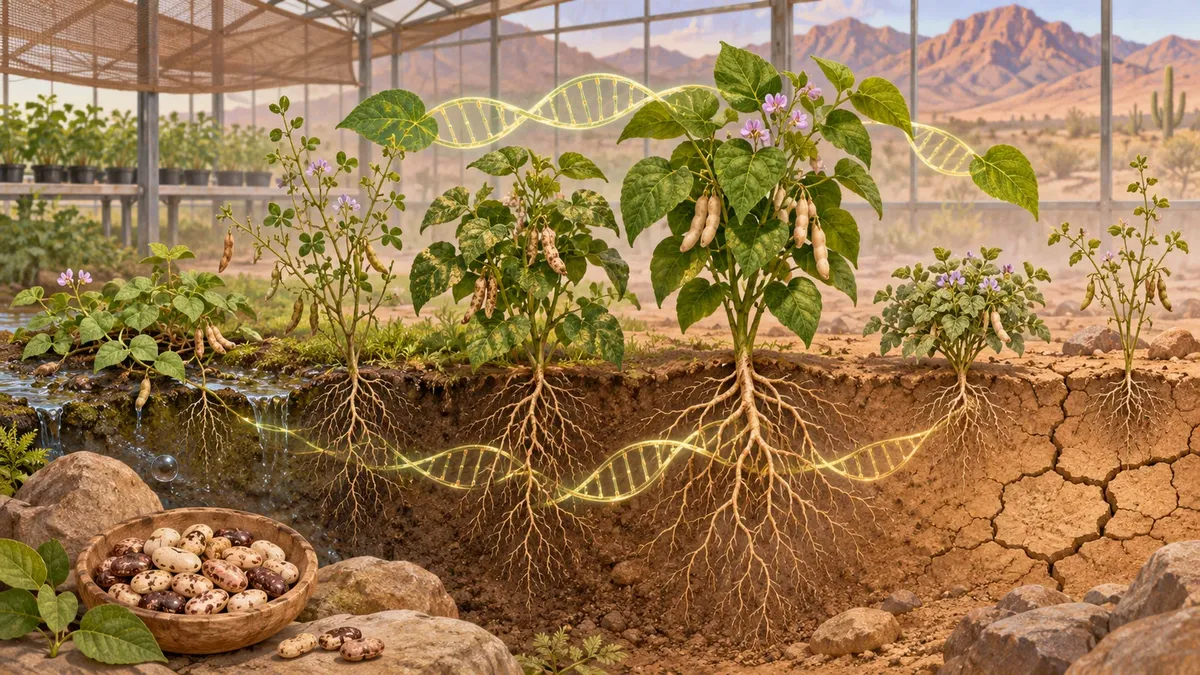
Tepary beans are associated with dry environments, but the genetic basis of their drought resilience is not fully understood. A new study combines genome sequencing with controlled indoor measurements to map drought-related variation—and finds that growth and water use tell different stories.
Tepary bean (Phaseolus acutifolius) is a legume associated with arid environments. Its drought resilience is widely reported, but the genes and traits behind it are less clearly understood. In a bioRxiv preprint, Srinivasan and colleagues examine how genetic variation across tepary beans relates to growth and other responses when water is limited.
Measuring diversity and drought response
The team resequenced 363 accessions—distinct collected lines spanning wild, weedy, cultivated and breeding material—and identified 6.9 million single-nucleotide polymorphisms, or SNPs. These are positions in DNA where individuals can differ by one genetic “letter.”
The researchers also grew and measured 282 accessions indoors. For 14 days, plants experienced either 60% or 10% of soil water-holding capacity, representing the study’s control and drought treatments. They measured growth, evapotranspiration—the movement of water from soil and plants into the air—and photosynthesis. Association mapping then tested whether genetic variants tracked with measured traits. The analysis covered 104 rank-normalized measurements; the abstract does not explain why this transformation was used.
Growth and water use did not tell the same story
Under the study conditions, cultivated and breeding lines grew roughly twice as fast as wild accessions. But the proportional reduction in growth under drought did not differ between these groups. Faster growth in cultivated and breeding material therefore did not translate into a smaller relative growth penalty when water was scarce.
Evapotranspiration distinguished the groups under full irrigation, but the difference narrowed under drought. The authors describe it as the most plastic trait they measured: its pattern changed substantially between water treatments. Canopy density predicted how much water a plant used, but not how well it tolerated losing water. Water use and drought tolerance are related questions, but they are not interchangeable measures.
Genetic signals—and their limits
The association analysis identified 113 significant SNPs at 46 positions. These signals resolved to three loci under drought conditions and six under control conditions. Three drought-associated loci accounted for 98 of the 113 SNP signals, with the largest on chromosome 8. That region distinguished wild from cultivated accessions, but the authors could not resolve it to a particular gene.
Three of the remaining eight loci had candidate genes supported by their location, expression under drought and previously described biological mechanisms: a cytokinin oxidase, a kinase from the CIPK1 clade and the light-harvesting antenna protein LHCB5. These are plausible candidates, not confirmed causes. The most structure-independent locus was narrowed to 26 kilobases, but the genes implicated there have no published role in water relations, leaving their possible functions uncertain.
The authors’ broader interpretation is that growth under drought and growth under control conditions rest on separate genetic bases. They also report that the variation with the largest effect under water deficit lies in haplotypes—sets of nearby genetic variants inherited together—that are affected by domestication. This indicates a connection between domestication history and drought-associated variation, but does not show that domestication itself caused a change in drought tolerance.
What the results can—and cannot—establish
The study maps statistical associations, not direct demonstrations that particular variants or genes cause drought resilience. Candidate genes need experimental follow-up, and the chromosome 8 signal remains unresolved to a gene. The measurements came from an indoor, 14-day experiment at two soil-water levels, so they do not establish how these patterns translate to field performance, yield or other drought conditions.
This account is based on the preprint’s abstract, rather than a full-text assessment of its methods, figures and statistical details. The results should be treated as preliminary while the study’s evidence is evaluated. The work offers a map of genetic signals and highlights why fast growth, water use and tolerance to water loss should be considered separately; it does not yet identify a proven genetic recipe for drought-resilient tepary bean.
- tepary bean
- drought response
- plant genetics
- genome-wide association
- crop domestication
- plant phenotyping
Reviewed cross-references
These connections were reviewed by a model, not independently fact-checked by a human. Similarity does not imply agreement; consult the original papers and the evidence below.
Pearl Millet’s Leaf Minerals and Drought Response
Shared method: Both preprints use genome-wide association mapping: the tepary-bean study maps measured traits in accessions grown under control and drought conditions, while the pearl millet study maps potassium plasticity across water treatments. This is a shared-method link, not evidence that their findings support one another; the species, traits and experimental settings differ, and both reports are preprints.
Model review: · openai-codex/gpt-6-luna
Evidence and provenance
Selected excerpts, not complete papers. PDF extraction can omit figures or damage equations, tables and reading order; sources may be preprints.
2026.11.24.768977v1 — Original paper
Excerpt reference:
content/articles/2026.11.24.768977v1.md#extra.abstract
Basis: Abstract only; full paper text was not used for this evidence
Abstract text SHA-256:c13354fb23a01e034d977cb684d94af5271fca5668b916fd95518e788324e0d32026.11.12.766145v1 — Original paper
Excerpt reference:
static/papers/2026.11.12.766145v1.md:2530-2655
Basis: Paper text
Source file SHA-256:f71e2922b86b14d77e6418ea91e0e08def6c7c26bfe410ea301a260c789503d2
Related reading
Automatically matched by shared topic keywords. These links do not imply that the sources agree or establish a consensus.
Wheat roots differ by position, not just size
Source published
Shared keywords: plant genetics
Genetic study identifies candidate markers for Pakistani wheat variety testing
Source published
Shared keywords: plant genetics
How a text memory helped AI recognize crop diseases
Source published
Shared keywords: plant phenotyping
Duckweed’s spectral signal can reveal pigments—but not reliably its biomass
Source published
Shared keywords: plant phenotyping
Synthetic root images help AI learn when real annotations are scarce
Source published
Shared keywords: plant phenotyping