TRANSMISSION // 2026.11.24.768924v1
A new way to watch photosynthesis adjust to light
Source published
Pairing fluorescent biosensors with chlorophyll measurements lets researchers track plant metabolism alongside photosynthetic performance, while revealing important measurement caveats.
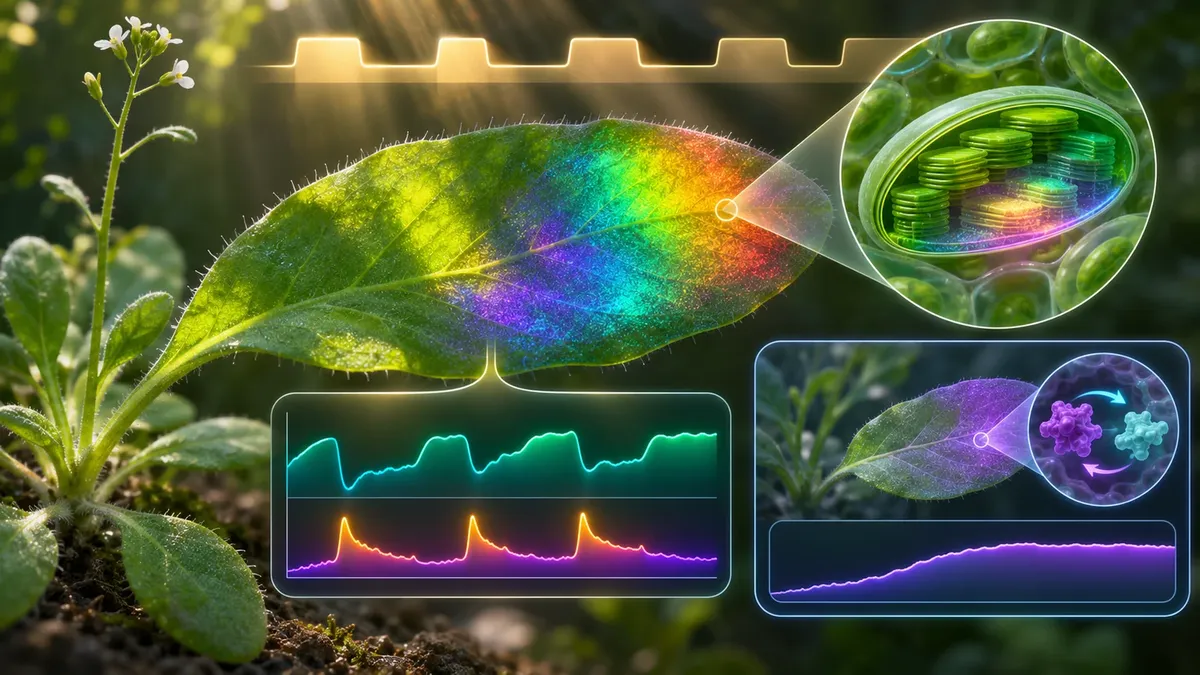
A leaf’s response to light involves more than its photosynthetic machinery: pH, energy and redox balance shift inside its cells too. Researchers tested a system that tracks these signals alongside chlorophyll fluorescence in living Arabidopsis leaves, revealing coordinated changes and important limits on what the measurements show.
Photosynthesis changes as sunlight shifts, but measurements of its light reactions do not always reveal what is happening elsewhere inside a leaf. Researchers report a way to record chlorophyll fluorescence alongside fluorescent biosensor signals, linking photosynthetic performance with changes in acidity, energy and redox state in living Arabidopsis thaliana plants.
Chlorophyll fluorescence can help estimate how photosystem II is performing and how much absorbed energy is being dissipated through regulated processes rather than used for photochemistry. But these measures do not directly reveal conditions such as pH or the state of particular metabolites inside cells. Genetically encoded biosensors—fluorescent proteins designed to respond to specific cellular conditions—can report some of those changes. ChloroSpec’s biosensor module had previously been used with redox sensors; this study extends its use to pH, ATP and NADH/NAD⁺ sensors while measuring chlorophyll fluorescence.
The team combined these biosensors with ChloroSpec L1, a spectrometer that records fluorescence across a broad range of wavelengths while researchers control the light falling on a leaf. The instrument can hold a leaf attached to a living plant and record an average signal across the illuminated area. For comparison, the researchers also used confocal microscopy on leaf discs, which can focus on a particular layer of mesophyll cells.
They tested sensors for pH, stromal MgATP and cytosolic NADH/NAD⁺. In a dark–light–dark test, the pH sensor showed that the chloroplast stroma became more alkaline in the light and moved back toward its earlier state after darkness returned. The attached-leaf instrument also detected a brief early overshoot in alkalinization before the signal settled. The pH response differed between the two setups: the overshoot appeared in attached leaves under conditions where it was not seen in the imaged mesophyll layer. The authors therefore describe the methods as complementary, not interchangeable.
The different sensors showed distinct timing. Stromal MgATP rose soon after illumination and fell rapidly when the light was switched off. Cytosolic pH changed in several phases, while the cytosolic NADH/NAD⁺ signal rose over minutes and relaxed slowly in darkness. These traces demonstrate the platform’s ability to follow different signals in different cellular compartments; they do not establish exactly which processes cause each change.
The researchers also applied a fluctuating-light program lasting about four hours. In this experiment, stromal pH and chlorophyll-fluorescence measures were recorded together. The pH signal rose and fell with the changing light, while its average level increased over the recording. Meanwhile, photosystem II’s effective quantum yield, a measure of photochemical performance, declined, and non-photochemical quenching (NPQ)—regulated dissipation of excess absorbed energy—increased.
Cytosolic NADH/NAD⁺ was measured under the same fluctuating-light program, but in separate plants, not alongside the pH and fluorescence signals in the same leaves. Its signal did not follow each individual light fluctuation and changed more slowly. The authors suggest that it reflects a longer-term integration of redox changes, but this interpretation is not a direct demonstration of the underlying mechanism. The ATP sensor, meanwhile, was tested in a separate light-response experiment, not in the fluctuating-light recording.
Fluorescence-derived values also depended on the wavelength used to detect them, and those differences changed over time. A single wavelength-integrated reading can therefore conceal variation present in the underlying spectrum. The measurements offer a more detailed view, but interpretation depends on how fluorescence is collected.
There are limits to what the study establishes. The experiments used Arabidopsis, and the fluctuating-light results are representative traces from three independent repetitions. The authors note that attached leaves and excised discs differ, the light setups were not perfectly matched, and leaf layers receive different amounts of light. The fluctuating-light experiment also changed the timing of light cycles as well as illumination history, so those influences cannot be separated here. The work demonstrates a measurement platform and associations between signals, not proof that one measured change causes another. It is a bioRxiv preprint and had not been certified by peer review when posted. One author is a co-founder and technology officer of the company that manufactures the instrument used.
- photosynthesis
- Arabidopsis
- chlorophyll fluorescence
- biosensors
- plant metabolism
- fluctuating light
Reviewed cross-references
These connections were reviewed by a model, not independently fact-checked by a human. Similarity does not imply agreement; consult the original papers and the evidence below.
A fluorescent readout of photosynthesis’s pH shifts
Supporting evidence: Both preprints report light-associated stromal alkalinization in Arabidopsis using stromal pHluorin2: the origin study also reports an overshoot, while the target study describes an intensity-dependent transient overshoot. This is compatible evidence for that bounded response, not an exact replication; the studies use different measurement setups and conditions, and neither preprint was peer reviewed.
Model review: · openai-codex/gpt-6-luna
Evidence and provenance
Selected excerpts, not complete papers. PDF extraction can omit figures or damage equations, tables and reading order; sources may be preprints.
2026.11.24.768924v1 — Original paper
Excerpt reference:
static/papers/2026.11.24.768924v1.md:18-118
Basis: Paper text
Source file SHA-256:fdf45edbbff82ad581770f17f7b08210d1c96104f73eaabd4fb3b156449f00a62026.11.23.768545v1 — Original paper
Excerpt reference:
static/papers/2026.11.23.768545v1.md:18-117
Basis: Paper text
Source file SHA-256:663c87d2769dafad95daac89c1def5e4e7e6bd6a3a6b954c6a1aae08c692fdd0
Related reading
Automatically matched by shared topic keywords. These links do not imply that the sources agree or establish a consensus.
A hidden sodium route helps chloroplasts handle shifting light
Source published
Shared keywords: fluctuating light
How a Mitochondrial Enzyme Shapes Arabidopsis’ Early Fungal Response
Source published
Shared keywords: plant metabolism
How two protein modifications help coordinate plant metabolism and growth
Source published
Shared keywords: plant metabolism
A second kind of oxidative burst may help plants detect danger
Source published
Shared keywords: plant metabolism
Maize lines differ in photosynthesis after a cold spell
Source published
Shared keywords: chlorophyll fluorescence