TRANSMISSION // 2026.11.23.768595v1
Warmer Autumns May Disrupt Spruce’s Seasonal Timing
Source published
In a field study of white spruce seedlings, autumn warming kept photosynthesis-related gene expression elevated and altered cold-response expression, without a detectable shift in growth-cessation timing. The study did not directly test freezing tolerance or total carbon gain.
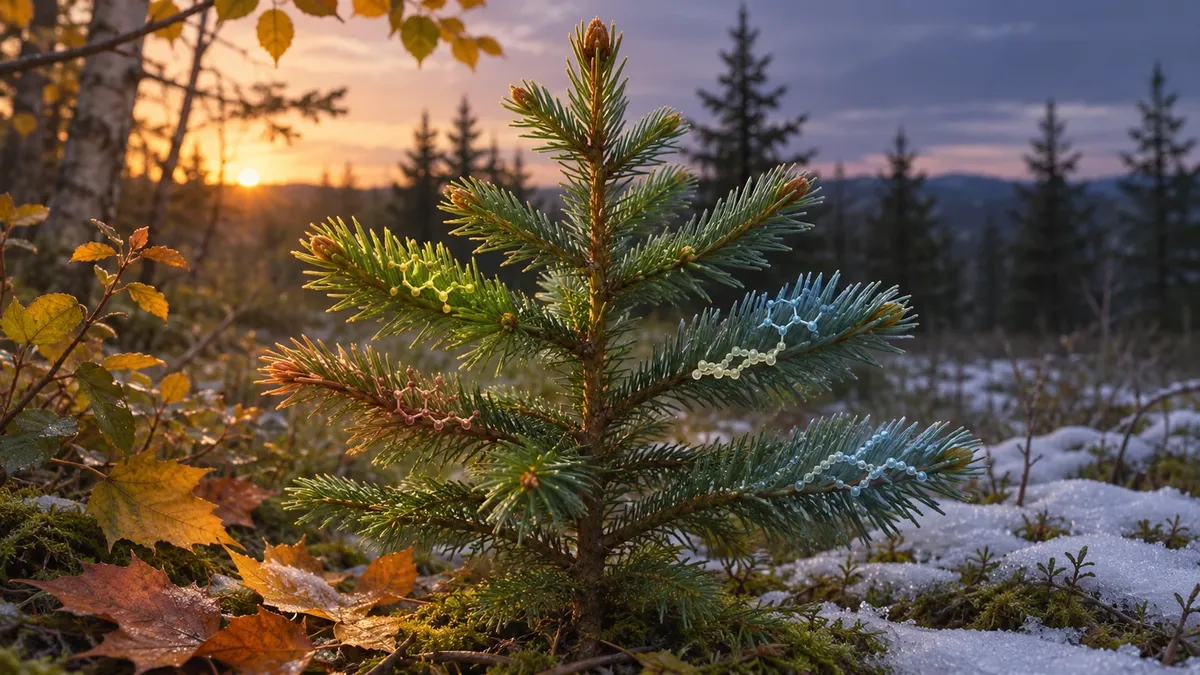
As days shorten, white spruce normally adjusts photosynthesis and prepares for winter. A field experiment suggests autumn warming can alter the gene-expression patterns associated with those responses even when the timing of growth cessation shows no detectable shift. What that means for freezing survival and carbon capture remains uncertain.
Autumn brings several changes for evergreen trees: growth slows or stops, photosynthetic activity adjusts, and tissues prepare for winter. Day length and temperature contribute to these seasonal responses, but they do not affect every process in the same way. If temperatures stay warm while days continue to shorten, seasonal responses may no longer line up as they usually do.
Researchers investigated this possibility in white spruce (Picea glauca) seedlings at a field site in Ontario. They studied two family crosses: one made from a northern-origin parent and a southern-origin parent, and another from two southern-origin parents. Seedlings received one of four treatments: control, summer rainout, autumn warming, or both rainout and warming. Infrared heaters raised leaf temperature by about 5°C; rainout structures intercepted roughly half of ambient precipitation. Researchers collected needles in July, August, October and December, then analyzed 66 RNA-sequencing libraries to track gene expression. One December sample was excluded after appearing to be mislabeled.
Under warming, expression of photosynthesis-related genes remained elevated into December compared with control conditions. Warming was also associated with lower expression of some genes linked to cold acclimation and stress responses. These effects were not uniform: patterns varied across genes, families, treatments and sampling dates, and some cold-related transcripts increased over the season. The study detected no shift in the timing of growth cessation under warming. That finding concerns timing; it does not establish that every aspect of growth cessation was unchanged.
Together, the expression patterns suggest that processes associated with photosynthesis and cold acclimation can respond differently to warming even when growth-cessation timing does not shift. The authors interpret this as a decoupling of seasonal networks, but the study inferred those networks from gene-expression patterns rather than directly testing how the networks work.
That distinction matters when interpreting the possible consequences. Gene expression is not itself a measurement of photosynthetic carbon gain, freezing injury or survival. The authors cite earlier physiological measurements from the companion field experiment, including indicators of photosynthetic activity. Those measurements provide context, but the gene-expression analysis reported here does not quantify how much carbon the seedlings captured overall or directly establish their freezing tolerance.
The researchers also investigated possible regulators. Cold-response models developed largely from herbaceous plants often emphasize CBF/DREB regulators. In this study, warming had limited effects on the expression of CBF-like homologs; that does not mean all members of the broader group were unresponsive, since some related transcripts changed seasonally. Expression patterns and homology-based network analyses drew attention to MYB and AP2/ERF transcription-factor families. These analyses suggest candidates for further study, not proof that those factors caused the responses or that a particular regulatory mechanism has been established.
Family background shaped some expression patterns. The cross involving two southern-origin parents showed stronger enrichment of photosynthesis-related gene sets than the other cross in October and, under warming, in December. Under warming and combined rainout-plus-warming, many cold-response genes had lower expression in that southern-parent cross than in the other cross, but effects varied among genes. The two crosses had similar growth-cessation phenology. Since one cross included a northern-origin parent and the other did not, these results should not be treated as a simple comparison of two regional populations, or as a measure of variation across all white spruce.
Summer rainout had relatively limited effects on most autumn responses measured, and combined rainout and warming often resembled warming alone. This conclusion applies to the rainout treatment used here; more severe or later-season water limitation might have different effects.
The study provides a detailed view of seasonal gene-expression patterns in young seedlings at one field site. Its findings do not by themselves show whether warming increases freezing damage, limits spring recovery, changes tree growth or affects forest carbon storage. The paper is a bioRxiv preprint and had not been certified by peer review when posted. Direct tests of cold hardiness, along with research across more families and environments, could help show how these molecular patterns translate into outcomes for trees.
- white spruce
- autumn warming
- cold acclimation
- photosynthesis
- gene expression
- conifer climate response
Reviewed cross-references
These connections were reviewed by a model, not independently fact-checked by a human. Similarity does not imply agreement; consult the original papers and the evidence below.
C4 leaf cells show distinct chloroplast-to-nucleus signalling
Shared method: Both studies use RNA sequencing to examine plant gene expression: the white-spruce study analyzes needle transcriptomes across seasonal climate treatments, while the Setaria study profiles cell-type-enriched fractions in its chloroplast-signalling work. The shared method does not imply comparable biological findings.
Model review: · openai-codex/gpt-6-luna
Evidence and provenance
Selected excerpts, not complete papers. PDF extraction can omit figures or damage equations, tables and reading order; sources may be preprints.
2026.11.23.768595v1 — Original paper
Excerpt reference:
static/papers/2026.11.23.768595v1.md:327-424
Basis: Paper text
Source SHA-256:f0f1d75d388eecc879af5edf37be4db53f573a5c638f7f62aff6246dfcb189802026.10.25.760861v1 — Original paper
Excerpt reference:
static/papers/2026.10.25.760861v1.md:74-146
Basis: Paper text
Source SHA-256:347949c0ece26276ee06602f9e1de59086e0bfc3827bf03122a26a59be0e36a3
Related reading
Automatically matched by shared topic keywords. These links do not imply that the sources agree or establish a consensus.
A Fast-Clock Potato with a Delayed Daily Rhythm
Source published
Shared keywords: gene expression
Maize’s extra chromosomes are active in pollen—and may echo across the genome
Source published
Shared keywords: gene expression
CAMEO links tissue images and gene activity with fewer paired samples
Source published
Shared keywords: gene expression
An image-editing model explores gene and shape signals in kidney cells
Source published
Shared keywords: gene expression
Reprogramming sorghum cells to make plant embryos
Source published
Shared keywords: gene expression