TRANSMISSION // 2026.11.23.768541v1
One Tomato Enzyme Connects Immunity and Photosynthesis
Source published
A study of gene-edited tomato plants finds that disrupted isochorismate synthase reduces pathogen-triggered salicylic acid and phylloquinone, while also impairing photosynthesis and growth.
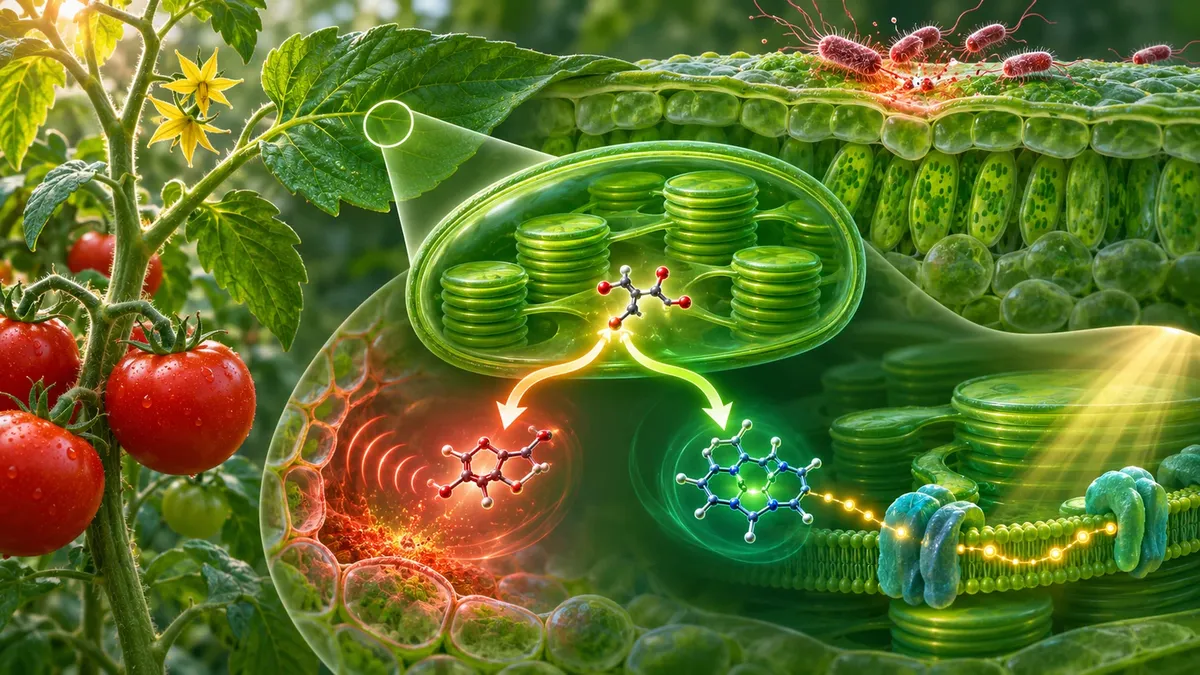
Tomato plants with disrupted isochorismate synthase showed weaker salicylic acid responses to bacterial infection and serious chloroplast and growth problems. A bioRxiv preprint links the enzyme to both immune-related chemistry and photosynthesis, though the precise connections remain unresolved.
Plants rely on chemical signals to respond to infection, but enzymes involved in making those signals can have other roles, too. A study of gene-edited tomatoes suggests that isochorismate synthase (ICS) contributes to pathogen-associated production of salicylic acid (SA) and to production of phylloquinone, a molecule needed for photosynthetic machinery.
The researchers asked what happens when tomato ICS is disrupted. In the model plant Arabidopsis, ICS has a well-known role in infection-triggered SA production. But the balance among SA-making pathways varies across plant species, and isochorismate also contributes to phylloquinone production. The roles of tomato ICS in immunity and chloroplast function had not been studied together using stable gene-edited lines.
Disrupting ICS affected more than immunity
The team used CRISPR/Cas9 to create two tomato lines with deletions in the ICS gene, resulting in predicted truncated proteins. They compared the mutants with wild-type tomatoes, including after infection with strains of Pseudomonas syringae that either trigger a defense response involving the Pto resistance gene or cause disease. They also measured metabolites and gene activity, examined chloroplasts, assessed photosynthetic performance, and used polysome profiling to study protein production. Polysomes are groups of ribosomes translating messenger RNA; their abundance can provide a broad indication of translation activity.
After infection, the mutant plants accumulated much less SA than wild-type plants. During the infection that triggers Pto-mediated immunity, bacteria multiplied more in the mutants, indicating impaired resistance. The mutants also had severe growth problems and could not be maintained in greenhouse conditions; they required in-vitro culture with added sugar.
A second set of findings concerned chloroplasts, the cell structures where photosynthesis takes place. Phylloquinone levels in the mutants were nearly undetectable, and photosynthetic performance was impaired. The chloroplasts also appeared swollen and rounded, with some disorganization of their internal membranes. Total chlorophyll, by contrast, was not significantly different, showing that chlorophyll levels alone did not reflect the observed dysfunction.
To test whether phylloquinone-related metabolism contributed to the photosynthetic problem, the team supplied 1,4-dihydroxy-2-naphthoic acid, a precursor in the phylloquinone pathway that lies downstream of the ICS-dependent step. Photosynthetic performance improved partially. This supports a functional link between the pathway and photosynthesis, but the incomplete recovery means the treatment did not reverse all the effects associated with ICS disruption.
Broad changes, with links still to untangle
The mutants showed changes across gene activity and metabolism. The researchers reported altered lipid and carotenoid profiles, lower levels of some sugars and plant hormones, and reduced amounts of several volatile compounds. Gene-expression analysis found changes in many processes, including photosynthesis and protein production. Polysome profiles showed more single ribosomes and fewer polysomes, a pattern consistent with reduced overall translation.
These results point to widespread disruption, not an isolated immune defect. They also make it difficult to determine exactly why SA responses weakened. ICS may contribute directly to SA production, but the authors note that impaired chloroplast function could indirectly affect pathogen-triggered SA accumulation. The study does not distinguish these possibilities. Nor does the increase in phenylalanine establish that plants compensated by making more SA through the phenylalanine-derived route. Residual SA in the mutants is compatible with other routes contributing, but their roles remain uncertain.
The experiments used two edited lines in one tomato cultivar and particular bacterial strains. They do not establish how ICS functions in every tomato variety, plant species, or natural growing condition. The precursor experiment produced only a partial improvement in photosynthetic performance; it does not show that a treatment for crop disease or poor growth is ready.
This study is a bioRxiv preprint and had not been certified by peer review when posted. Its findings support a connection between tomato ICS, pathogen-associated SA accumulation, and phylloquinone-dependent chloroplast function. Follow-up work will be needed to clarify the mechanisms and how broadly they apply.
- tomato
- isochorismate synthase
- salicylic acid
- phylloquinone
- plant immunity
- chloroplast
- photosynthesis
Reviewed cross-references
These connections were reviewed by a model, not independently fact-checked by a human. Similarity does not imply agreement; consult the original papers and the evidence below.
Melanoidin treatments reduce several cucumber and tomato diseases in greenhouse tests
Supporting evidence: Both preprints report tomato resistance outcomes involving Pseudomonas syringae pv. tomato and salicylic-acid-associated immunity: Pérez-Pérez et al. found reduced pathogen-induced SA and compromised Pto-mediated resistance in ICS mutants, while Elad et al. reported melanoidin-associated suppression of bacterial speck and described its resistance-inducing activity as primarily involving the SA pathway. These different interventions and experimental contexts do not establish the same mechanism or a direct interaction between ICS and melanoidins.
Model review: · openai-codex/gpt-6-luna
Evidence and provenance
Selected excerpts, not complete papers. PDF extraction can omit figures or damage equations, tables and reading order; sources may be preprints.
2026.11.23.768541v1 — Original paper
Excerpt reference:
static/papers/2026.11.23.768541v1.md:12-108
Basis: Paper text
Source SHA-256:178a014ac9ab9d82888440720e976964097c3466f7055afa82020d728f3de0bf2026.11.07.765025v1 — Original paper
Excerpt reference:
static/papers/2026.11.07.765025v1.md:35-54
Basis: Paper text
Source SHA-256:c732619fb3bb7b46de3f9620015ae12b6c7a5f8d4c39b5d4bc15f88f9f4630262026.11.07.765025v1 — Original paper
Excerpt reference:
static/papers/2026.11.07.765025v1.md:704-747
Basis: Paper text
Source SHA-256:c732619fb3bb7b46de3f9620015ae12b6c7a5f8d4c39b5d4bc15f88f9f463026
Related reading
Automatically matched by shared topic keywords. These links do not imply that the sources agree or establish a consensus.
Systemin signals uncovered in tobacco relatives
Source published
Shared keywords: plant immunity
How Mitochondria Signal During Stomatal Immunity
Source published
Shared keywords: plant immunity
A second kind of oxidative burst may help plants detect danger
Source published
Shared keywords: plant immunity
Rice study explores ancestral protein sites and disease resistance
Source published
Shared keywords: plant immunity
Can easing grapevine defenses aid mildew control?
Source published
Shared keywords: plant immunity