TRANSMISSION // 2026.11.23.768518v1
Same species name, different oxygen responses in green algae
Source published
A study of 20 green microalgal strains found that strains with the same working species name could show different oxygen-response profiles. The exploratory groupings were sensitive to analysis choices, and the assay cannot separate light effects from changes over time or carbon availability.
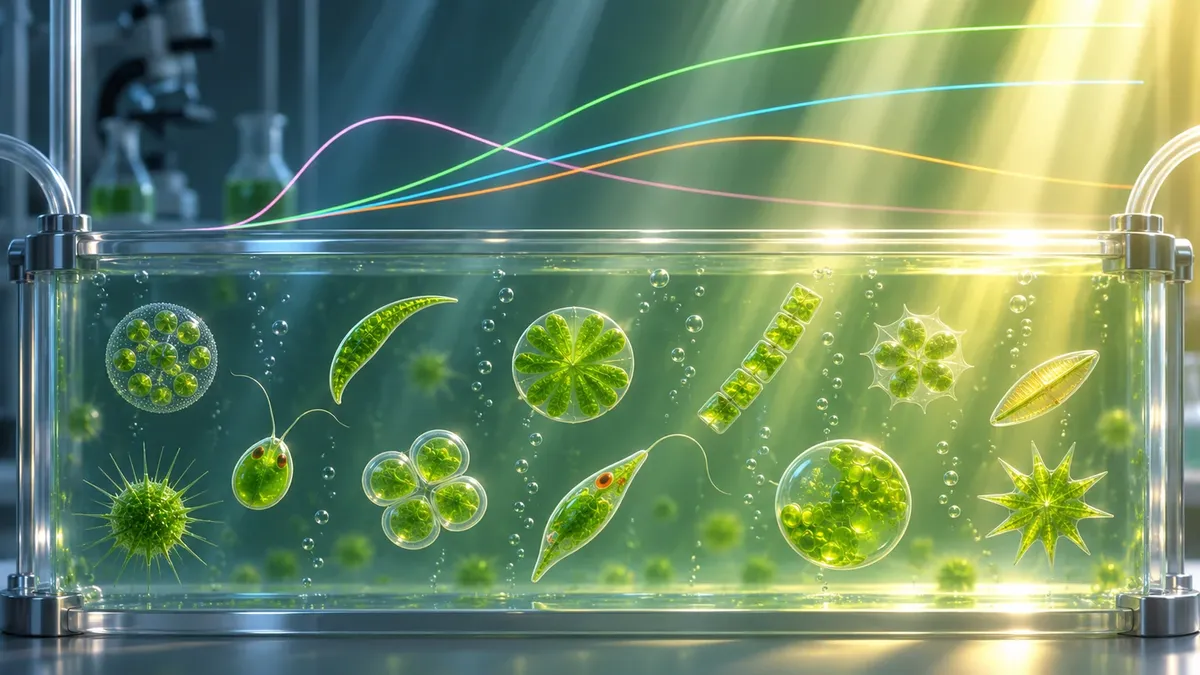
A species label tells us something about an alga—but does it predict how it responds to light? Researchers compared oxygen exchange in 20 green microalgal strains and found differences among strains, including pairs given the same species name. The results offer a snapshot under one laboratory protocol, not a definitive ranking of algal performance.
A shared species name can suggest that two organisms are alike. But organisms assigned to the same species may still differ, and a name alone does not show how they will behave under particular conditions. A new study asks how much extra information oxygen measurements can provide when comparing green microalgae identified by microscopy and DNA markers.
The researchers examined 20 strains: 18 collected from the environment and two previously identified strains. They combined microscope observations with ribosomal DNA sequencing, which can help place algae in a taxonomic framework. The team then measured oxygen exchange in three independently grown cultures of each strain. In a roughly 35-minute assay, cultures received 17 light levels in ascending order, each followed by a dark interval. Oxygen produced during illumination and oxygen consumed just afterward were recorded.
Those measurements describe different parts of the response. Net oxygen evolution during light reflects oxygen production minus consumption, while post-illumination oxygen uptake captures consumption immediately after a light exposure. It is not necessarily the same as respiration after an extended period in darkness.
Different profiles, but tentative groupings
The oxygen-response profiles varied across the collection. To compare their shapes, the researchers separately scaled each strain’s oxygen-evolution and oxygen-consumption measurements relative to that strain’s own strongest measured response. This makes it easier to compare patterns, but it removes information about absolute rates and the relative scale of the two processes. The researchers also compared rates in their original units for three pairs of strains carrying the same named species assignment.
In each of those pairs, the average net oxygen-evolution rates differed at some light levels, and all three cultures of one strain were higher than all three cultures of the other at certain points. The pattern was not identical across pairs: for the Desmodesmus abundans pair, which strain had the higher average changed with light level. These are descriptions of the cultures tested, not statistical tests establishing a general difference between all members of those species.
The team used statistical methods to summarize similarities among the normalized profiles. One exploratory analysis divided the strains into five groups. But the group assignments were not robust categories: they changed with the number of principal components used, resampling of cultures, and the method used to extract rates from the oxygen records. The original five-group arrangement reappeared in only 49 of 2,000 culture-resampling runs. The groups are therefore best read as a way to summarize these particular strain averages, not as established physiological types.
The study found no clear association between physiological distances and either 18S genetic distances or assigned genus. That does not show that physiology is independent of evolutionary history. The comparison involved a limited collection, and the molecular markers and taxonomic assignments did not resolve every relationship. The authors note that some species names remain provisional and that closely matching DNA markers do not prove two strains are the same species.
What the assay cannot settle
The design has an important limitation: light intensity always increased in the same order. As a result, brighter light was also associated with more time in the assay, more accumulated oxygen, and potentially less available inorganic carbon. The cultures received no added carbon dioxide or bicarbonate during measurement, and dissolved inorganic carbon and pH were not measured. The experiment therefore cannot identify which of those changing conditions contributed to a particular response. Nor do these short measurements establish steady-state capacity, productivity rankings, or suitability for an application.
Each strain was represented by three cultures, and the cultures were not necessarily free of bacteria. The authors say bacterial oxygen consumption cannot be ruled out. They also report that some rate estimates and comparisons changed when they used a different time window to calculate slopes.
The practical takeaway is modest but useful: taxonomy and oxygen-response measurements provide complementary information. A species assignment is valuable context, but these results suggest that researchers may need to measure individual strains when their responses under a defined protocol matter. The work is a bioRxiv preprint and has not been certified by peer review; its findings should be treated as provisional.
- green microalgae
- oxygen exchange
- photosynthesis
- microalgal strains
- irradiance response
- preprint
Related reading
Automatically matched by shared topic keywords. These links do not imply that the sources agree or establish a consensus.