TRANSMISSION // 2026.11.22.768468v1
Moss cyclins show distinct but overlapping roles
Source published
Experiments in the moss Physcomitrium patens link selected D-, A- and B-type cyclins to different aspects of cell-cycle progression and development, while revealing overlap among their roles.
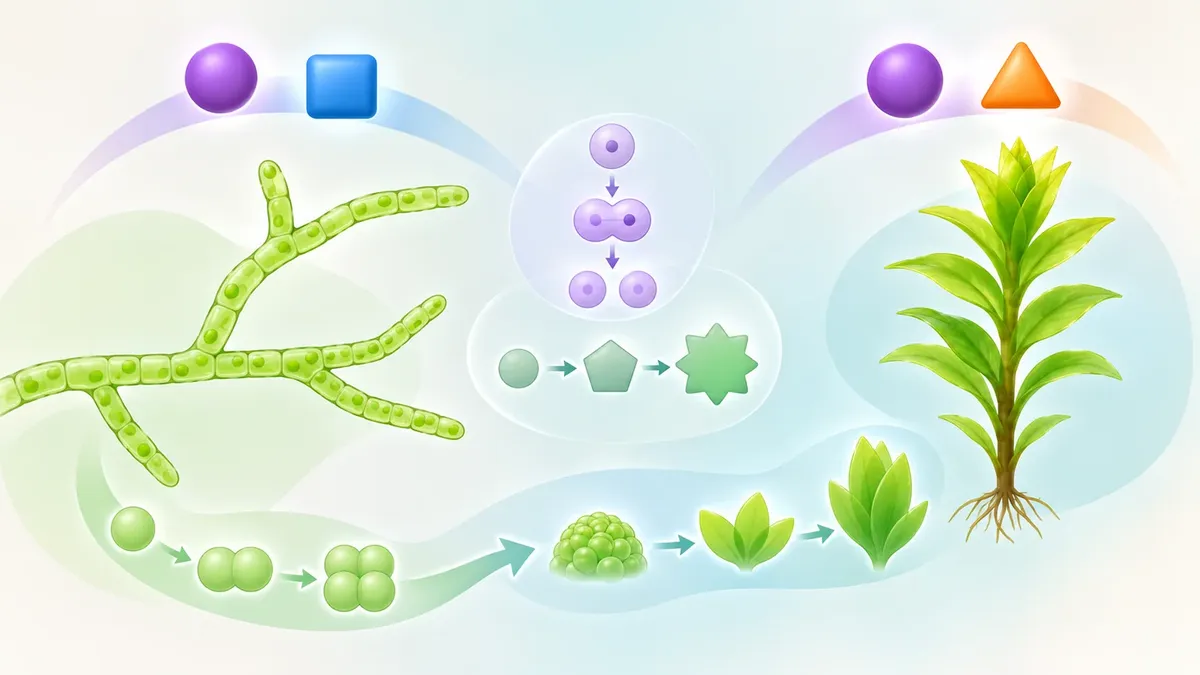
Cyclins are proteins that help regulate the cell cycle, but their jobs can differ across organisms and tissues. Researchers tracked and altered selected cyclins in a moss to examine how their patterns relate to cell division and development.
Cells rely on cyclins working with cyclin-dependent kinases (CDKs) to regulate the cell cycle. Plants have several cyclin families, but what their different roles mean for non-vascular plants—such as mosses—remains incompletely understood.
A bioRxiv preprint examines D-, A- and B-type cyclins in the moss Physcomitrium patens. The researchers asked when selected cyclins appear, what happens when their genes are removed or overexpressed, and which CDKs can associate with them. The findings point to both distinct and overlapping roles.
Tracking cyclins and changing their levels
The team used fluorescent reporters to follow CYCD2, CYCA2 and CYCB1 in living moss cells. In this design, a fluorescent protein linked to the cyclin marked its protein-level signal; a second signal, produced through an F2A peptide and an SV40 nuclear-localization sequence, served as an indirect reporter of transcription. The researchers also used CRISPR/Cas9 to create single and combined knockouts, made lines that overexpressed selected cyclins, and observed cell division with time-lapse microscopy. Flow cytometry measured DNA content in cell populations, and yeast two-hybrid assays tested potential cyclin–CDK associations.
CYCD2 protein signal remained broadly steady across the cell cycle. CYCA2 protein signal declined during mitosis, while the reporter results led the authors to infer that CYCA2 transcription is activated after mitosis. These signals do not amount to a direct, continuous measurement of gene activity: the authors note that early post-mitotic increases in the transcriptional reporter may reflect movement of already-produced fluorescent proteins into the nucleus. CYCB1 appeared at the nuclear envelope in prophase and associated with chromosomes after the envelope broke down; its protein signal dropped rapidly during anaphase.
From these observations and other experiments, the authors propose that D-type cyclins mainly help regulate cell-cycle entry, B-type cyclins are important for mitotic progression, and A-type cyclins act across multiple stages. They emphasize that this is not a strict division of labor: the cyclins’ functions overlap and may differ between tissues.
Different effects in filaments and leafy shoots
The genetic tests revealed varied effects on the moss’s filamentous protonema. Removing cyca1 or cyca2 increased colony growth, and the effects were stronger in combined A-type knockouts; the cyca3 single mutant showed no discernible growth defect. Removing all three tested D-type cyclins increased protonema cell length and width, while the cycd3 single and cycd double mutants showed no discernible growth defects. These findings support the authors’ interpretation that D- and A-type cyclins influence protonema growth through cell-cycle regulation. However, measurements found no significant change in tip-cell growth rates in the lines tested. That result does not establish the cause of all size differences or rule out cell expansion effects in general.
The effects in leafy, three-dimensional structures called gametophores were also class-specific. Overexpressing CYCB1 left plants arrested at a late-bud stage in which leaf-like organs, called phyllids, failed to mature; cell death was observed in affected tissues. In time-lapse observations, chromosome-segregation delays and failures occurred in 9 of 21 examined CYCB1-overexpressing protonema cells. That cell-level observation complements the developmental phenotype but is not a measure of how often every moss cell is affected.
D-type changes altered gametophore form without preventing formation. CYCD2 overexpression was associated with larger gametophores, taller and wider stems, more phyllids and greater spacing between them. The triple D-type knockout also changed several growth traits, generally more mildly.
A-type changes produced contrasting effects. The cyca1,a2,a3 triple mutant had reduced gametophore emergence and size, with abnormal division planes observed in early buds. CYCA2 overexpression also reduced emergence, but increased gametophore size. In a separate inducible-expression experiment, ectopic divisions occurred in 8 of 26 examined filaments after CYCA2 expression; this finding is specific to that assay and condition.
The authors suggest that a complex gametophore may be more vulnerable to cell loss than a filamentous protonema, but the experiments do not establish exactly why the tissues respond differently.
What the interaction tests tell us
In yeast two-hybrid assays, CYCB2 associated with a broad range of tested CDKAs and CDKBs, CYCA2 preferentially associated with CDKAs, and CYCD1 associated with CDKAs and a subset of CDKBs. These results identify potential associations in yeast, not necessarily partnerships operating in the same way inside moss cells. Many tested cyclin–CDK combinations also affected yeast growth, complicating interpretation.
The study’s conclusions are limited to the genes, conditions and moss species tested. Knockouts can be complicated by redundancy among related cyclins, while overexpression can disrupt the system in ways that do not reflect normal protein levels. The results offer a basis for further comparisons across plants, but do not establish that the same roles apply throughout land plants. The paper was posted on bioRxiv on November 25, 2026; it has not been certified by peer review.
- moss
- plant cell cycle
- cyclins
- cyclin-dependent kinases
- Physcomitrium patens
- plant development
Related reading
Automatically matched by shared topic keywords. These links do not imply that the sources agree or establish a consensus.
How a moss keeps its leaf-like organs flat
Source published
Shared keywords: physcomitrium patens
How root cell structure relates to CYCB1 signals
Source published
Shared keywords: plant cell cycle
Why two maize genes share the work of growth
Source published
Shared keywords: plant development
A gene network helps build the Arabidopsis seed coat
Source published
Shared keywords: plant development
One liverwort regulator, two distinct roles
Source published
Shared keywords: plant development