TRANSMISSION // 2026.11.22.768464v1
GnotoBag gives plant microbiome studies more room to grow
Source published
A bag-based sterile growth system was demonstrated with Arabidopsis, tomato and rice. It offers researchers a way to study plant–microbe interactions over longer growth periods, though wider testing is still needed.
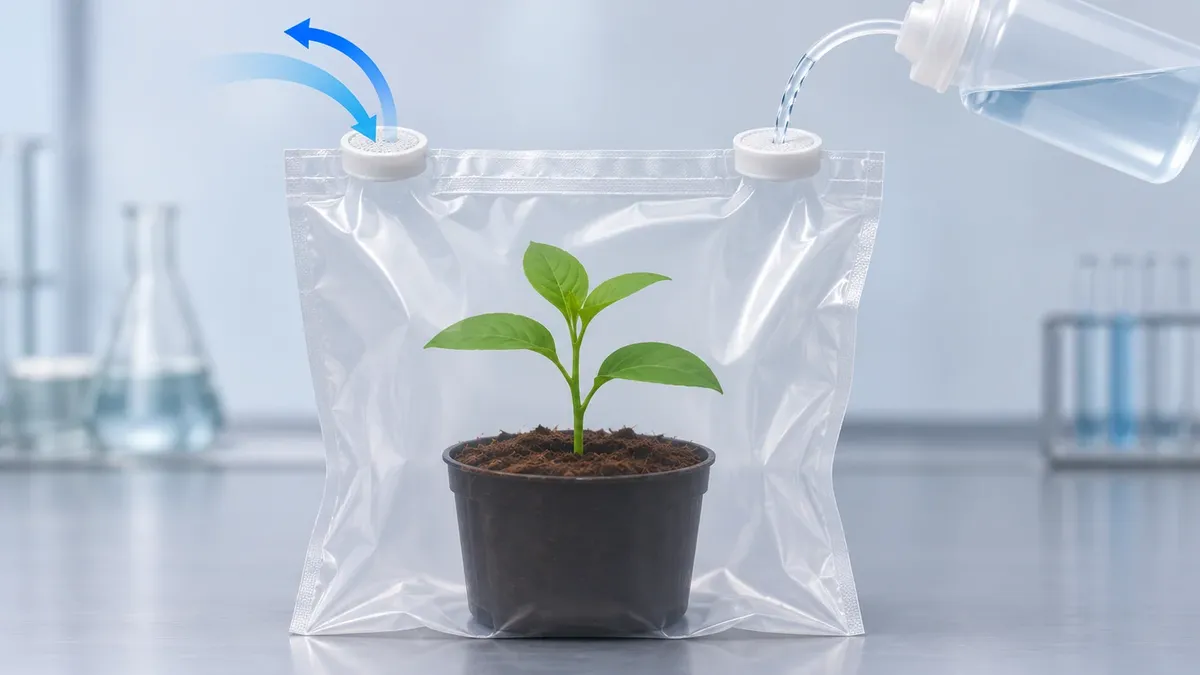
Studying plant–microbe relationships means keeping unwanted microbes out while allowing chosen ones in. A bioRxiv preprint describes GnotoBag, a peat-based setup designed to provide more growing space and filtered airflow, with a way to add water without opening the bag.
The challenge: control microbes as plants grow
Plants live alongside microbial communities that can affect growth, development and stress responses. To investigate what particular microbes do, researchers use gnotobiotic conditions: plants are kept free of detectable microbes or exposed to a defined community. This makes it possible to compare microbial treatments under controlled conditions.
Maintaining that control over a longer experiment is not straightforward. Plants need room, airflow, water and nutrients, while opening a growing system can introduce contamination. The authors describe earlier gnotobiotic systems as useful for many short-term studies, but less suited to later developmental stages or larger plants. They also found that the fixed size and shape of peat pellets in an earlier workflow limited flexibility in pot size, seed types and plant species.
Nan Wu and colleagues developed GnotoBag as an extension of a peat-based platform. It places pots inside a larger bag, with filtered airflow and a port for adding water or nutrients. The aim is to support longer cultivation while maintaining controlled microbial conditions.
How the system works
The protocol uses a loose peat-and-vermiculite substrate in pots. After sterilization, researchers sow surface-sterilized seeds and add either a live microbial inoculum or a heat-killed control. For longer-term cultivation, the pots go inside a bag that is heat-sealed. Filtered air flows continuously through one port. A second port allows water to be added through a filter without opening the bag; nutrient solution is used for initial irrigation before sealing.
The researchers describe demonstrations with Arabidopsis thaliana, tomato and rice. Plants were grown either under axenic conditions—meaning no microbial growth was detected by the reported checks—or with microbes introduced through a soil slurry or a defined bacterial community. The paper also describes a Microbox workflow for shorter experiments.
What the authors observed
The paper reports that Arabidopsis plants grown in GnotoBags reached flowering and produced seeds under controlled microbial conditions. Representative tomato and rice plants shown were four weeks old; the rice methods state that plants were maintained under growth-chamber or greenhouse conditions, with water and nutrients supplied as needed. These examples show the system being used beyond early seedling growth and with species larger than Arabidopsis. They do not establish that it will suit every plant or experiment.
The team also measured plant responses associated with microbial treatments. In Arabidopsis and tomato, leaves from plants grown with microbes showed greater flg22-triggered production of reactive oxygen species (ROS) than leaves from axenic plants. Flg22 is a bacterial signal used to provoke an immune response, and ROS is one measurable part of that response. In rice, plants inoculated with soil slurry had higher levels of two defense-associated genes, OsFLS2 and OsPR1b, than axenic plants given heat-killed soil slurry. This comparison concerns a natural soil-derived inoculum, not a defined community.
These results demonstrate that the system supported comparisons of plant responses under different microbial conditions. They do not show that the introduced microbes improved overall plant health, growth or agricultural performance. The authors present the measurements as examples of research the setup can enable, not evidence that a particular treatment benefits crops.
What remains uncertain
The demonstrations do not establish how consistently GnotoBag will perform across laboratories, plant varieties or other experimental conditions. The internal environment also may differ from the surrounding growth chamber. In one monitoring period, relative humidity inside the bag fell from about 100% to about 60% within six days. The authors recommend monitoring conditions inside the bag rather than assuming they match chamber settings; that measurement describes the monitored setup, not every experiment.
Sterility needs verification, too. The protocol recommends monitoring indicator media and carrying out endpoint checks. If contamination is detected, the corresponding plant samples and data should be excluded. A sealed bag and filtered airflow help maintain separation, but do not guarantee that every unit remains uncontaminated.
This work is a bioRxiv preprint posted November 25, 2026, and was not certified by peer review in the source. It provides a detailed protocol and representative demonstrations, but its claims should be treated as provisional. Further testing will be needed to establish reproducibility and usefulness across research settings. The experiments also do not show whether findings from this controlled setup translate to plants in fields or greenhouses.
- plant microbiome
- gnotobiotic system
- GnotoBag
- plant–microbe interactions
- Arabidopsis
- rice
- tomato
Reviewed cross-references
These connections were reviewed by a model, not independently fact-checked by a human. Similarity does not imply agreement; consult the original papers and the evidence below.
Root microbes shape how a legume responds to higher CO₂
Shared method: Both studies use gnotobiotic cultivation in sterile peat with controlled microbial inputs: GnotoBag supports axenic or holoxenic plant growth, while EcoChamber tests defined microbial communities in Lotus japonicus. This is a shared experimental approach, not evidence that the platforms or plant outcomes are equivalent.
Model review: · openai-codex/gpt-6-luna
Evidence and provenance
Selected excerpts, not complete papers. PDF extraction can omit figures or damage equations, tables and reading order; sources may be preprints.
2026.11.22.768464v1 — Original paper
Excerpt reference:
static/papers/2026.11.22.768464v1.md:65-122
Basis: Paper text
Source SHA-256:7a078c9c13ec5ef4bac492e0c35477c985b652f97fe792ec372be40aafadf39a2026.11.07.764780v1 — Original paper
Excerpt reference:
static/papers/2026.11.07.764780v1.md:127-177
Basis: Paper text
Source SHA-256:d918a718a9bb49cc06d2656bdcdaccb85abb588e0f09626cfce46ef8040ee936