TRANSMISSION // 2026.11.22.768382v1
A hidden sodium route helps chloroplasts handle shifting light
Source published
An Arabidopsis preprint identifies NHD1 as a thylakoid sodium–proton exchanger linked to photosynthetic changes during prolonged fluctuating light. The findings remain provisional.
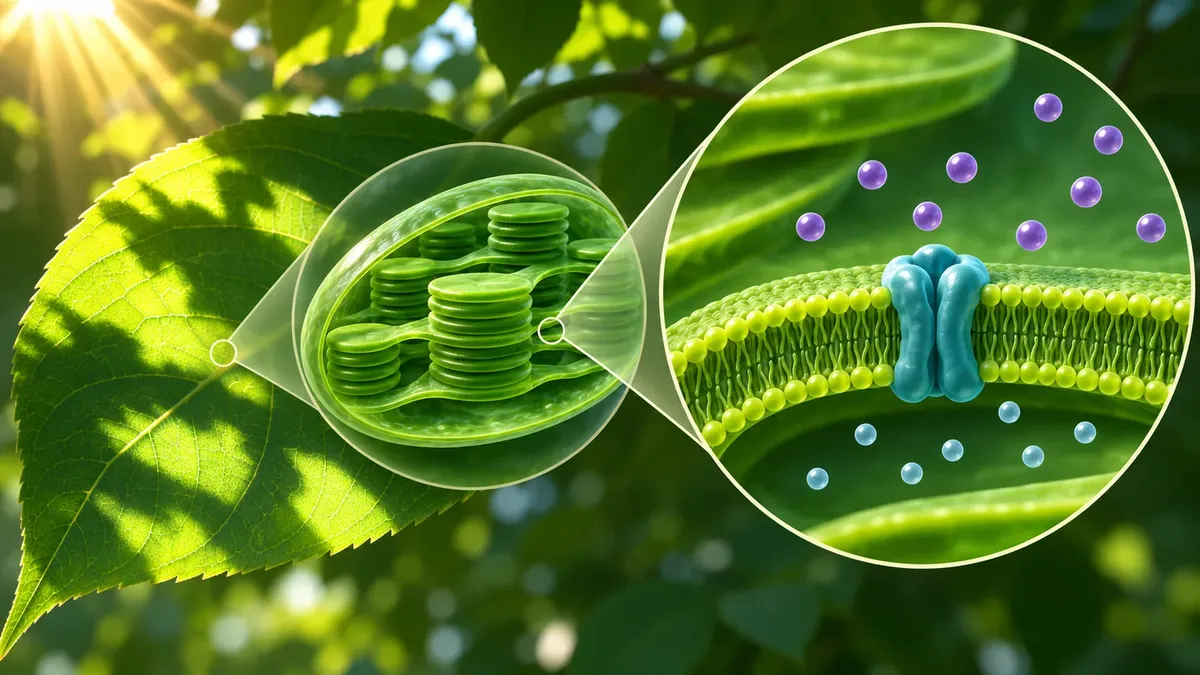
Plants must adjust photosynthesis as sunlight shifts between bright and dim. An Arabidopsis preprint points to a possible part of that adjustment: sodium–proton exchange involving a protein in the chloroplast’s thylakoid membrane.
The question: does sodium help tune photosynthesis?
Sunlight changes over the course of a day and as leaves move between shade and exposure. Chloroplasts must manage that shifting supply of energy. In their thylakoid membranes, photosynthetic reactions build a proton-motive force—a combination of a proton concentration difference and an electrical charge difference. This force helps drive photosynthetic processes and supports protective responses.
The roles of potassium and chloride transport in regulating this system are established in Arabidopsis thaliana, according to the authors. Sodium’s contribution was less clear. The study asks whether the thylakoid protein NHD1 transports sodium in exchange for protons, and whether it matters for photosynthesis under changing light.
How the researchers approached it
The authors report that they identified NHD1 as a thylakoid-localized transporter and tested its activity in a heterologous system—a different biological system used to study the protein. There, NHD1 mediated pH-dependent sodium–proton exchange. The abstract reports an approximate Km of 2 millimolar, but does not specify which substrate the value refers to or provide enough assay detail to interpret it further.
The team also compared plants lacking NHD1 with controls. They assessed photosynthesis under control light and after prolonged exposure to fluctuating light, and examined non-photochemical quenching (NPQ), photosystem II performance, chloroplast structure and plant growth. The abstract additionally reports tests of higher-order mutants missing NHD1 together with two other transport proteins, KEA3 and VCCN1. Because this account is based on the abstract, it does not provide the protocols, sample sizes or statistical analyses needed to assess those experiments in detail.
What the study reports
Under control-light conditions, loss of NHD1 did not alter photosynthesis, according to the abstract. After prolonged fluctuating-light exposure, NHD1-deficient plants showed delayed NPQ relaxation, reduced photosystem II quantum yield, altered chloroplast ultrastructure and impaired growth.
NPQ is one way plants safely dissipate excess absorbed light energy. Its relaxation as light conditions change is part of the photosynthetic response. The reported delay suggests NHD1 matters during extended exposure to shifting illumination, but the abstract does not establish exactly how sodium–proton exchange leads to each observed effect.
Plants lacking NHD1 along with KEA3 and VCCN1 showed stronger photosynthetic responses than the respective single mutants, the authors report. This pattern suggests partial functional overlap among the transporters: one may partly compensate when another is absent. It does not show that the proteins are interchangeable or explain all the interactions between them.
What remains uncertain
The authors describe NHD1-mediated sodium–proton exchange as functionally conserved in Chloroplastida, the group that includes green plants and algae. The abstract does not provide the comparative species or experiments needed to assess the scope of that claim independently. Nor does it establish how broadly the findings apply across plant varieties, natural environments or different patterns of light.
This article is based on the abstract rather than a full-paper assessment. Experimental details, underlying data and alternative explanations are not available here, limiting how fully the evidence can be evaluated. The source is a bioRxiv preprint and has not been certified by peer review, so its findings should be treated as provisional rather than settled.
The work adds NHD1 as a candidate component in chloroplast management of changing light. It suggests that sodium–proton exchange may contribute to thylakoid ion balance and longer-term photosynthetic adjustment. Further research will be needed to clarify the mechanism and determine how widely the result applies.
- photosynthesis
- Arabidopsis
- chloroplast
- thylakoid membrane
- NHD1
- fluctuating light
- sodium–proton exchange
Related reading
Automatically matched by shared topic keywords. These links do not imply that the sources agree or establish a consensus.